

Can you imagine creating metal parts with impossible shapes right from your desk? 🤖✨ This is how metal 3D printing is transforming manufacturing in 2025.
This technology has gone from science fiction to an essential tool in the industry. The impact is enormous: from lighter aircraft to fully customized medical prosthetics.
In this guide, you'll discover everything you need to get started and master metal 3D printing this year.
We'll explore the most advanced technologies, key materials, the step-by-step process, real-world applications, future trends, and practical tips to help you make the most of this revolution.
Ready to dive into the future of manufacturing? Keep reading and become a metal 3D printing expert.
What is metal 3D printing?
Metal 3D printing ⚙️ is an additive manufacturing technology that creates solid, functional parts from metal powders, fused layer by layer using a laser or electron beam. Unlike 3D printing with plastics or resins, metal 3D printing produces strong, durable components ideal for demanding applications. If you want to learn more about the differences with resin printing, check out this article: What is resin 3D printing.
Over the past decade, this technology has evolved rapidly. Today there are methods such as SLM (Selective Laser Melting), DMLS (Direct Metal Laser Sintering), and Binder Jetting. Here's a quick overview:
| Technology | Key feature | Common application |
|---|---|---|
| SLM | Full metal fusion | Aerospace, automotive |
| DMLS | Selective sintering | Medical, industrial |
| Binder Jetting | Binder-based bonding | Prototypes, short runs |
Metal 3D printing makes it possible to produce complex parts such as medical implants, aircraft turbines, and custom tooling. The advantages are clear: extremely high precision, full customization, minimal material waste, and the ability to create shapes that are impossible with traditional manufacturing methods.
According to recent reports, the global metal 3D printing market is set to grow by more than 25% annually and is expected to surpass $5.5 billion in 2025. The revolution is already here!

Metal 3D printing technologies and materials in 2025
The metal 3D printing revolution is in full swing, and in 2025 we'll see more advanced technologies and materials than ever before. If you're wondering how to choose the best option for your project, keep reading — I'll break it all down in a clear and straightforward way. 😎
Leading metal 3D printing technologies
Metal 3D printing relies on several leading technologies, each with its own strengths and specific use cases. The most widely used are:
| Technology | Advantages | Limitations | Printer Example |
|---|---|---|---|
| SLM | High precision, complex parts | High cost | EOS M 290 |
| DMLS | Versatility, functional prototypes | Moderate speed | SLM Solutions 280 |
| Binder Jetting | Fast, lower cost per part | Lower density | Desktop Metal Studio |
| EBM | Ideal for titanium, medical use | Fewer compatible materials | Arcam Q10 Plus |
These technologies make it possible to manufacture everything from turbines to medical implants. Did you know that compact printers for small workshops already exist? The evolution shows no signs of stopping.
Most commonly used metal materials and their applications
In the world of metal 3D printing, the material you choose makes all the difference. The most widely used include:
- Stainless steel: Durable and strong, widely used in tools and industrial components.
- Titanium: Lightweight yet strong, ideal for medical implants and aerospace applications.
- Aluminium: Lightweight and versatile, perfect for automotive and electronics.
- Cobalt-chrome: Biocompatible, a popular choice in dentistry.
- Copper and specialist alloys: Excellent conductivity, highly useful in energy and electronics sectors.
Applications range from custom prosthetics to engine components. According to the Metal 3D Printing Market Report, industrial demand is set to continue growing through 2025, driven by the wide variety of materials available and their unique properties.
Material and technology innovations for 2025
Ready for what's coming? Expect to see recycled metal powders, more sustainable options, and significant improvements in both speed and cost. New systems will enable the production of complex parts in less time, as the industry places a strong focus on waste reduction and customisation.
Technology is advancing at a remarkable pace — and you can be part of this change!
Step-by-step process: How to 3D print in metal
Ready to find out how metal 3D printing actually works? Here's a straightforward guide, complete with examples and practical tips to help make your first print a success. Let's take it one step at a time! 🛠️✨
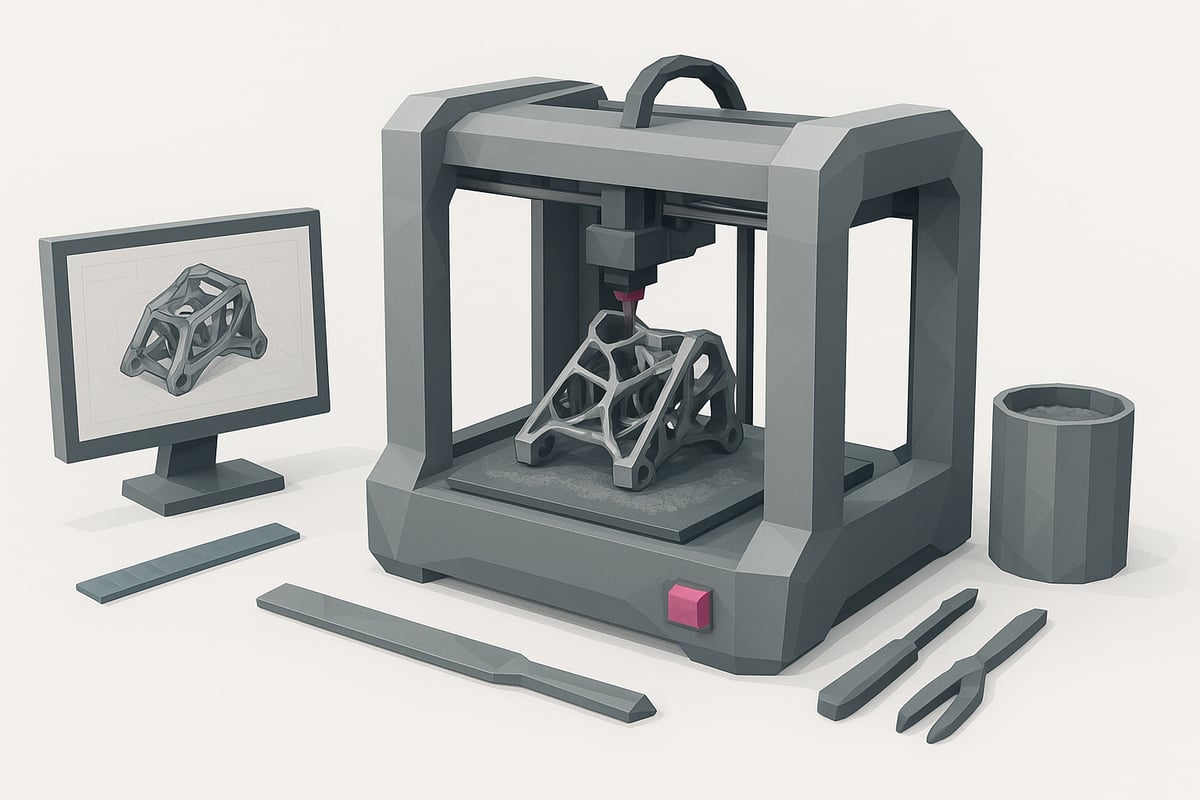
Model preparation and material selection
Everything starts with the CAD design. It's essential to model your part with the specific requirements of metal 3D printing in mind — avoiding walls that are too thin and planning supports for complex geometries. Choose the right material based on your intended use, such as stainless steel for strength or titanium for lightweight performance and biocompatibility.
For example, if you're designing a functional gear, make sure to optimise wall thickness and fine details. Want to compare this workflow with other technologies? Take a look at this Complete Guide to Resin 3D Printing to explore the similarities and differences. 🖥️🔩
Printer setup and print parameters
Set up your metal 3D printer by ensuring a clean workspace and controlled environment. Adjust temperature, scan speed, and laser power according to your chosen material. Metal-specific slicing software is essential — this is where you define layer height, supports, and infill.
On the MrResin website you can find real-world images of printers like the SLM Solutions SLM 280, ready to work with metal powders. Remember, every parameter matters for a successful final result. ⚙️🖨️
Printing process and monitoring
During printing, the machine deposits metal powder layer by layer, fusing it with a laser or electron beam. Metal 3D printers typically include cameras and sensors to monitor temperature and quality in real time.
You can track the part's progress on the printer's screen and catch any issues instantly. This level of control eliminates waste and ensures precision in every detail. Can you imagine watching your design come to life right before your eyes? 👀🤩
Post-processing and part finishing
Once printing is complete, the part needs to cool down before supports are removed. Afterwards, heat treatments are applied to enhance mechanical properties. Finishing can include polishing, machining, or painting, depending on the intended use.
Just look at the difference between a freshly printed part and one after post-processing — the transformation is incredible! That's how you achieve the professional, functional quality that truly sets your work apart. 🧤✨
Current and future applications of metal 3D printing
The metal 3D printing revolution is already making waves across the most innovative industries. Today, sectors like aerospace, automotive, medical, dental, energy, and jewelry are leveraging this technology to create unique, optimized parts. 🚀
For example, lightweight aircraft turbines, custom medical implants, and complex industrial tooling are all being produced this way — things that would be nearly impossible with traditional manufacturing. On top of that, metal 3D printing enables mass customization and on-demand production, driving innovation forward at a faster pace than ever.
Key advantages over conventional manufacturing:
| Advantage | Traditional Manufacturing | Metal 3D Printing |
|---|---|---|
| Customization | Limited | Unlimited |
| Complex geometries | Difficult/costly | Straightforward |
| Material waste | High | Low |
According to 3D Printing Projections and Trends, industrial adoption of these technologies is expected to grow by more than 20% annually through 2025. This opens the door for small and medium-sized businesses looking to compete with cutting-edge solutions.
While challenges like upfront costs and regulatory requirements still exist, the push toward sustainability and customization will continue to drive the metal 3D printing market forward in the years ahead.
Tips, recommendations, and common mistakes
Want to get the best results from your metal 3D prints? Here are some practical tips and warnings that'll save you a lot of headaches down the line. 🤓
Choosing and optimising your approach
Choose the right technology and material for your project. Not all metal 3D printing requires the same type of printer or metal powder. Make sure you validate your design in CAD and take full advantage of the customisation options available. Think about geometries that are simply impossible with traditional manufacturing methods!
Maintenance, safety and training
Keep your equipment clean and calibrated, always use appropriate protective gear, and follow the manufacturer's recommendations. Ongoing training is essential — advances in metal 3D printing are happening all the time. Joining communities like 3D Printer Group and Community helps you stay up to date and get your questions answered.
Common mistakes and useful resources
Avoid these classic pitfalls:
- Incorrectly configured parameters
- Skipping or rushing post-processing
- Neglecting quality control
Make use of specialist blogs, courses, and forums. This will help you cut costs and boost productivity. Remember — practice and curiosity will take you a long way!
Metal 3D printing trends and what to expect in 2025
The metal 3D printing revolution is showing no signs of slowing down in 2025. More and more companies are automating their processes and digitising production, integrating artificial intelligence and machine learning to streamline output, reduce errors, and improve part quality.
The strongest trends include the development of more affordable, compact, and user-friendly metal 3D printers, enabling small and medium-sized businesses to get in on the innovation. Sustainability is also a major focus — new methods for recycling metal powders and technologies that minimise carbon footprint are setting the pace.
According to 3D Printing Innovations in 2025, collaboration between large corporations and startups is driving the development of advanced materials and smart systems. This momentum is translating into a wave of faster, more efficient machines hitting the market, with a direct impact on supply chains and large-scale industrial customisation.
The metal 3D printing market is expected to grow exponentially, opening the door to on-demand manufacturing and mass customisation across multiple industries.
Now that you know how metal 3D printing is changing the game in 2025 — and you've got a solid grasp of the technologies, materials, and key tips — you're probably keen to take your ideas to the next level. If you want to experiment, try new materials for your projects, or simply explore everything 3D printing has to offer, I'd encourage you to browse our selection. We've got resins to suit every taste and need, whether you're just starting out or you're already a seasoned pro. Take a look here: Shop all 3D printing resins