

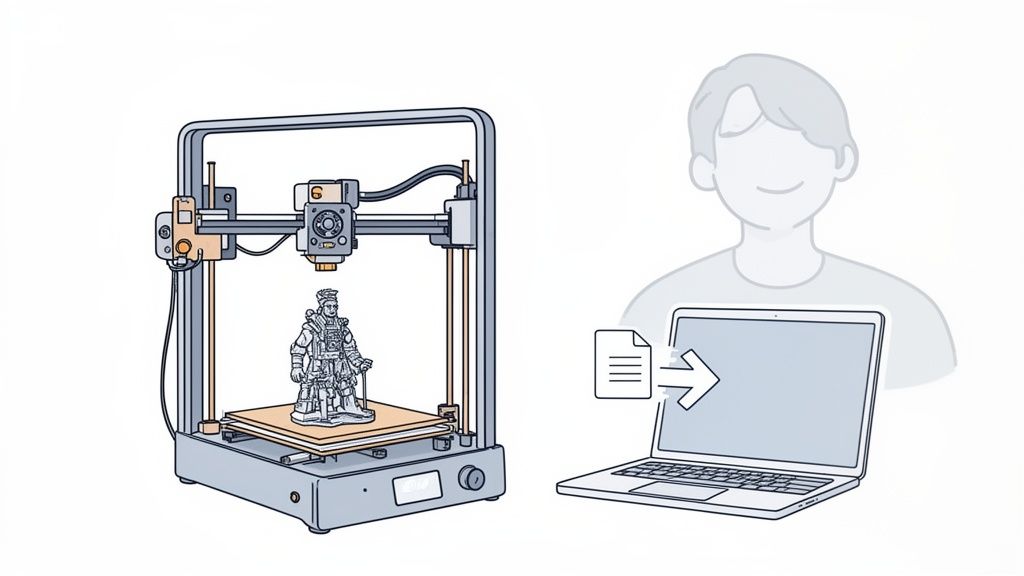
Simply put, a 3D printing service is your personal on-demand manufacturing workshop. 🏭 It's the perfect solution if you don't want to — or can't — invest in expensive equipment and learn all the technical know-how that comes with it. The process is straightforward: you send us your digital design, and we send back a finished physical part, ready to use.
Think of it like a traditional print shop, but for three-dimensional objects. 😉
What is a 3D printing service and how can it help you
Chances are you've got an idea brewing: an awesome miniature for your next gaming session 🎲, a prototype for a product you want to launch, or a replacement part that's impossible to track down. A 3D printing service takes that digital idea and turns it into something you can actually hold and use — no need to buy a printer, wrestle with calibration, or pull your hair out over materials.
It's the most direct and professional way to bring your projects to life. This model opens the doors of additive manufacturing to everyone, letting anyone produce parts with the kind of quality and precision that used to be reserved for large industries. And all from the comfort of your home or workshop. 🚀
The benefits of outsourcing your production
Choosing a 3D printing service like ours comes with some clear advantages, especially if you're just starting out or only need parts produced occasionally. Here are the most important ones:
- Lower upfront costs 💰 Forget the hefty investment of buying a quality 3D printer, plus all the materials, tools, and accessories that go along with it.
- Access to professional technology and materials 🧪 You get access to a wide range of technologies. Need maximum detail? We use resin. Looking for a functional, durable part? We go with FDM. We also work with industrial-grade materials that aren't easy to handle in a home setting.
- Time savings and zero learning curve ⏱️ Skip all the tedious stuff: the test prints, the failures, the endless tweaking. You just send the file and let the experts handle calibration, supports, and post-processing so the part comes out perfect.
- Flexibility and scalability 📈 Order anything from a single part to short production runs, with no commitment to maintaining equipment. If your project grows and you need more, we scale up with you.
Using an external service doesn't just get you the part you need. It gives you access to a team's expertise in optimising your design to get the best possible results.
The 3D printing industry is booming. 🔥 Forecasts suggest it will generate €10.12 billion annually and see more than 8 million printers sold per year by 2027. This highlights the enormous potential of this technology, and you can read more about the sector's growth here.
Understanding 3D Printing Technologies in Depth
To get the most out of a 3D printing service, you first need to understand the tools available. Printing a collector's figure is a completely different challenge from manufacturing a machine gear. So let's break down the two most popular technologies you'll come across: resin printing and filament (FDM) printing. 🧐
Think of yourself as a sculptor. With resin printing (technologies like SLA or DLP), your chisel is a beam of light. Starting with a vat of light-sensitive liquid resin, a UV projector cures the material layer by layer with microscopic precision. It's an almost magical process, ideal for capturing ultra-fine details in miniatures, jewellery, or dental models. 🦷✨
FDM printing (Fused Deposition Modeling), on the other hand, works more like a hot glue gun — but robotic and incredibly precise. A plastic filament is heated, melted, and extruded through a nozzle, building the object layer by layer. It's a tough, reliable technology, perfect for functional prototypes, mechanical parts, or anything that needs to withstand real-world use. ⚙️
Resin vs FDM: Which One Should You Choose?
The real question isn't which technology is "better" — it's which one is right for your project. 🤔 The decision almost always comes down to three factors: the level of detail required, the mechanical strength you need, and how the part will actually be used.
Here are some handy guidelines:
- Detail and surface finish: If your part has intricate textures, tiny lettering, or you simply want a smooth, professional finish with no visible layer lines, resin is the undisputed winner. 🏆
- Strength and durability: For parts that need to take a beating — brackets, enclosures, or prototypes put through their paces — FDM offers materials like PLA+ and PETG that can handle far more stress. 💪
- Object size: FDM printers can generally produce larger objects at a lower cost. Resin printers typically have a more limited build volume.
- End use: Is it a figure to paint and display? Resin. Is it a part to fix your washing machine? FDM. Simple as that.
Here you can see one of the professional resin machines we use in our service, capable of achieving spectacular definition.
With their 8K resolution, these printers can capture details that would simply be impossible with other technologies.
The Real Potential of Additive Manufacturing
3D printing isn't just a trend for makers — it's a technology reshaping entire industries. 🌍 Its ability to produce complex, customised, and functional objects on demand is accelerating innovation at a remarkable pace.
What once required expensive moulds and lengthy manufacturing processes can now be prototyped in a matter of hours. This dramatically cuts development time and opens the door to a level of experimentation that simply wasn't viable before.
The economic impact speaks for itself. The global 3D printing market, already valued at around $18.5 billion, is projected to reach $101.74 billion by 2032, growing at an annual rate of 23.4%. You can explore these 3D printing market projections to see the full picture.
This expansion shows that more and more people — from freelancers to large companies — are turning to a 3D printer service to bring their ideas to life. If you've caught the 3D printing bug, we have a complete guide where we explore the different types of 3D printing so you can become a true expert. Understanding these fundamentals will help you communicate more effectively with your provider and ensure the final result is exactly what you had in mind.
How to Prepare Your Files for a Perfect Print
Many people think that the success of a 3D printer service order starts with the machine, but the truth is it all begins much earlier — right on your computer. 🖥️ A well-prepared digital file is the foundation of a flawless final part, and putting a little care into this stage will save you headaches, time, and most importantly, money.
The quality of your print is a direct reflection of the quality of your 3D model. A small design error, no matter how minor it seems, will show up as a physical defect in the finished object. Fortunately, preparing your files is fairly straightforward once you know what to look out for.
This process ensures that the printer correctly translates the geometry of your design — turning an idea on screen into a part you can hold in your hands. 🤝
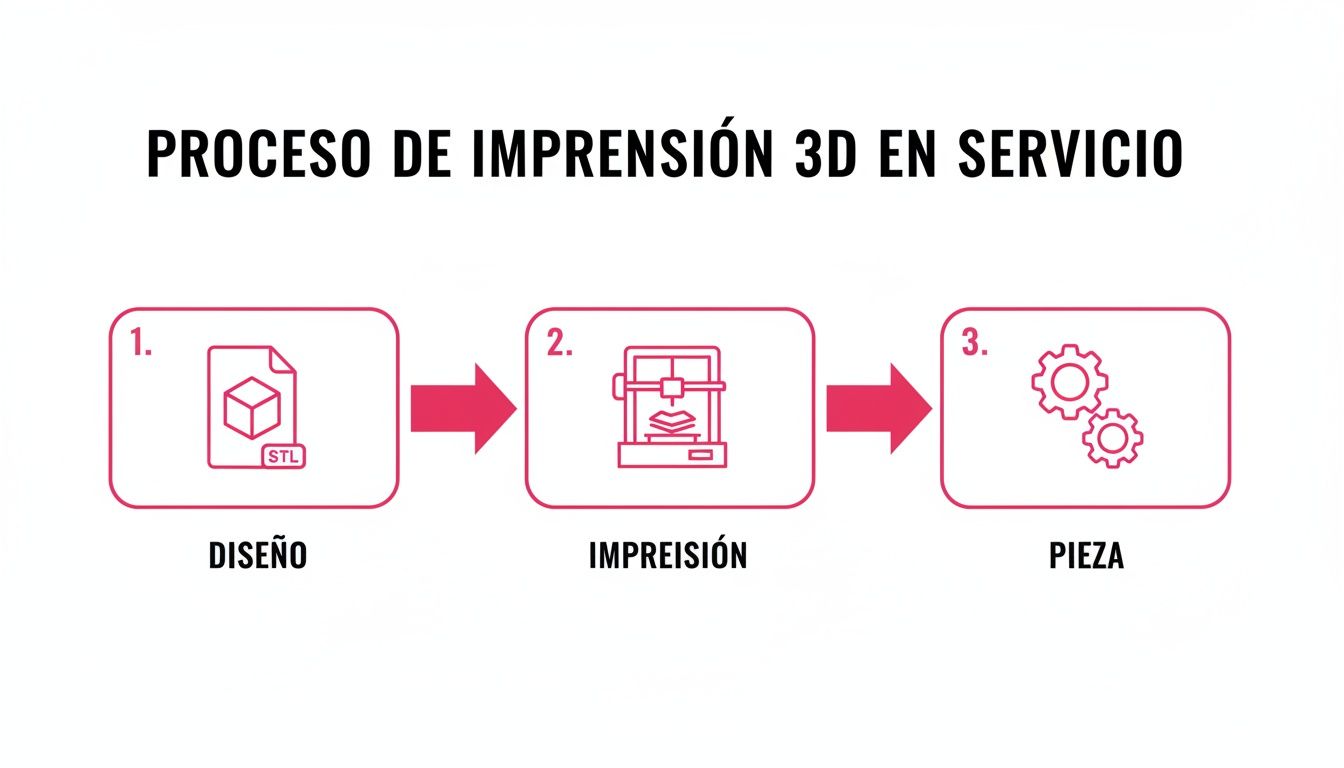
The workflow is straightforward: everything starts from a solid digital design that the printer builds layer by layer to create the object you envisioned.
File Formats and Essential Checks
The first step is exporting your model in a format that 3D printers can read. 💾 While several options exist, the ones we work with day in and day out are:
- STL (Stereolithography): The undisputed industry standard. It simplifies your model's surface into a mesh of triangles. It's a simple, robust format compatible with virtually any software you can think of.
- OBJ (Object): A slightly more feature-rich format than STL. In addition to shape, it can store color and texture information — very useful for projects that require extra visual detail.
- 3MF (3D Manufacturing Format): The modern contender, designed to overcome the limitations of STL. It can pack far more information into a single file, including materials, colors, and print settings.
Once you have your file, it's essential to check that it's "healthy." A very common issue is non-manifold geometry — essentially holes or zero-thickness walls in your model. These defects confuse the printer and can cause serious print failures. 😱
Think of your 3D model like a container. If you filled it with water, would it leak anywhere? If the answer is yes, your mesh has a problem that needs fixing. For printing, the model must be a completely watertight solid.
Key Parameters That Define Your Part
When you send us your file for a 3D printer service, we don't just care about the geometry — we also need to know how you want it made. Certain parameters are critical to achieving exactly the result you're looking for:
- Layer height: This is the thickness of each individual layer that makes up the finished print. A smaller layer height (for example, 0.05 mm in resin printing) produces an ultra-smooth, highly detailed surface, but significantly increases print time. For quick prototypes, a larger layer height (such as 0.2 mm in FDM) is usually more than adequate.
- Infill percentage: Most prints don't need to be solid all the way through. Infill is an internal structure (typically a grid pattern) that adds strength without wasting material. An infill of 15–20% is ideal for decorative pieces, while functional parts that need to handle stress may require 50% or higher.
- Supports: These are temporary structures the printer generates to hold up any overhanging parts of the model—think of an outstretched arm or a protruding ledge. They're essential for complex geometries, though removing them always leaves a small mark that needs sanding.
Getting your part orientation right before you hit print is a real art form. 🎨 A smart orientation can dramatically cut down on supports, improve the structural strength of the part, and give you a much cleaner finish on the visible surfaces.
For example, when printing a human figure, it's almost always better to tilt it slightly backward. This concentrates the supports on the back, leaving all the facial details completely clean. If you want to go deeper into the world of 3D modeling, check out our article on the best 3D design software, where you'll find the tools you need to create print-ready files.
How to choose the right 3D printing service
Finding the perfect 3D printing service can feel overwhelming, but at its core it's like finding any other collaborator for your project: you need trust, quality, and—most importantly—someone who genuinely understands your vision. 🤝 Not all providers are created equal, and the difference between an average print and a stunning one usually comes down to the small details.
When making your decision, don't stop at the bottom line on the quote. You need to dig a little deeper and make sure your design is in good hands. After all, you're entrusting your idea to someone else to bring it to life.
Let's break down the key factors you should consider to make sure you always choose the right provider. ✅
Equipment and available technology
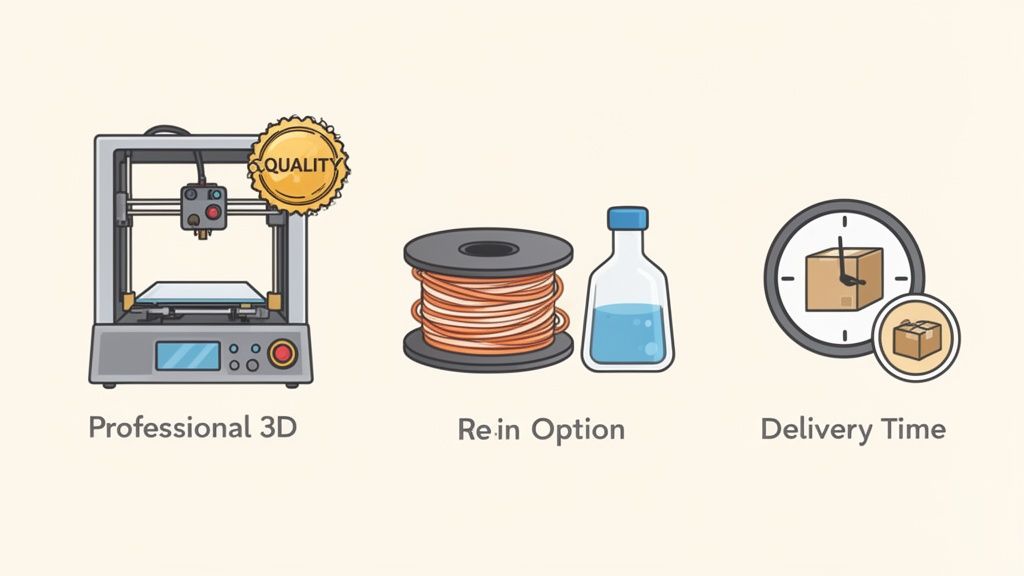
First things first: what machines are they actually running? A reputable provider should be working with well-known brands and, crucially, keeping their equipment properly calibrated. Names like Anycubic and Elegoo are a good sign—a clear indication that quality is taken seriously, especially if resin printing is what you're after. 🖨️
Don't be shy about asking which printer models they use. A transparent service will have no problem telling you. That information gives you a solid read on the level of precision, resolution, and reliability you can expect for your parts.
It's also worth finding out whether they offer both resin printing (SLA/DLP) and filament printing (FDM). A provider that's confident with both technologies can give you genuinely useful advice on which process suits your project best, rather than trying to force everything through the one machine they happen to own.
Variety and quality of materials
A good 3D printing service isn't limited to just a couple of options — it needs a wide, high-quality materials catalogue. Think about it: a standard resin for a display figure is a completely different beast from a technical ABS-like resin for a functional prototype that's going to take a few knocks.
A decent catalogue should include, at minimum:
- Standard resins: Perfect for visual models where detail is everything.
- Water-washable resins: They make post-processing much easier and are a more eco-friendly option. 💧
- Technical resins: Such as ABS-like or flexible resins, for parts that need to hold up in engineering applications.
- Common FDM filaments: Like PLA, PLA+ and PETG for durable, functional, and cost-effective parts.
At Mr. Resin, we don't just offer this variety — we maintain real stock of all of them. That might sound like a small thing, but it's absolutely critical for avoiding unnecessary delays caused by suppliers having to order materials and wait for delivery.
Material quality is just as crucial as the printer itself. A cheap or low-quality resin can result in brittle parts or blurry details, no matter how good the machine is.
Technical support and added value
This is where a good supplier becomes a trusted partner. What happens if you have questions about your STL file? Or if you're not sure which material is right for your part? 🤔 A quality service needs to offer approachable, accessible technical support that speaks your language. At Mr. Resin, for example, we provide specialist support from Spain. 🇪🇸
Another factor that really makes a difference is community. Having a place to ask questions, share your projects, and learn from others is a massive bonus. That's why an active community like our Telegram group is a resource that goes far beyond simply printing a part.
Finally, look for transparency. A clear, itemised quote, realistic turnaround times, and smooth communication are all signs that you're dealing with professionals. A good supplier will explain the reasoning behind every decision and keep you informed throughout the process.
Breaking down costs, quality, and turnaround times
Let's cut to the chase: you want to know how much your part is going to cost and when you'll have it in your hands. 💰 That's completely fair. There's nothing worse than getting hit with an unexpected bill, or having a project stall because deadlines keep shifting. The price of a 3D printing service isn't pulled out of thin air — it's the sum of several very specific factors.
When we break down the cost of a print, there are several pieces of the puzzle. Once you understand them, you won't just have a clear picture of your quote — you'll also be able to optimise your designs to keep costs down without sacrificing an ounce of quality. Let's get into it! 💪
The 4 factors that define the price
The final cost of your part rests on four key pillars. Each one affects the total, and understanding them is essential for managing your budget like a pro.
- Part volume and size 📦: This is the most obvious factor. A larger model uses more material and ties up the machine for longer. Makes sense, right? Total volume is always the starting point for any quote.
- Material type 🧪: Not all resins or filaments are priced the same. A standard resin is far more affordable than an 8K ultra-high-definition technical resin or a flexible resin. The material you choose has a direct impact on the final cost.
- Design complexity 🧩: Is your part a work of intricate art? A design packed with fine details, complex geometry, and challenging overhangs requires more processing time, more supports, and extra care during post-processing. A simple, compact part will always cost less than a highly complex one.
- Post-processing services ✨: The magic doesn't stop when the part comes off the printer. The process continues with cleaning, UV curing (for resin prints), and support removal. These steps take time and hands-on work, and that's reflected in the final price.
A pro tip to save money: if you have several small designs, combine them into a single order. Many services optimize part placement on the build platform, which can significantly reduce the total cost compared to ordering them separately.
How to read a quote and avoid nasty surprises
A professional 3D printing service quote should be completely transparent and straightforward. 💧 Steer clear of anyone who gives you a single final price with no breakdown. A proper quote should itemize the following:
- Material cost: The price based on the amount of resin or filament required.
- Print cost: The machine time dedicated exclusively to your part.
- Labour cost: This covers file preparation, post-processing, and quality control.
- Shipping and additional charges: Any extras should be clearly listed.
Make sure you understand every line item and don't hesitate to ask questions if something doesn't add up. Clear communication is the best sign you're working with a trustworthy provider.
Lead times: how long will I have to wait?
Patience is a virtue, but in manufacturing, time is money! ⏱️ Lead times depend mainly on two things: the printing technology being used and the provider's current workload.
As a general rule, resin printing tends to be faster for small and medium-sized parts, with typical turnaround times of 2 to 4 business days. FDM printing, especially for larger parts, can take a little longer, usually falling in the 3 to 6 business day range.
Bear in mind these are estimated timeframes. A reliable service will always provide a realistic estimated delivery date alongside your quote. If you want to dive deeper into this topic, we recommend checking out our full guide on how long resin 3D printing takes, where we break down all the factors that affect print speed.
Practical Tips from Mr Resin and Projects That Inspire
Theory is great, but the true potential of a quality 3D printer service really shows in the results you can hold in your hands. 🤩 Let's talk about real projects — those ideas that jumped off the screen and became physical objects you can use, display, or keep improving. At Mr Resin, we don't just print parts; we bring your passions to life.
Whether it's an incredibly detailed miniature for your wargaming army, a prototype you need to validate a design before mass production, or a small run of custom parts, our service is built to make your creations a reality with quality that will genuinely blow you away.
Expert Tips for a Flawless Print
We want every part you order from us to be a complete success. That's why we've put together some tips from our day-to-day experience that make the difference between a "good" print and a truly spectacular one. Take notes! ✍️
- Nail your design's foundation: While we handle bed adhesion on our end, a great design tip is to add a small base or raft to your model if it has very small contact points with the build plate. This ensures a solid grip and prevents warping or print failures halfway through.
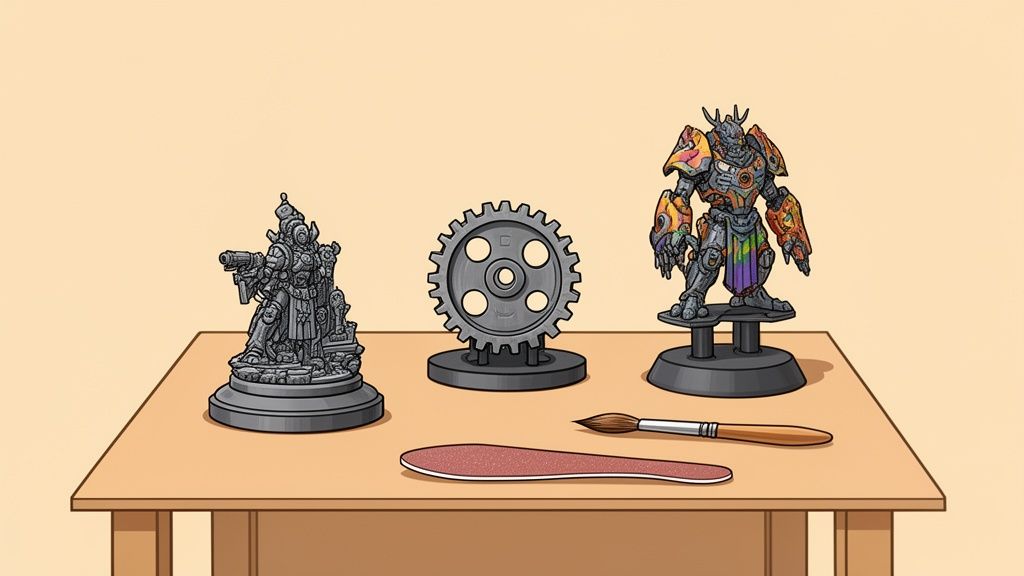
- Post-processing is your secret weapon: Once you receive your part — especially if it's resin — you have a real opportunity to take it to the next level. Light sanding with fine-grit sandpaper can remove any small support marks, leaving a smooth, polished surface ready for the next step.
- Paint like a pro: The print is just the canvas! 🎨 To really bring your creations to life, we recommend using quality materials. Vallejo primers and paints combined with Artis Opus brushes — both available in our store — are the winning combo for achieving studio-quality finishes.
Great post-processing can completely transform how a part looks. Taking the time to sand, prime, and paint not only improves the aesthetics but also protects your model and makes it far more durable.
Bringing Your Prints to Life with Color
For many creations, painting is the final step — and it's where a printed figure truly becomes a character with personality. We always recommend starting with a solid primer coat, which not only helps paint adhere better but also unifies the surface and brings out even the finest details.
For example, Vallejo's special effects paints are fantastic for adding realism to your models with rust, verdigris, or blood effects.
Using specialist paints like these takes your finished pieces to a whole new level, letting you achieve effects that would otherwise be incredibly difficult to pull off.
A Checklist for Your Next Order
So you don't miss a thing, here's a quick reference guide you can run through before submitting your next project to our 3D printer service. Follow these steps and you'll set yourself up for the best possible results:
- ✅ Check your STL file: Make sure the mesh is closed (known as watertight) and free of errors.
- ✅ Choose the right material: Think about what you'll actually use the part for. Do you need extreme detail (resin) or are you looking for mechanical strength (FDM)?
- ✅ Define the quality you need: Is it a quick prototype to check the shape, or the final version you're going to paint? This helps us dial in the perfect layer height.
- ✅ Tell us exactly what you want: Do you need us to remove the supports for you? Are you after a specific finish? Just let us know.
- ✅ Group your small parts together: If you have multiple small models, send them in a single order! You'll save on setup costs and overall pricing.
With these tips and your creativity, there's no limit to what we can create together. 🚀
Your most common questions, answered
We know that placing your first 3D print order can raise a few questions. That's completely normal! 🤓 To make sure you feel confident from the very start, we've put together answers to the questions we hear most often.
What file types can I send, and how do I prepare them?
We keep it simple! We work with the most widely used formats in the 3D printing world: STL, OBJ, and 3MF. These are the most universal formats and help avoid any compatibility issues. ✅
A quick tip from one maker to another: if your part has a lot of fine detail (like a miniature or intricate filigree), we recommend exporting it as an STL at the highest resolution your design software allows. Either way, don't worry. Before any printer starts running, our technical team reviews every file to make sure everything is good to go.
How long will it take to receive my parts?
We know turnaround time matters — a lot! ⏱️ The exact lead time depends on the technology we use and the number of parts involved, but here's a general idea:
- Resin printing: Our speciality for parts that demand incredible detail — and it's also a fast process. Most orders are ready within 2 to 4 business days.
- FDM printing: The go-to for larger parts, functional prototypes, or longer runs. This typically takes a little longer, around 3 to 6 business days.
Of course, every quote we send includes a firm delivery date with no surprises. Full transparency, always. 😉
How can I be sure the quality and accuracy will be good?
Quality isn't just an option — it's something we're obsessed with. 💎 To ensure every part comes out perfectly, we use professional-grade machines that we carefully maintain and calibrate on a regular basis. We also only work with resins and filaments from leading brands that deliver consistent, reliable results.
And that's not all. Before anything gets packaged, every single part goes through a quality control check where we verify that the dimensions and details match your original design down to the millimetre. Your satisfaction is what drives us.
What finishing and post-processing do you include?
Every part that leaves our workshop is delivered clean, cured, and ready to use. For resin prints, this means each part receives a professional UV cure to achieve maximum hardness and durability. As part of our standard service, we always handle support removal for you.
Want to take your print to the next level? ✨ If you need a special finish — like ultra-fine sanding for a mirror-smooth surface or a professional painting service — just let us know. We'll put together a custom quote to give your piece that perfect final touch.
Conclusion:
We've covered the entire journey, from the idea in your head to the physical object you can hold in your hands. A professional 3D printing service like ours is exactly that: the bridge that takes your projects from a file on your screen to something real. 🌉
Whether you need a quick prototype to test, a short run of functional parts, or a highly detailed miniature, outsourcing your printing gives you access to top-of-the-line machines and materials — without having to invest in all of it yourself.
The ball is in your court now. This is your moment to bring your designs to life. Browse our store to see the full range of resins and filaments we have ready for your next project. And if you have any questions or aren't sure where to start, we're here to help you every step of the way. 😉
Don't let your ideas gather dust in a folder. A professional service is the fastest and smartest way to turn them into something you can touch, use, and improve.
Don't miss out — subscribe to our Newsletter for exclusive community discounts, deals, coupons, news, and events. We'd also love for you to join our community! You can share our Telegram group here with fellow makers to access exclusive community discounts, deals, coupons, news, and events. 🤝
✨ Happy Printing! 🚀