

If you've made it here, you already know that a printed miniature is just a blank canvas. The real magic happens when you paint it — and in that process, your brush is your most sacred tool. 🙏 In this guide, we're going to break down everything you need to know to choose the best brushes for miniature painting and turn those resin figures into tiny works of art. 🎨
The right brush: the key to bringing your miniatures to life
Let's talk about why a quality brush is so much more than just a handle with some hairs on the end — it's an extension of your hand and your creativity. A precise tool is what lets you lay down smooth base coats and nail those seemingly impossible details, like the glint in a pupil, with complete control. ✨
The difference between a decent paint job and one that genuinely stops people in their tracks 😮 usually comes down to the quality of your tools. Sound familiar? A bad brush can ruin your whole painting session — it leaves streaky marks, sheds hairs that stick in your wet paint, or loses its load so fast you're constantly re-dipping. Pure frustration. 😩
The right brush, on the other hand, becomes your best ally at the painting table. Get ready, because we're going to explore how the right tool doesn't just improve your technique — it unlocks everything you've got as a miniature painter.
Anatomy of a miniature painting brush: what does each part actually do?
To paint well, you need to understand your tools. And no, a brush is not just a stick with hairs. Every part serves a specific purpose, and knowing what to look for will help you find the best miniature painting brushes for your style. 🧐
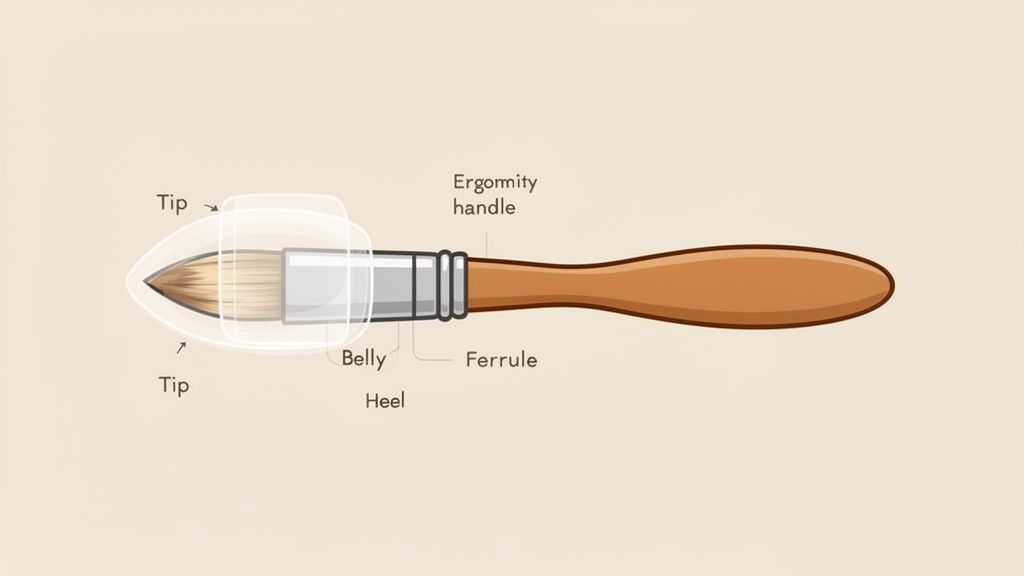
Let's work from the bottom up. The handle — whether triangular or more rounded — is your point of contact. Good ergonomics prevent hand fatigue during long painting sessions, giving you better control and less frustration. A comfortable grip means more precise brushstrokes. 👍
Next is the ferrule, the metal sleeve that holds the bristles in place. A quality ferrule — seamless and securely crimped — keeps your brush from shedding hairs mid-detail and ruining your work. Think of it as the chassis of the brush.
Finally, we get to the heart of the matter: the bristles. There are three key zones to understand:
- The tip: This is where the magic happens. A sharp, fine tip is what makes it possible to tackle extreme detail work — like painting the eyes on a Space Marine. 🎯
- The belly: Think of this as your brush's paint reservoir. A full, well-shaped belly holds more paint and releases it in a controlled flow, so you're not re-loading every few seconds. 💧
- The heel: The base of the bristles where they meet the ferrule. This is a vulnerable spot — paint that dries here will splay your brush and ruin its shape, so clean it thoroughly every time.
Natural vs. synthetic brush hair: the age-old debate
If you've been in the hobby for any length of time, you've definitely heard this one: natural hair or synthetic? The truth is there's no definitive winner. It's like asking whether a hammer or a screwdriver is better — it depends entirely on the job. ⚔️
Natural hair brushes, especially Kolinsky sable, are the gold standard — think of them as a surgeon's instruments. They hold an incredible amount of paint and release it gradually with complete control. Best of all, the tip snaps back to a razor-sharp point almost like magic. That's exactly why they're the go-to choice for fine glazes or painting the glint in a 2mm eye. 👑
Then you have synthetic brushes, the reliable workhorses of the hobby. And make no mistake — they've improved massively in recent years. These are true all-rounders: incredibly durable and ideal for the toughest jobs, like applying metallic paints (which destroy natural hair), drybrushing, or stippling on rust effects. They're also more affordable and animal-friendly. 🌿
The real trick isn't picking a side — it's building a mixed arsenal. A quality natural hair brush for the details that really make a difference, plus a handful of synthetics for the dirty work. That way you've got every situation covered. 😉
Brands like Artis Opus are pushing synthetic fibres to a whole new level, nearly matching natural hair performance and closing that long-standing gap. Ultimately, the smartest move is to build a mixed toolkit that takes the best of both worlds — maximising both your budget and the final result on your minis.
Choosing the right brush shape and size for each painting technique
Finding the best brushes for miniature painting isn't about buying the most expensive option — it's about picking the right tool for the job. Let's be honest: no single brush can do everything well, so building your own arsenal is essential. Every shape has a specific purpose. 🖌️
Round brushes are the ultimate all-rounders in the hobby. Their sharp tip and generous belly make them perfect for basecoating and painting general detail without any hassle. They're undoubtedly the most versatile brushes you'll own. As a starting point, a basic kit should include at least a size 1 and a 2.
For those jaw-dropping details — like painting eyes or engraved armour — you need a detail brush. These are ultra-fine (think size 00 or even 000) and give you almost surgical precision. 🔬
Flat brushes are brilliant for covering large areas evenly, creating crisp, clean edges, and — of course — they're the undisputed king of drybrushing. And finally, wash brushes are designed to flow shading into recesses effortlessly, letting the paint settle exactly where it needs to go.

As you can see, deciding between natural and synthetic hair is the first step before even thinking about shape. If you're looking for high-precision tools to take your minis to the next level, check out our range of Vallejo fine detail brushes.
The brands that set the quality benchmark
Right — we've covered the theory, so now it's time to talk names. Which brands do the people who really know their stuff reach for, and why? Each one brings something special to the table. ✨
The elite standard and the everyday workhorse
Artis Opus has become the crown jewel for many elite painters — and for good reason. The ergonomic design feels fantastic in hand, and the bristle quality gives you near-surgical control with every stroke. Their popularity among resin miniature painters is huge; in specialist stores across Spain, Artis Opus sets can account for up to 45% of painting tool sales, as you can see by browsing the best-selling 3D printing accessories.
Then there's Vallejo — a trusted classic that never lets you down. Their value for money is excellent, making them the perfect entry point for anyone just starting out. Durable, reliable, and built to handle whatever you throw at them. 💪
A combination approach works brilliantly: invest in a premium brush like Artis Opus or a Winsor & Newton for fine detail work, and use a set of Vallejo Pro Modeler natural hair brushes for base coats and heavier tasks.
Other brands worth keeping on your radar include The Army Painter, great for their themed sets that make everything more straightforward, and Winsor & Newton Series 7, which have been the absolute benchmark for Kolinsky sable hair for decades.
How to care for your brushes so they last for years
Investing in a quality brush set is a real commitment. But knowing how to look after them so they stay with you for years is a skill in itself. A well-maintained brush can be your faithful companion across countless projects — so let's look at those small cleaning rituals that make all the difference. 🧼
The golden rule is almost embarrassingly simple, but absolutely vital: never let paint dry past the halfway point of the bristles. And whatever you do, never let it reach the ferrule. That's the beginning of the end for any brush, no exceptions. ☠️
The cleaning process is your moment of zen. Use dedicated brush soaps that don't just remove paint — they condition the hairs and restore them to their best. To keep your tools always ready to go, a brush cleaner like Vallejo's works brilliantly, dissolving even the most stubborn residue while being gentle on the bristles.
Pro Tip: After cleaning your brush, dampen it slightly and reshape the tip with your fingers. And whatever you do, don't store it resting on the tip! Let them dry horizontally or, better yet, hanging with the bristles pointing downward. 💡
Building these small habits is what will keep your tools performing at their peak every painting session. Take care of them and they'll repay you tenfold! ❤️
So, which brush should you choose?
And that brings us to the end of our deep dive into the world of brushes. We've broken down the anatomy, explored hair types, and covered how to care for them so they last a lifetime. You now have everything you need to choose the best brushes for your miniatures. 🎯
There's no single right answer — the key is understanding what you need at each stage of your painting. The ideal approach is to mix different types, shapes, and brands until you find that perfect toolkit that feels tailor-made for you.
Here's a golden tip: always keep a good synthetic brush on hand for the rough work, and a sharp, natural hair brush for those fine details that really make the difference. Now it's your turn — take everything you've learned and put it into practice at your next painting session.
Conclusion:
We've broken down everything you need to choose the best brushes: their anatomy, the difference between natural and synthetic hair, key shapes and brands, and how to care for them properly. The secret is building a combined toolkit that works for every technique. A great brush is an investment that will transform your miniatures. 💪
Now it's over to you. Head to the Mr. Resin store and browse our selection of brushes and paints. 🛍️ We're sure you'll find exactly what you need for your next project.
And remember, to stay up to date with everything, we have two ways to keep in touch!
- Subscribe to our Newsletter for exclusive community discounts, deals, coupons, news, and events. 💌
- Join our Telegram group here for exclusive community discounts, deals, coupons, news, and events. Don't miss a thing! 📢
✨ Happy Printing! 🚀
Published via the Outrank app