

If you're looking for the best brushes for miniatures, there's one thing you need to understand right from the start: there's no single perfect brush 🤯. The real secret is building a small arsenal where every tool has a job to do. Ideally, you want a versatile set that combines tough synthetic brushes for heavy-duty techniques alongside natural hair brushes for those fine details that truly make a difference. 🖌️✨
The brush: the tool that changes everything for your miniatures
Getting into miniature painting can feel pretty overwhelming at first, especially when you see how many tools are out there. But what if I told you that the right brush matters just as much as the paint itself? 🤔 A good brush doesn't just apply color — it's what takes you from laying down a base coat to painting the eyes on an orc with the kind of precision that truly brings a figure to life.
With this guide, I want to take all the mystery out of it. It's not about buying the most expensive brand — it's about understanding how a brush works and why some are built for certain jobs while others aren't.
Why does brush selection matter so much?
A quality brush feels like a natural extension of your hand. It gives you complete control over paint flow and holds that sharp tip you need session after session. A bad brush, on the other hand, is your worst enemy: it'll leave stray hairs stuck to your mini, splay out like a fan brush at the first opportunity, and force you to fight uneven strokes that ruin hours of work. 😩
Throughout this article, we're going to break down the key factors you need to look at:
- Brush anatomy: From the bristles to the handle, every part affects how you control your brushstrokes.
- Natural vs. synthetic hair: We'll dig deep into the age-old debate so you know exactly when to reach for each one.
- Essential shapes and sizes: You'll find out which brushes you absolutely need for every technique.
Forget the frustration of splayed tips and clumsy brushstrokes. By the time you finish reading, you'll know exactly what to look for in a brush and how to build your toolkit like a true pro. Let's get into it! 💪
Miniature brush anatomy: what actually makes a brush good?
First things first — stop thinking of a brush as just a stick with some hair on it. Think of it as a precision instrument, almost like a surgeon's scalpel. Every part has a specific job, and how they work together is what separates a frustrating tool from one that feels like magic. Once you understand how a brush is built, you'll instantly see why some brushes cost more and why the best brushes for miniatures are genuinely worth the investment. 🤔
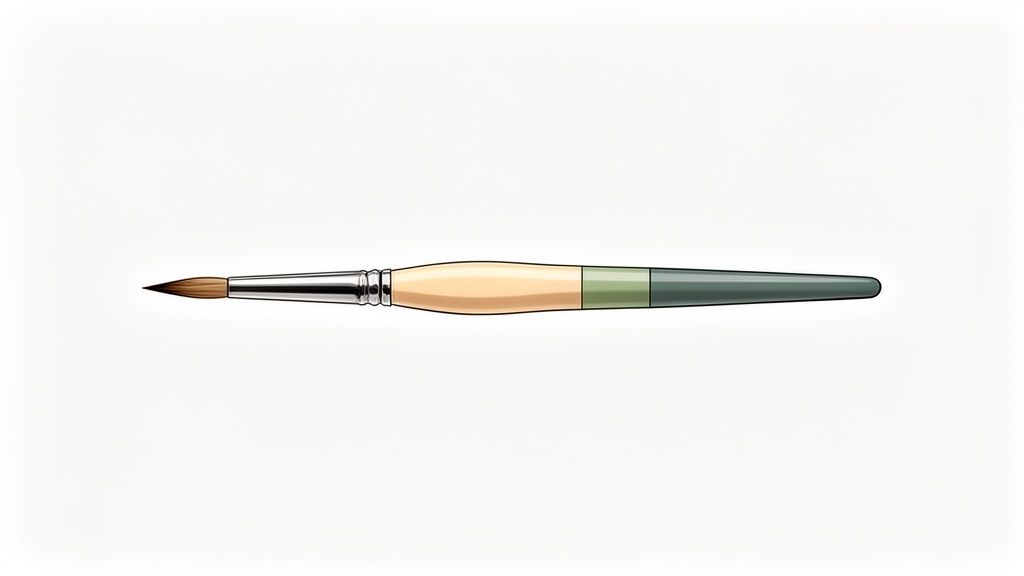
Let's take a brush apart piece by piece. There's really nothing complicated about it — and this knowledge will give you a real edge when it comes to making the right choice.
The key parts of a quality brush
Here's a quick breakdown so you can see what's what and exactly what to look for.
| Key Components of a Miniature Painting Brush | ||
|---|---|---|
| Component | Main Function | Quality Indicator |
| The tip | Precision and fine detail. | Should be sharp, spring back to its original shape, and not splay. |
| The belly | Paint reservoir. | Should be full enough to hold plenty of paint and release it in a controlled flow. |
| The ferrule | Secures the hairs to the handle. | Metal, seamless, and tightly crimped to prevent hair loss. |
| The handle | Comfort and control. | Well-balanced, ergonomic (many painters prefer triangular handles) and made from a material that won't swell. |
Now let's take a closer look at each part.
-
The tip: Think of it as your scalpel. 🔪 A fine tip lets you paint the glint in an eye, pick out the edge of a piece of armour, or lay down the thinnest lines imaginable. A quality brush has what we call "snap" or spring: no matter how much you use it, the tip snaps back into shape, sharp as a needle.
-
The belly: This is your brush's paint tank. 💧 A full, rounded belly holds more paint, which means longer, smoother strokes. You won't need to reload constantly — crucial for techniques like glazing, where interruptions can ruin the flow.
-
The ferrule: This is the metal band that bonds the hairs to the handle — think of it as the brush's chassis. A poor-quality ferrule (one with a visible seam or a loose crimp) will shed hairs straight onto your miniature. A good ferrule, typically seamless brass or nickel, keeps everything firmly in place and stops water from seeping into the handle and causing it to rot from the inside out.
-
The handle: It should feel like a natural extension of your hand. 💪 A great handle is comfortable, perfectly balanced, and lets you paint for hours without hand fatigue. Many miniature painters prefer triangular handles because they won't roll off the desk and provide a more secure grip.
Understanding brush anatomy is the first step to mastering it. It's not just about hair quality — it's about how every component works together to give you complete control over your paint.
Knowing what to look for means you can assess a brush the moment you pick it up. A well-made brush doesn't just improve your results — with proper care, it'll be a faithful tool for years to come.
Now that you know the hardware, let's get into the age-old debate: natural hair vs. synthetic? The answer might surprise you.
Natural vs. synthetic hair: choosing the right brush for the job
The question every miniature painter eventually asks: natural hair or synthetic? 🤔 The truth is, this isn't a battle with a winner — it's about understanding that these are two different tools, each with its own moment to shine. 🤩 Knowing which material to reach for and when will not only level up your technique, but also protect your investment over the long run.
Thinking that only one type of brush hair is worth using is a beginner's mistake. The best brushes for miniatures aren't always the most expensive — they're the ones that are perfectly suited to the job at hand. An experienced painter uses each type for its strengths, building an unbeatable toolkit on their workbench.
Natural hair brushes: the gold standard for detail work
When it comes to natural hair, the undisputed king is Kolinsky sable. These brushes are the gold standard for one very simple reason: their performance on high-precision work is, quite simply, exceptional. Their microscopic structure, covered in tiny scales, allows them to do two things extremely well.
First, they hold a surprising amount of paint in their "belly." This means you can pull long lines and apply smooth glazes without constantly reloading the brush. Second, they release that paint in a fluid, controlled way while maintaining a razor-sharp tip that springs back to its original shape almost like magic. ✨
They're ideal for:
- Fine details: Eyes, gems, filigree, and anything that demands surgical precision. 💎
- Glazing and blending: Their ability to release paint gradually makes them perfect for achieving ultra-smooth color transitions.
- Lining and edge work: The elastic, sharp tip gives you total control for painting clean, crisp lines.
Kolinsky sable brushes are like a scalpel. You wouldn't use one to cut down a tree, but they're unbeatable when you need maximum control and precision.
Their main drawbacks are cost and fragility. They require meticulous care and don't hold up well against harsh paints like metallics or texture products.
Synthetic brushes: the workhorses
On the other side, modern synthetic brushes have come a long way. Forget the scratchy, straw-like synthetics of years gone by. Today's high-quality nylon and taklon fibres offer incredible durability and resilience, making them the true workhorses of any painter's collection. 🐴
They're far more robust and take a beating without complaint. This makes them perfect for the kinds of tasks that would destroy a natural hair brush in no time. They're also more affordable and easier to clean, making them the go-to choice for beginners and for any task that doesn't demand extreme finesse.
They're perfect for:
- Drybrushing: This technique is incredibly harsh on bristles, and a synthetic brush handles it without breaking a sweat.
- Applying metallic paints: Metal particles can wreck natural hair over time. A synthetic is the smart choice. 🛡️
- Base coating and varnishing: Their firmness helps cover surfaces quickly and evenly.
- Washes and texture products: They're ideal for applying thicker products or those with stronger solvents.
In short, the smart strategy is to have both. Use your synthetics for the heavy lifting and dirty work, and save your prized sable brushes for the finishing touches and fine details that will make your miniature truly sing. 🎶
Mastering brush shapes and sizes for every painting technique
Would you try to hammer in a nail with a screwdriver? Of course not! 😂 Well, the world of miniature painting is exactly the same. Every brush has a shape and size designed for a specific purpose. And trust me, using the right tool doesn't just make the job easier — it takes the quality of your results to a whole new level.
Choosing from the huge variety of brush shapes can feel overwhelming at first, but in reality, you only need to master a few key types to cover 90% of your needs. This section is your brush map — your guide to knowing exactly which brush to reach for and why. Stop fighting your tools and start actually painting.
The all-purpose brushes you can't live without
Some brush shapes are the bread and butter of every miniature painter. They're versatile, functional, and the foundation of any kit — whether you're just starting out or you've got years of experience under your belt.
-
Round Brush: The undisputed king. 👑 Its sharp tip is perfect for detail work, while its full belly holds enough paint for base coating larger areas. A size 1 or 2 will be your go-to for almost everything — from painting a Space Marine's armour to the folds of a wizard's robes.
-
Detail Brush (Miniature Brush): When maximum precision is non-negotiable, this is your secret weapon. In sizes like 00 or 000, the tip is extremely fine and short, giving you total control for painting eyes, gems, tattoos, or the finest linework.
To make it even clearer, this infographic helps you instantly decide which brush hair type you need for each task — a choice just as important as the shape itself.
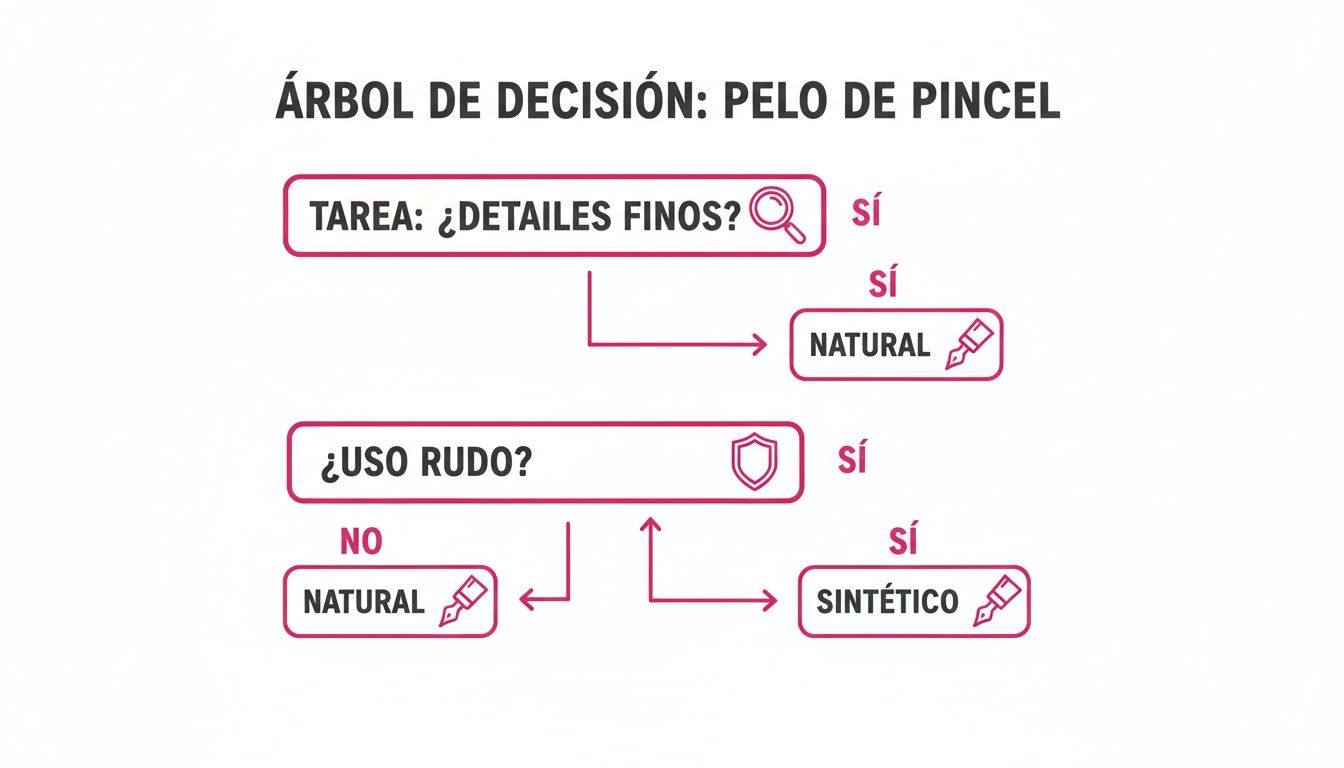
As you can see, the logic is pretty straightforward: if you need maximum precision, natural hair is your best friend; if the job calls for durability and heavy use, synthetic is the way to go.
Specialist brushes for specific techniques
Beyond the basics, there are brushes designed to make specific techniques much easier. Adding these to your collection opens up a whole new world of possibilities and effects.
-
Flat Brush: Need to cover a large surface like a tank hull or a sorcerer's cloak? A flat brush is your answer. It distributes paint evenly, eliminates brushstroke marks, and saves you valuable time.
-
Drybrush: This is a truly unique tool. It has short, stiff bristles and often a flat or slightly rounded tip. It's purpose-built for drybrushing — perfect for quickly picking out textures like fur, chainmail, or the stonework on a diorama, and incredibly effective at it.
For a quick reference, I've put together this handy cheat sheet.
Quick guide to brush shapes and their uses
| Brush Shape | Primary Use | Ideal Techniques | Recommended Sizes for Beginners |
|---|---|---|---|
| Round | All-purpose, from base coats to fine details | Base coats, glazes, lining | 1, 2 |
| Detail | Extreme detail work, ultra-fine lines | Painting eyes, gems, tattoos, specular highlights | 00, 000 |
| Flat | Coverage of large, flat surfaces | Base coats on vehicles, terrain and scenery | 4, 6 (depending on surface) |
| Drybrush | Highlighting raised textures | Drybrushing fur, metals, stone | Small and Medium |
Use this table as a quick reference for grabbing the right brush every time.
A skilled painter doesn't have dozens of brushes for the sake of it. They have exactly what they need — and they know precisely what each one is for. The goal is to build a smart set, not a big one.
If you're looking for a high-quality starting point that covers several of these needs, it's well worth checking out a complete set like the Artis Opus Series S. These packs typically include the most useful sizes of round and detail brushes.
Ultimately, mastering the best brushes for miniature painting comes down to understanding the synergy between shape, size, and technique. Experiment, try different combinations, and you'll soon develop an instinct that tells you exactly which brush you need just by looking at your miniature.
How to care for your brushes so they last for years
You've already invested in some of the best brushes for miniature painting — now it's time to protect that investment. Brush care is far easier than it sounds, and trust me, it will save you money and frustration in the long run. Think of it as a small ritual at the end of every painting session. 🙏
Your brushes have one true enemy, and it goes by a very specific name: dried paint in the ferrule. When paint seeps down to the base of the bristles and hardens there, it acts like a wedge. It permanently splays the hairs apart and destroys that sharp point you worked so hard to maintain.
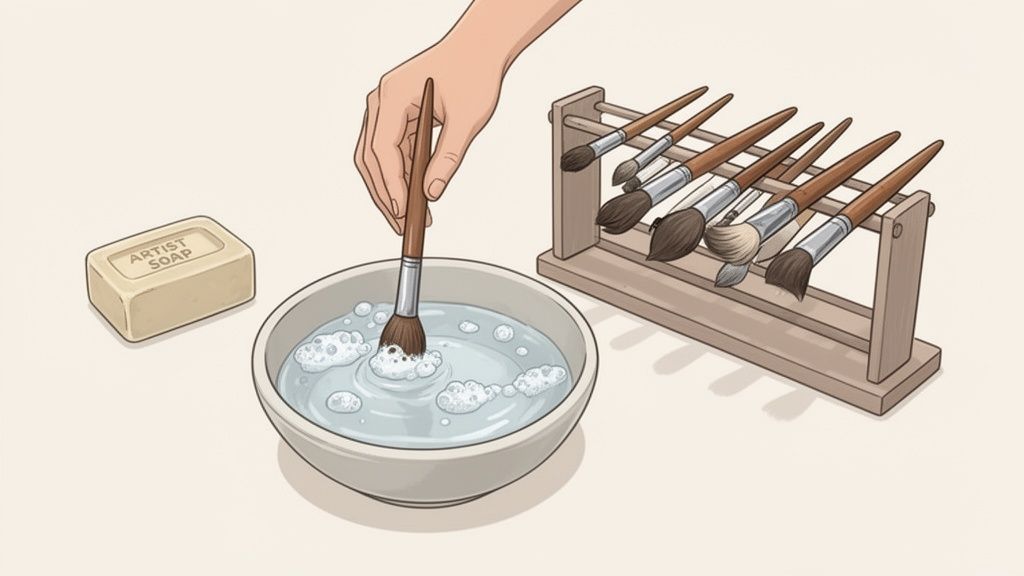
The cleaning ritual for a long and healthy brush life
Keeping your tools in perfect condition only takes a few minutes. The key is consistency — and never, ever letting paint dry where it shouldn't. Good cleaning habits are the difference between a brush that lasts a few months and one that stays with you for years.
Here's a simple but highly effective process:
- Rinse frequently while you paint: Keep two containers of water nearby. Use the first for a rough rinse and the second for a cleaner final rinse. This stops pigment from building up in the bristles.
- Clean thoroughly at the end of each session: When you're done painting, use a dedicated brush soap for artists. Gently work the damp brush into the soap, then lather it in the palm of your hand. You'll be amazed how much paint comes out.
- Shape and condition the bristles: After rinsing the soap out completely, reshape the tip with your fingers (clean ones — no licking the brush!). A good brush soap will also condition the hairs and restore their natural snap.
Pro Tip: Never leave a brush resting on its tip inside a water pot. It's one of the most common — and most destructive — mistakes out there, because it permanently bends the bristles. 😱
How to store your brushes and rescue "damaged" ones
Storage is just as important as cleaning. The golden rule is simple: always store brushes horizontally or bristle-side up, never bristle-side down. A pencil pot or a dedicated brush case is ideal for keeping them safe and organised.
What if the tip has already splayed open? Don't panic — all is not lost. Sometimes a deep treatment with a brush conditioner or brush restorer can work wonders and bring those stray bristles back together. If you want to dive deeper into the topic, we've put together a full guide on how to clean acrylic paint brushes that covers everything you need to know.
Follow these simple steps and your precision tools will stay in peak condition, ready to bring hundreds of miniatures to life. Proper brush care is the best-kept secret of professional painters. 💪
Right, now you've got the theory down. Time to roll up your sleeves and make some decisions. With so many options out there, finding the best brushes for miniature painting can feel completely overwhelming. To save you the headache, we've put together a selection based on our own hands-on experience, matched to what each painter actually needs at their stage of the hobby. Let's get into it! 😉
For the beginner who needs bulletproof brushes 💣
If you're just starting out, don't overcomplicate things or blow your budget. What you need are tools that can take a beating — brushes you can experiment with freely without worrying about ruining them on day one. For that, synthetic brushes are your best friends.
A solid set of synthetic brushes, like those from Vallejo, is a fantastic starting point. 🤩 They're true all-rounders: durable, easy to clean, and incredibly versatile. They'll forgive beginner mistakes like letting paint dry in the bristles, and they'll carry you through all the core techniques — from base coating to your first attempts at drybrushing.
For the intermediate painter ready to level up their precision 🎯
Got a good number of minis under your belt and feeling like your brushes are holding you back? It's time to upgrade. You don't need to replace everything at once, but adding one quality natural hair brush for detail work will completely change the game.
A size 1 or 2 Kolinsky sable brush will quickly become your go-to tool for anything that demands fine detail. The difference in paint flow and the ability to hold a razor-sharp tip will genuinely blow your mind. Suddenly, those fine edge highlights and tiny light reflections that used to be a nightmare will start coming naturally.
For the advanced painter pushing the boundaries of excellence 🏆
If display-quality painting is your goal, or you simply love pushing your minis to their absolute limit, investing in a high-end Kolinsky sable brush set is the natural next step. This is where brands like Artis Opus prove exactly why they sit at the top of the game. ✨
These brushes aren't just tools — they're precision instruments. The quality of the hair and their construction give you near-total control. With them, you can achieve ultra-subtle glazes, seemingly impossible fine detail, and blends as smooth as silk. Yes, it's an investment, but if you're serious about the hobby, the payoff in the final quality of your pieces is absolutely worth it.
The key isn't having a massive collection of fifty brushes — it's having the right ones for your skill level and painting style. Build your toolkit gradually and you'll find your work improves right alongside your tools.
Ready to start building your setup or take your current kit to the next level? Check out our carefully curated brush selection at MrResin.es and find the perfect tools to level up your miniatures.
Conclusion
And there we have it — we've reached the end of our deep dive into the world of miniature painting brushes 🎨. The bottom line: there's no single magic brush, but there is the right tool for every job. Combine the durability of synthetics for the heavy-duty work with the finesse of natural hair for detail work, and you've got a winning setup. Ultimately, the most important thing is finding what works for you.
Ready to take your miniatures to the next level? Browse our brushes and paints section at MrResin.es and find everything you need for your next project.
And don't go too far... subscribe to our Newsletter! 💌 You'll get exclusive discounts, news, and special offers delivered straight to your inbox. And if you want even more, join our community on our Telegram group. More coupons, exclusive deals, and a passionate community of hobby enthusiasts are waiting for you. Hope to see you there!
✨Happy Printing! 🚀