

Ready to find out who wins the resin slicer battle? 😎 In 2026, the Chitubox vs Lychee debate is more exciting than ever — and choosing the right software can make a real difference in your 3D prints.
Here's our definitive, fully updated comparison of Chitubox vs Lychee, the two titans of resin 3D printer slicing software. We'll cover everything: interface, licensing models, advanced features, compatibility, slicing speed, support generation, community, and technical support.
Want to optimize your results and choose like a pro? Keep reading and make the right call for your 3D printing projects this year. 🚀
Pricing and Licensing Models
Wondering which gives you more bang for your buck in the Chitubox vs Lychee battle? 💸 Both offer freemium models, but the differences in pricing and licensing can seriously impact your resin 3D printing experience.
|
Slicer |
Free Version |
Pro (monthly) |
Pro (annual) |
Premium |
Free Trial |
|---|---|---|---|---|---|
|
Chitubox |
Yes, no ads |
$16/month |
$169/year |
No |
First month at a reduced price |
|
Lychee |
Yes, with ads |
~$6/month |
~$76/year |
+$4/month |
30-day free trial |
In the free version, Lychee includes ads and a mandatory wait before slicing, while Chitubox Free is ad-free but locks out advanced features. If you need to work across multiple machines, Lychee Premium supports up to 4 devices with dedicated support, while Chitubox Pro targets professional users with advanced tools.
Upgrading unlocks features like intelligent auto-support generation, fast hollowing, and priority customer support. Is it worth it? Many users choose Lychee for its lower annual cost and ad-free experience on the paid tier.
If you're still unsure what each slicer does or how they relate to resin printing technology, we recommend reading this article on resin 3D printing to understand the full context behind chitubox vs lychee.
Remember, the real value lies in the tools that streamline your workflow and deliver the print quality you're after.
System Requirements and Printer Compatibility
Wondering if your setup is compatible for the chitubox vs lychee showdown? 🤔 Here's everything you need to know to resin print without any technical surprises.
System specs and compatibility
For smooth performance with both slicers, Chitubox recommends at least an i5 or Ryzen 5 processor, 16GB of RAM, and a 1GB GPU. Lychee, on the other hand, only requires 8GB of RAM and any WebGL2-compatible graphics card, making it more accessible if you're running a modest setup.
Both programs run on Windows, Mac, and Linux. Lychee even supports more Linux distributions, which is ideal if you're running less conventional systems in your workspace.
|
|
Chitubox |
Lychee |
|---|---|---|
|
CPU |
i5/Ryzen 5 |
Any |
|
RAM |
16GB |
8GB |
|
GPU |
1GB dedicated |
WebGL2 compatible |
|
OS |
Win/Mac/Linux |
Win/Mac/Linux (more distros) |
Printer Support and Profiles
Both Chitubox and Lychee support over 80 resin printer models. Chitubox stands out with official, up-to-date profiles, while Lychee focuses on community-sourced importable profiles in various formats such as CFG, PWX, CTB, and LYR.
Looking for compatible models and resins? Browse our resin collection to find tried-and-tested options recommended for both slicers.
Lychee makes it easy to import and share profiles, which speeds up your workflow when switching printers or materials.
Tips and Usage Insights
If you're working with large STL files (over 100MB), we recommend simplifying them before use — especially with Lychee, which can slow down without a dedicated GPU. According to All3DP, Lychee's profile flexibility is ideal for users who want full customization, while Chitubox shines in terms of reliability and official support.
User Interface and User Experience
Do you prefer a classic interface or a guided, modern experience? In the Chitubox vs Lychee battle, the user experience can be the deciding factor for many makers. Both slicers compete not just on features, but on how they feel when you're preparing your 3D models. 🖥️✨
Interface Comparison Table
|
Feature |
Chitubox |
Lychee |
|---|---|---|
|
Visual style |
Classic, Cura-style |
Modern, guided workflow |
|
Menus |
Side and top panels |
Contextual and step-by-step |
|
Customization |
Limited |
Highly adaptable |
|
Sample STL |
No |
Yes |
|
Preview |
Layer-by-layer |
By phase and layer |
Design, Learning Curve, and Customization
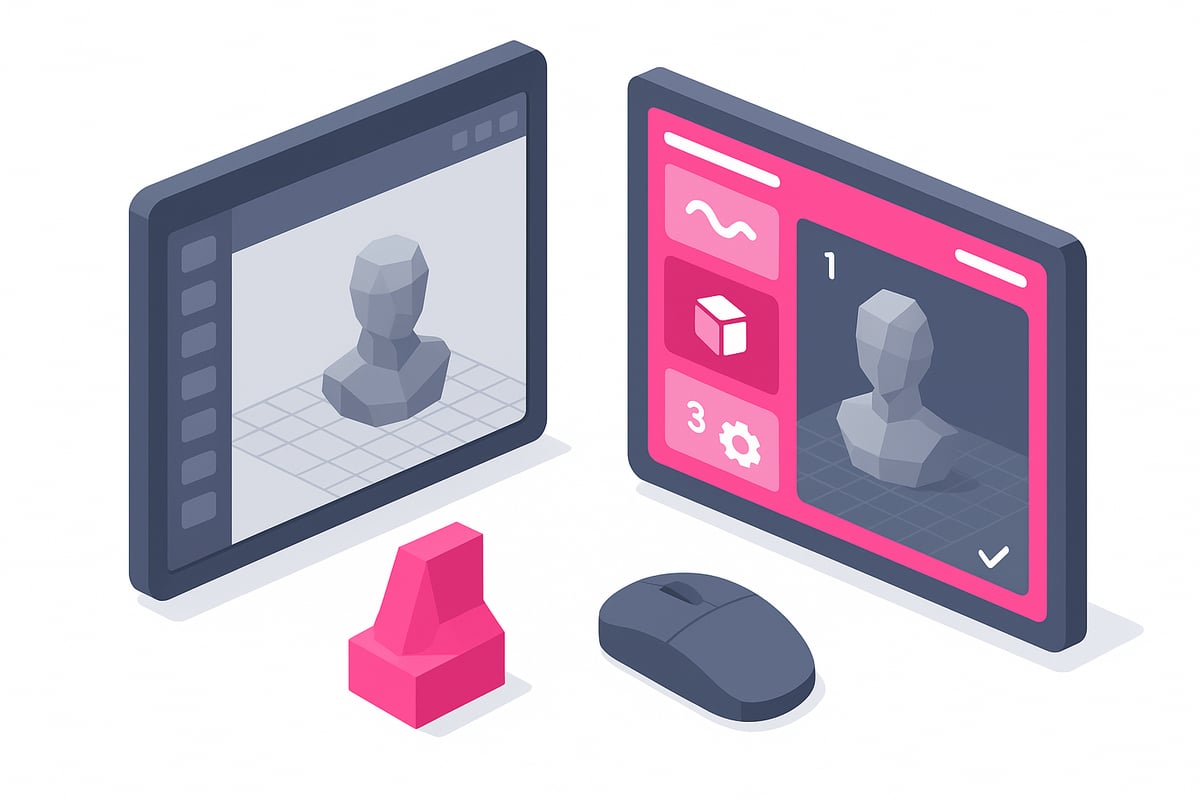
Chitubox goes with a traditional interface — side and top menus that will feel familiar to anyone who's used slicers like Cura before. If you already have some 3D printing experience, you'll feel right at home.
Lychee takes a different approach, organizing your workflow into "Layout", "Prepare", and "Export" phases. This step-by-step structure makes it much easier to follow along, which is great for beginners or anyone who prefers a more guided process. On top of that, Lychee's customization options let you tailor the interface to suit your own workflow.
Feature Access and Visual Examples
When comparing Chitubox vs Lychee, feature access is a key difference. Lychee locks many of its advanced tools behind the Pro version, while Chitubox makes most of its core features available for free.
Lychee includes sample STL models so you can practice and get familiar with the software, while Chitubox shines with its detailed layer-by-layer preview after slicing. Both have their own way of easing the learning curve — it just comes down to which style suits you better.
User Opinions and Final Comparison
According to Techreviewer, 70% of new users prefer Lychee for its gentler learning curve and modern interface. That said, Chitubox continues to be highly regarded for its stability and clean, straightforward layout.
If you want a deeper look at how SatelLite stacks up in this area, check out this review: ELEGOO SatelLite vs. CHITUBOX and Lychee: How Good Is the New Free Slicer?.
At the end of the day, in the Chitubox vs Lychee debate, the best choice really comes down to your personal preferences and experience level. Are you a fan of the classic approach, or are you ready to try something more modern? 😉
Advanced Features and Print Preparation Tools
Want to get the most out of your resin 3D printer? Advanced tools can make or break your workflow — and that's where the Chitubox vs Lychee battle really heats up. Here's how each slicer takes file preparation to the next level. 🛠️✨
Mesh Repair and Smart Supports
Lychee stands out for automatically repairing mesh errors, while Chitubox typically handles repairs manually or semi-automatically depending on the version. Both generate automatic and manual supports, but Lychee Pro adds features like "Support Recalculation" and "Adaptive Supports" for greater precision. Chitubox Pro, on the other hand, boasts advanced customization and smart supports with recent improvements, as you can see in the article CHITUBOX Basic and Pro V2.0 with Faster Slicing and Smarter Supports. If you're looking for efficient support generation, the Chitubox vs Lychee matchup is very evenly matched.
Hollowing, Cutting, and Automation Tools
Both offer hollowing and cutting tools in their paid versions. Lychee supports boolean operations and fast hollowing, ideal for saving resin without the hassle. Chitubox adds advanced repair during these processes, reducing print errors. Lychee's "Magic" feature automates orientation, supports, and raft in one click — similar to the "One-Click Print" found on other platforms. This significantly speeds up your workflow, especially if you print on a daily basis.
Profiles, Preview, and Practical Examples
Lychee supports more profile formats and lets you import community configurations with success rate statistics. Chitubox focuses on official profiles, ensuring stability. Both offer layer preview and time estimates before exporting your file. An interesting fact: 90% of Lychee Pro users rely on the "Magic" feature to optimize their results. Chitubox Pro flags "islands" in the mesh, while Lychee detects "suction cups" and helps you avoid print failures. Overall, the Chitubox vs Lychee experience caters to users of all skill levels.
Slicing Speed and Performance
Is speed a deciding factor for you when choosing between Chitubox vs Lychee? If you print regularly, every minute matters. The competition is fierce here, but there are clear differences that can help you make your decision.
In recent tests, Lychee stands out for its speed, particularly when processing complex, detail-heavy models. SatelLite, the newest competitor, outperforms Chitubox Free by 20%, but Lychee still leads in raw slicing speed.
|
Slicer |
Slicing Complex Models |
Smooth Preview |
Requires Manual Adjustments |
|---|---|---|---|
|
Lychee |
Very fast |
Yes |
No |
|
Chitubox |
Fast |
Sometimes |
Yes |
|
SatelLite |
Very fast |
Yes |
No |
Lychee produces print-ready files with fewer manual steps, while Chitubox often requires extra tweaking — especially with models that have a lot of fine structures. On lower-end machines, Chitubox can slow down noticeably, whereas Lychee and SatelLite keep slicing smooth and responsive.
According to Techreviewer, Lychee completed slicing on complex models 10% faster than Chitubox Pro. Chitubox has also recently rolled out a major update claiming up to 88x faster performance in some scenarios — you can read more about it here: CHITUBOX launches its most powerful update yet with up to 88x faster performance.
Bottom line: if speed is a priority for your workflow, slicing performance could be the deciding factor between these options.
Support, Community, and Updates
Community and technical support are key considerations when choosing a resin slicer in 2026. Both Chitubox and Lychee have invested heavily in building learning resources and support networks for their users. 🌎
Community and learning resources
Lychee has a particularly active community — users can share and download print profiles, as well as access collaborative data on resins and settings. Chitubox, on the other hand, offers official forums and a comprehensive technical knowledge base.
Both slicers provide tutorials and documentation, but Lychee integrates guides and videos directly into the platform, making it easier for beginners to get up to speed. For additional resources on specific print settings, check out the official Formlabs print settings guide for Creator resins, which applies to both slicers. 📚
According to All3DP, 85% of users who choose Lychee cite its strong community as a key reason. That said, Chitubox remains the go-to for those who prefer direct technical support and detailed documentation.
Updates and technical support
When it comes to updates, both Chitubox and Lychee maintain a steady release cadence — but Lychee tends to roll out experimental features ahead of the competition. This appeals to users who want to try the latest tools first, though it can occasionally mean a less stable experience.
For technical support, Lychee Premium offers personalized assistance, while Chitubox Pro provides priority support for advanced users. SatelLite, although it features innovative tools like multi-printer management, is still building its community.
Choosing between the two may come down to language and support accessibility — especially if you prefer help in Spanish and an active community where you can get answers fast.
Conclusion:
To sum it up, the Chitubox vs Lychee debate is still going strong in 2026. Each slicer shines in its own way: Chitubox stands out for its reliability and stability, while Lychee wins hearts with its modern interface, speed, and thriving community. The best choice depends on your needs and budget — but either way, you're guaranteed top-quality resin 3D printing results!
Ready to take your projects to the next level? Visit our online store to discover the best resins, printers, and accessories with real product images and expert support in Spanish. Join our Telegram community at https://t.me/MrResin3D for exclusive discounts, coupons, and the latest news. And don't forget to subscribe to our Newsletter for more tips and surprises.
Want to keep learning about Chitubox vs Lychee and other resin 3D printing tips? Check out our 3D Printing Blog, packed with helpful guides and in-depth comparisons.
✨ Happy Printing! 🚀
Now that you know which slicer fits your resin printing workflow best, why not take your projects to the next level? One thing is clear: great results come down to both the software you use and the quality of your resins. At Mr Resin, you'll find an incredible selection of materials, top brands, and expert advice to make every print a success. Browse our collection and find the perfect resin to get the most out of your printer.
Shop all 3D printing resins