

Meta Title: 🦷 Dental 3D Printer Price: Buying Guide for Your Practice Meta Description: 💰 Find out the real cost of a dental 3D printer. Complete guide with comparisons, hidden costs, and tips for choosing the best option.
The price of a dental 3D printer covers a pretty wide range, running from around $300 for entry-level models all the way past $20,000 for industrial-scale production systems. But rather than thinking of it as an expense, trust me — it's a strategic investment that completely transforms the efficiency of any modern dental practice or lab.
🤔 Is Adding 3D Printing to Your Practice Really That Expensive?
Making the jump to digital dentistry can feel overwhelming when you first look at the upfront costs. A lot of colleagues — both in practices and labs — wonder whether the price of a dental 3D printer is something they can realistically afford. The short answer, and I say this from experience, is yes. And it's far more accessible than you might think. 😉
The key is shifting your mindset: stop seeing it as a cost and start seeing it as an investment with a return that comes much sooner than you'd expect.
3D printing technology is no longer the exclusive domain of large corporations — it's become a practical tool for professionals like you and me. It lets us produce parts with a level of precision and speed that simply wasn't possible with traditional methods. That doesn't just raise the quality of care we deliver; it streamlines workflows in a way that's genuinely game-changing.
What This Actually Looks Like Day to Day
Digital dentistry isn't some far-off concept anymore — it's happening right now in practices around the world. With one of these machines in your own workspace, you can suddenly:
- Create study models with millimeter-level accuracy in just a few hours.
- Produce custom surgical guides that improve the safety and precision of implant placement.
- Print night guards, splints, or aligners directly in your own practice or lab.
- Get the most out of your materials by using the right 3D printer resin for each application and cutting waste to a minimum.
Having that in-house production capability frees you from depending on outside labs, cuts turnaround times for patients, and — most importantly — gives you complete control over the quality of the final product. If you want to dive deeper into how this technology is reshaping the industry, check out our essential guide to dental 3D printers for practices and labs.
Keep this in mind: the upfront cost of the printer is just one piece of the puzzle. The real value lies in the efficiency, control, and profitability it brings to your day-to-day practice.
Throughout this guide, we're going to break down the idea that this technology is out of reach. We'll walk through price ranges, what drives those costs, and — most importantly — how to calculate the true cost of ownership so you can make the best decision for your business. Let's get into it! 🚀
📊 Dental 3D Printer Price Comparison
The best way to understand dental 3D printer pricing is to break the market down into categories. Not every lab or practice has the same needs or the same budget, so let's look at three clear tiers to help you figure out where your situation fits.
Think of it like buying a vehicle: a city car for commuting and a cargo van for large-scale deliveries are two completely different tools — each with its own purpose and price tag.
Entry Level (up to €2,000)
This first tier covers the most affordable printers on the market. They're ideal for students, small labs just getting started with digital workflows, or clinics looking to experiment with basic applications. But don't let the price fool you — the quality these machines deliver today is genuinely impressive. ✨
- Common applications: Study models, orthodontic models, custom trays, and simple splints.
- Key features: These are typically MSLA printers with high-resolution LCD screens (4K or 8K). Build volume is more limited, but more than enough to get started with confidence.
- Examples: Brands like Anycubic and Elegoo have made 3D printing accessible to a much wider audience. While not designed exclusively for dentistry, these printers deliver excellent precision for a wide range of dental tasks. In Spain, adoption of 3D printers in dental labs has already reached an impressive 61%. Resin printers from Anycubic or Elegoo — available through specialist retailers like Mr Resin — typically range from €300 to €1,500, an accessible investment that pays for itself quickly by cutting production times by 40–50% compared to traditional methods. You can read more about this in this dental sector opportunity analysis by Katia Dental.
Professional Level (€2,000 – €10,000)
This is the sweet spot of the market — the most popular segment for dental clinics and mid-sized labs that need a reliable workhorse for daily production. The higher price reflects not just a better machine, but improved reliability, faster print speeds, dedicated technical support, and — critically — certification for use with biocompatible resins. 💪
- Common applications: Everything in the entry level, plus surgical guides, temporary crowns and bridges, and models for removable prosthetics.
- Key features: Faster print speeds, larger build platforms, automatic calibration systems, and a much more robust software and materials ecosystem.
- Examples: Brands like Phrozen, Shining 3D, and Ackuretta dominate this space, offering a near-perfect balance of cost and performance.
To give you a clearer picture, the chart below shows how these price ranges break down across categories.
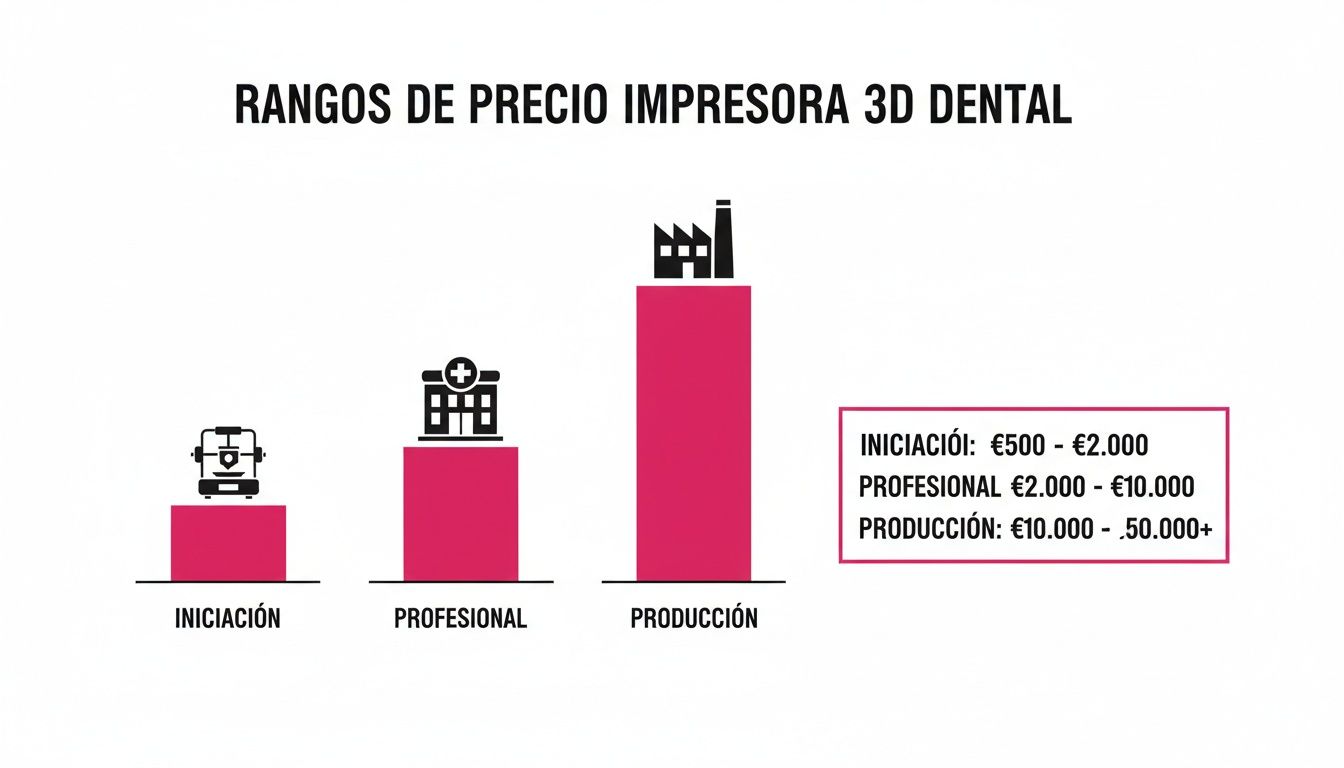
As you can see, the price jump between tiers is significant — and it directly reflects the increase in capability, reliability, and production volume that each category brings to the table.
Production Level (over €10,000)
This is the league of large dental laboratories and production centres that need to manufacture hundreds of parts per day. These printers are true workhorses, designed to run 24/7 with minimal human intervention. 🏭
- Common applications: Mass production of clear aligners, high-precision models, surgical guides, and large-scale prosthetics.
- Key features: Extremely high speed, large build volumes, automated workflows (such as resin management), and software to manage fleets of multiple printers simultaneously.
- Examples: Industry giants such as Carbon, 3D Systems, and Stratasys operate at this level, with advanced technologies including industrial DLP and SLA.
The key is not to buy the most expensive printer, but the one that best suits your workload and the applications you actually need. Starting with an entry-level or professional model is the smartest strategy for most users.
Comparison Table of Dental 3D Printers by Level and Price
To help you visualise the differences at a glance, we have put together this summary table. Think of it as a quick reference guide to know what to expect from each category. 📝
| Level | Approximate Price Range (€) | Ideal for | Typical Applications |
|---|---|---|---|
| Entry-Level | €500 – €2,000 | Students, small laboratories, clinics just getting started | Study models, trays, basic splints |
| Professional | €2,000 – €10,000 | Mid-sized clinics and laboratories | Surgical guides, temporaries, high-precision models |
| Production | > €10,000 | Large laboratories and milling centres | Mass production of aligners, prosthetics, and models |
Choosing the right level is the first and most important step towards making a smart investment that truly drives your dental laboratory or clinic forward.
⚙️ Technical Factors That Influence the Price
Understanding why two printers that look almost identical can carry such different price tags is essential to avoid overspending. The price of a dental 3D printer is not set arbitrarily — it reflects a series of technical factors that directly affect the quality, precision, and reliability of your daily lab work. Let's break them down so you know exactly what you're paying for.
Think of it like buying a car. You have the base model that gets you from A to B without any issues, and then you have the premium version with more power, better finish, and enhanced safety. Both will get you there, but the experience — and above all, the reliability — are worlds apart. The same applies to dental 3D printers.
XY Resolution and Layer Height: Precision Is in the Details
XY resolution is one of the most important specifications. Think of it like the sharpness of your phone screen: the more pixels packed into the same space, the clearer and more detailed the image. In a printer, XY resolution refers to the minimum size of the light point — known as a voxel — that cures the resin.
- A lower XY resolution (e.g., 50 microns) may be sufficient for large study models, but could fall short when it comes to accurately reproducing preparation margins.
- A high XY resolution (20 to 30 microns) is critical for work demanding maximum precision, such as crown dies, implant fits, or complex surgical guides.
Layer height, on the other hand, is the thickness of each "slice" the printer produces. Lowering the layer height (to 25 microns, for example) yields incredibly smooth, detailed parts — but print times increase. Raising it (to 100 microns) speeds up the process, but layer lines become more visible. Higher-end printers tend to be more reliable and consistent when working with ultra-thin layers, which is vital for final quality.
Build volume and print speed: size and pace matter
Build volume is, quite simply, the size of the working area — the usable space (width, depth, and height) available for printing your parts.
A printer with a small build volume can be perfect if you only need an occasional surgical guide. But if your lab needs to produce 10 orthodontic models at once, you'll need a much larger print platform. The bigger the volume, the higher the price — naturally.
Print speed, measured in millimeters per hour (mm/h), determines how quickly you have a finished part in your hands. This is where more advanced printers really stand out. They use more powerful light sources or more efficient layer-release mechanisms to print at full speed without sacrificing quality — essential in a production environment where every minute counts. If you want to dive deeper into the technologies behind resin printers and how they affect speed, take a look at our guide to resin 3D printers.
Light technology: the engine behind the printer (SLA, DLP, or MSLA)
The heart of any resin printer is its light source. This is where some of the biggest price differences between models come from:
- SLA (Stereolithography): The original technology. It uses a laser that "draws" each layer point by point. It delivers exceptional precision but tends to be slower and more expensive. You'll find it in very high-end machines.
- DLP (Digital Light Processing): Uses a projector — similar to a cinema projector — to cure an entire layer in a single flash. Much faster than SLA while maintaining excellent precision. Typical of professional-grade printers.
- MSLA (Masked Stereolithography): The most popular technology today. It uses an LCD screen acting as a mask over an LED array. It offers outstanding value for money and is found in both entry-level and professional machines. Budget models use 2K screens, while top-tier units feature 8K, 12K, or even 16K screens for impressive XY resolution.
Build quality and reliability: what you can't see at a glance
Finally, there's a factor that's easy to overlook: material quality. A printer built with a machined metal chassis, sturdy linear rails, and a long-lasting monochrome LCD screen will be far more reliable and durable than one made with plastic components and lower-grade parts.
Reputable brands invest heavily in build quality and, most importantly, offer solid technical support. This is invaluable when your daily production depends on your machine running without a single hiccup.
💸 The Real Cost Beyond the Initial Purchase
This is where many people go wrong: the price of a dental 3D printer is just the tip of the iceberg. To understand your true investment, you need to think about the Total Cost of Ownership (TCO) — the sum of every expense you'll face after taking the printer out of the box. 📦
Think of it like buying a car. The sticker price at the dealership is just the beginning. Then comes the fuel (resin), insurance, oil changes (maintenance), tires (consumables)... If you only look at the purchase price, you're in for a rude awakening.
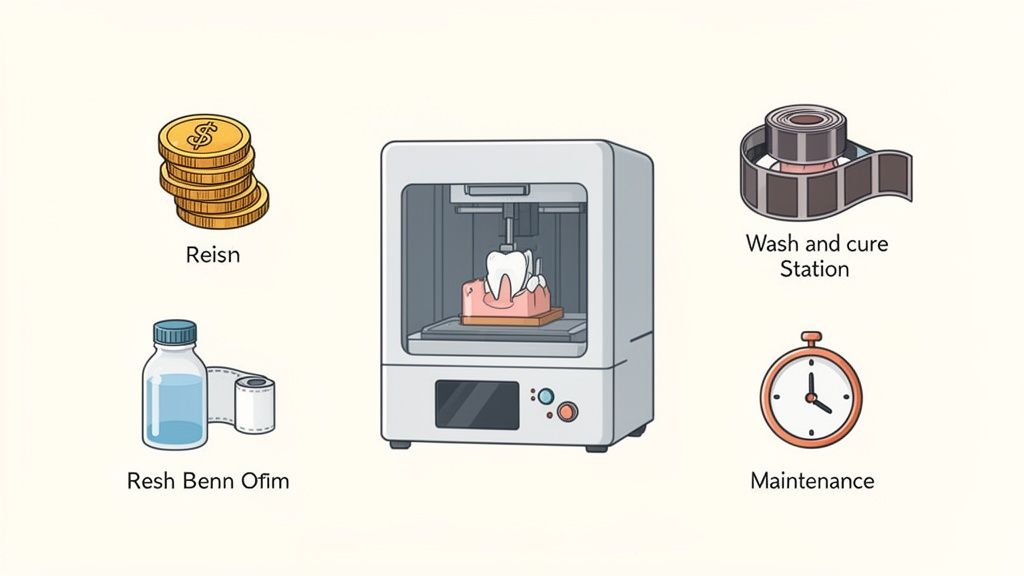
In the world of dental 3D printing, those "hidden costs" are what will truly determine whether your investment pays off. Overlooking them is the fastest way to blow your budget. At Mr Resin, we believe in full transparency so you know exactly what you're getting into from day one.
TCO Breakdown for Dental 3D Printing
Let's get into the details and break down the recurring expenses you need to keep on your radar.
1. Dental Resin: The Fuel That Drives Your Production
Resin will be your most consistent ongoing expense. Every model, surgical guide, or splint you print will consume material. The cost per litre varies enormously depending on the type and brand — from more affordable options for study models to certified biocompatible resins that, understandably, come at a higher price point.
Choosing the right resin for your 3D printer is essential for striking the right balance between quality and cost. You won't always need the most expensive resin; for working models, a standard high-definition resin is usually more than adequate — saving your biocompatible resins for applications that truly require them, such as intraoral use.
2. Consumables: The Wear-and-Tear Components
Your printer has parts that naturally wear down with use and need replacing periodically. None of them are particularly expensive on their own, but if you print frequently, they add up.
- LCD/DLP Screen: This is the heart of MSLA and DLP printers. They have a limited lifespan measured in hours of use. Modern monochrome screens last thousands of hours, but replacement can cost several hundred euros on professional models.
- FEP/ACF/nFEP Film: This is the transparent film that sits at the bottom of the resin tank (the vat). Over time, it degrades, scratches, or can get punctured. Replacing it on time is essential to prevent resin leaks that could destroy your screen.
- Activated Carbon Filters: Many printers include these to reduce resin odour. These filters also become saturated and need periodic replacement.
Optimism is growing across the dental sector, with 39% of clinics expecting increased revenue by 2026, driven largely by digitalisation. While maintenance costs — which can account for up to 20% annually of the printer's purchase price — remain a concern, they can be offset through affordable resins and support from local suppliers. Adopting these technologies is key, as they can reduce material waste by up to 50% compared to traditional subtractive methods. You can explore more about trends in the dental sector in this analysis by Katia Dental on dental clinics in Spain.
3. Post-Processing: Achieving a Professional Finish
A freshly printed part isn't ready to use straight away. It needs to go through a wash and cure process, which comes with its own associated costs.
- Wash & Cure Station: While you could do this by hand, a dedicated station makes the whole process simpler, safer, and delivers consistent results every time. It's an investment we consider almost essential.
- Isopropyl Alcohol (IPA): The most common liquid used to wash parts and remove uncured resin. Consumption can be high, especially if you're printing in large volumes. A great alternative is using water-washable resin, which eliminates this cost entirely.
- Gloves and PPE: Safety comes first. Always wear nitrile gloves and eye protection when handling liquid resin. It's a small but ongoing expense — and a non-negotiable one.
Building a Realistic Budget
When evaluating the price of a dental 3D printer, don't just focus on the headline figure. Take the time to estimate your monthly running costs. Ask yourself: how many models will I print per month? What type of resin do I need? How often will I need to replace the FEP film?
Having a clear picture of your total cost of ownership (TCO) will allow you to calculate the true cost per part — and set your prices accordingly. It will help you understand when you'll break even on your investment and, most importantly, avoid any unwelcome surprises down the line. Good advice at this stage really does make all the difference.
##🧪 Why Resin Compatibility Matters
Think of it this way: resin is the real fuel that powers your printer. You can have the most advanced machine on the market, but if the material doesn't perform, the quality of your work will suffer. That's why, when assessing the price of a dental 3D printer, resin compatibility is just as critical a factor as the technology itself.
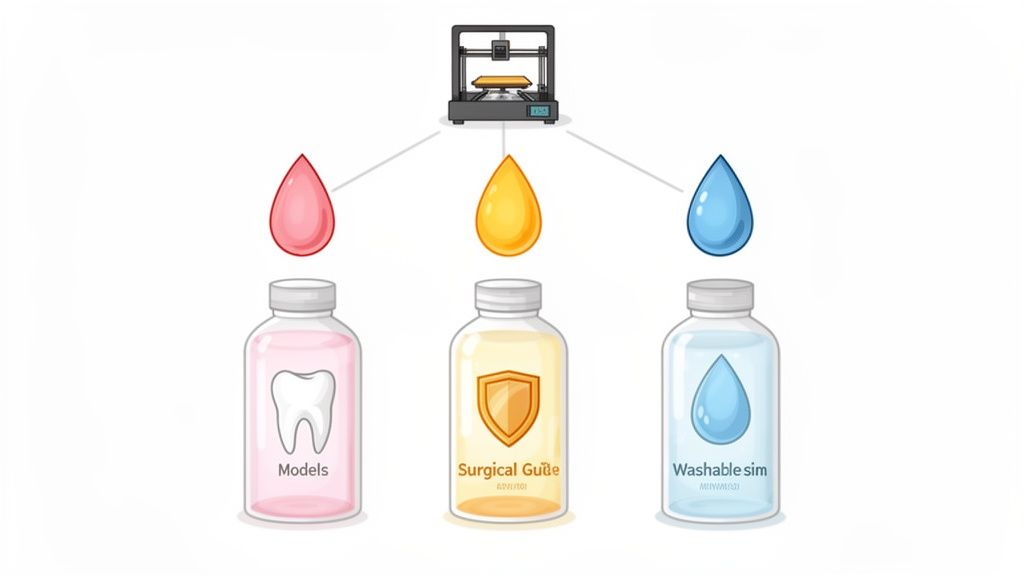
This is where two philosophies clash: closed ecosystems versus open ones. Closed systems lock you into using only their own brand's resins, which — unsurprisingly — tend to be significantly more expensive. Open ecosystem printers, on the other hand, like the popular Anycubic or Elegoo machines, give you complete freedom to choose.
And that freedom doesn't just mean saving money on every litre of resin — it opens the door to experimenting with a whole world of materials. You can test and find the perfect formulation that fits each application like a glove, and of course, fits your budget too. It's a massive advantage!
Types of dental resin and when to use each one
In the dental field, there's no such thing as a one-size-fits-all resin. At Mr Resin, we know this well — every job comes with very specific requirements. That's why we offer a complete range compatible with the leading open ecosystem printers.
- For study models and orthodontics: You need a high-definition resin capable of capturing even the finest detail with pinpoint accuracy. The result should be a smooth, hard surface — the foundation for reliable diagnosis and treatment planning.
- For surgical guides and splints: Mechanical strength is the top priority here. An ABS-like resin is the ideal choice, combining excellent hardness with just the right amount of flex so it won't crack during clinical use.
- For streamlining post-processing: If you want to speed up your workflow, water-washable resin is a fantastic option. No isopropyl alcohol needed, making cleanup safer, more cost-effective, and above all, much faster.
A figure that speaks for itself: already 60% of dental clinics in Spain have integrated digital technology. In this landscape, materials like water-washable resin — available from around €30 per litre — are proving to be a game-changer, cutting costs and working time by up to 30%. For more details, check out this report on dental digitalisation.
Tips for choosing and validating your resin
Getting your resin right is a crucial step that will save you a lot of headaches, time, and money. First and most importantly: make sure the printer you choose is an open ecosystem model. Then, always check the recommended print profiles for the resin you plan to use.
Brands like Anycubic and Elegoo, for example, are well known for working brilliantly with a wide range of third-party resins, including those available from Mr Resin. A handy tip is to start with a standard resin to dial in your machine, and once it's running perfectly, begin testing more specialised materials based on what you need to produce. If you want to dive deeper, don't miss our complete dental resin guide.
Conclusion:
We've seen that the price of a dental 3D printer isn't a barrier — it's a gateway to greater efficiency. Remember: there are options for every budget, the true cost goes beyond the initial purchase, and choosing an open-ecosystem printer gives you enormous freedom. 😉
With the right information, you're more than ready to make a smart decision that takes your clinic or lab to the next level.
Ready to take the leap? Head over to our store and browse all the 3D printer resins we carry. You're sure to find the perfect one for you!
And if you want to stay ahead of the curve, don't miss our Telegram channel. Join the community here: https://t.me/MrResin3D. Exclusive discounts, coupons, news, and events are waiting for you. Don't miss out!
Also, make sure to subscribe to our Newsletter to get the best deals delivered straight to your inbox. 💌
✨ Happy Printing! 🚀
🤔 Frequently asked questions about dental 3D printer prices
It's completely normal to have a ton of questions before investing in new technology — we've all been there! That's why we've put together answers to the most common questions about dental 3D printer pricing, so you can make a confident, well-informed decision.
Can I use a budget 3D printer for dental applications?
Absolutely! The short answer is yes. Entry-level printers — like many models from Anycubic or Elegoo — offer resolution and accuracy that will genuinely surprise you. They're a fantastic starting point for producing study models, orthodontic models, or custom trays.
They let you dive straight into a digital workflow without a major upfront investment. That said, it's worth knowing their limitations: they're not designed for applications that require certified biocompatible resins, such as surgical guides or temporaries. For everything else, they're a great way to get started.
How quickly will the investment pay for itself?
That's the million-dollar question — and the answer is: it depends on how much you use it, but it's usually much faster than you'd expect. Once you start producing your own parts in-house, you cut out shipping costs and the turnaround times of external labs. Your cost per model or splint comes down to what you spend on resin, and the savings are noticeable from day one.
To put it in perspective, a small clinic or lab printing around 10–15 models per week can recoup the cost of a professional-grade printer (between €2,000 and €5,000) in under a year. With an entry-level machine, the return on investment can come in a matter of months.
Do I need to be an expert to start printing?
Not at all. Forget the idea that this is only for engineers. Today's 3D printers — especially entry-level and professional models — are increasingly plug-and-play. They come with highly intuitive slicing software and helpful features like automatic build plate leveling that make the whole process straightforward.
On top of that, the online community is huge. There are thousands of tutorials on YouTube and forums where you can ask anything. With a bit of curiosity and a willingness to experiment, you'll be producing impressive prints within a couple of afternoons. It's far more accessible than it looks!
What type of resin is best for dental models?
The key is to ask yourself: what am I actually going to use this model for? A study model for showing a patient their case is very different from a surgical guide that needs to withstand real stress.
- For study or diagnostic models where maximum detail is the priority, a high-definition resin is the ideal choice for its precision and great value.
- If you need a part that can take some punishment — like surgical guides or splints — ABS-like resin is your best bet for durability.
- And if you want to simplify post-processing and ditch the IPA altogether, water-washable resin will save you both time and money.