

If you've searched "dental resin price," you've probably come across a range of costs that would confuse anyone. You can find everything from basic model resins for around €50 per litre to biocompatible materials exceeding €400. This massive price gap isn't random — each resin is its own world, and the technology, certifications, and above all the intended use dictate what it costs.
Breaking Down the Price of Dental Resin for 3D Printing 🧐
Getting into dental 3D printing means accepting one truth: the price of a resin is about far more than a number on a label. It reflects precision, patient safety, and the day-to-day reliability you can count on.
Assuming all resins are more or less the same is like thinking a brick and a surgical titanium implant are equivalent just because both are used to "build" something. 🏗️ It simply doesn't hold up.
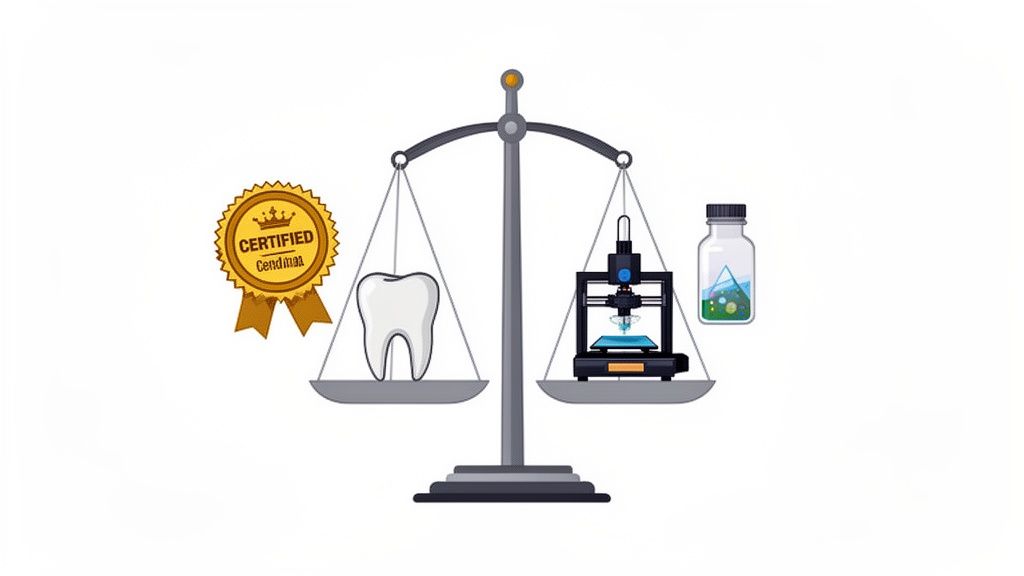
The reality is that every bottle of resin is formulated down to the last additive for a very specific purpose. Its price is directly tied to the factors that protect patient health and guarantee final output quality.
The Factors That Actually Drive the Cost ✅
To understand why a resin costs what it costs, let's break down what's behind that price tag.
-
Biocompatibility and Medical Certification: This is, without question, the factor that changes everything. A resin intended for use in a patient's mouth — whether for a splint, a temporary crown, or a surgical guide — must pass rigorous clinical testing and obtain certifications such as the Class IIa CE marking. That approval process isn't cheap, but it's the only guarantee that the material is non-toxic and won't cause problems. 📜
-
Specific Application: A resin for printing a study model that will sit on a desk is a very different product from one used to manufacture a surgical guide requiring micron-level precision. Model resins are more affordable because their technical and regulatory requirements are far less demanding.
-
R&D and Chemical Formulation: Developing a resin with specific mechanical properties — flexible yet break-resistant, wear-resistant, colour-stable — requires a massive investment in research and development. Behind every formula lie thousands of hours of lab work. 🧪
In dentistry, price goes hand in hand with safety and precision. Investing in a certified resin isn't an expense — it's a guarantee for your patient and a safeguard for the reputation of your clinic or lab.
With that in mind, you can now evaluate the options on the market from a different perspective. It's not about finding the cheapest option, but the most appropriate one for each job.
To give you a clearer picture, we've put together a table showing the most common price ranges.
Estimated Price Ranges by Dental Resin Type (per litre) 📈
This table gives you a general overview of approximate costs. As you'll see, prices climb sharply as soon as a resin requires certification for clinical use.
| Dental Resin Type | Primary Use | Approximate Price Range (€/L) |
|---|---|---|
| Dental Model Resin | Study models, orthodontics. | €50 - €120 |
| Castable Resin | Cast metal frameworks. | €150 - €250 |
| Surgical Guide Resin | Guided implant surgery. | €250 - €400 |
| Crown & Bridge Resin | Temporary restorations. | €300 - €500 |
| Splint Resin | Occlusal splints and mouthguards. | €280 - €450 |
As you can see, understanding these price ranges helps you plan your costs more effectively and justify the investment in quality materials when the job demands it.
Resin types and their real impact on your budget 💰
Getting into the world of dental resins is a bit like walking into a high-end hardware store: you know there's a world of difference between a basic hammer and a professional-grade rotary hammer drill. Each resin is formulated for a very specific task, and understanding what each one does is the first step to justifying why dental resin pricing can vary so dramatically from one bottle to the next. 🧐
Not all resins are created equal. Their chemistry, mechanical properties, and above all, whether or not they're certified for intraoral use, are the factors that set them apart and determine where they belong in your clinic or lab.
Study and working model resins
Let's start with the most common and affordable option: model resins. These are the workhorse material in many dental labs — the go-to choice for creating accurate replicas of a patient's dentition.
Their job is straightforward but critical: delivering exceptional dimensional accuracy and a hard, smooth surface you can work on with complete confidence. They're ideal for diagnostic models, opposing arch models, and orthodontic treatment planning.
Since they're not intended for direct patient contact, their certification requirements are far less stringent. This naturally translates to a significantly lower price point, making them the perfect cost-effective workhorse for everyday lab use.
Castable resins for metal frameworks
Castable resins are a chemistry marvel with a very specific purpose: they burn out completely without leaving any ash residue. 🔥 This property is the cornerstone of the lost-wax casting process, used to fabricate metal frameworks such as copings, bridges, and the metal bases of removable prostheses.
The workflow is straightforward: you print the piece, invest it in a heat-resistant refractory material, and fire it in a furnace. The resin burns away entirely, leaving a flawless hollow mould ready to receive the molten metal. A quality castable resin must have minimal thermal expansion and burn out cleanly to ensure a precise, void-free casting.
As you'd expect, this highly specialised formulation justifies a higher price tag compared to a standard model resin.
Biocompatible resins for intraoral applications
This is where dental resin pricing takes a significant jump — and for very good reason. Biocompatible resins are medical-grade materials, specifically designed and tested for direct, prolonged contact with the human body.
Biocompatibility isn't just another feature — it's a legal and ethical requirement. These resins undergo rigorous clinical testing and must obtain certifications such as Class IIa CE marking or ISO 13485. All of this ensures they are non-toxic, non-allergenic, and won't leach harmful substances into a patient's mouth.
Within this category, things get even more interesting across several subspecialties:
- Surgical guides: These need to be extremely rigid and dimensionally accurate so surgeons can place implants with millimeter-level precision. They must also withstand autoclave sterilization without warping.
- Occlusal splints: These strike a delicate balance between hardness — enough to handle even the most severe bruxism — and toughness, so they don't become brittle. Clarity and stain resistance (think coffee) are also major advantages.
- Temporary crowns and bridges: Aesthetics are paramount here, with shades that closely mimic natural dentition (the well-known A1, A2, A3 shade system). They also need sufficient mechanical strength to hold up under normal chewing forces for weeks or even months.
- Denture bases: These resins replicate the color of gum tissue and must offer excellent fracture and wear resistance to handle the daily demands of a full denture.
The significant investment in R&D, clinical trials, and regulatory certification is what drives the price point. Paying for these materials is, in reality, investing in your patients' safety and peace of mind.
A market on the rise 📈
This push toward increasingly advanced materials is no coincidence. The dental sector in Spain is booming. According to data from the Spanish Federation of Health Technology Companies (Fenin), the dental market generated €1.1 billion in revenue — 11.4% higher than pre-pandemic figures. Laboratory segments and CAD/CAM solutions are among the fastest-growing areas, with growth rates of 6.6%.
This momentum is driving demand for more specialized, reliable materials, where certified quality is no longer optional — it's essential. If you want a broader understanding of how resins are classified beyond the dental field, you'll find our consumer resin guide for 3D printing a great place to start.
Understanding this classification makes you a smarter buyer — one who can choose the right material for each application and justify every euro spent.
Calculating the true cost per printed part 🧮
Buying a bottle of resin is just the starting point. To know whether your investment is truly profitable, you need to look beyond the dental resin price on the label and calculate what each part that comes off your printer actually costs you. 🧐 It's the only way to set competitive prices and, more importantly, to understand your margins.
Focusing solely on the cost per liter is like calculating the price of a cake based only on the cost of flour. What about the eggs, the sugar, the electricity for the oven — and most importantly, your time? 🍰 3D dental printing is no different; there are several "hidden" costs that need to be brought to light to avoid any unpleasant surprises.
This diagram summarizes the key factors to consider when selecting a resin, placing intended use and certification first, followed by material quality.
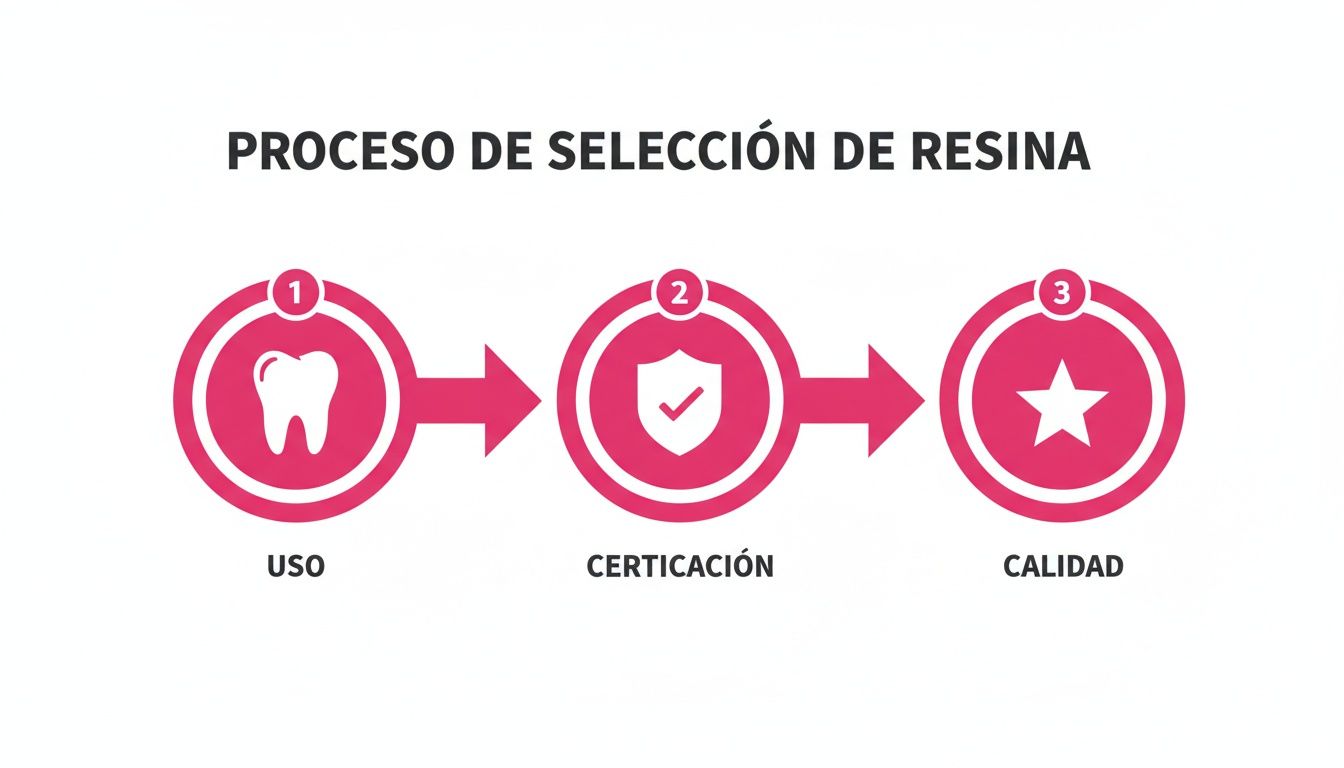
As you can see, the first step is to think about what the part will be used for and whether it needs certification. These are the filters that determine which resin category you need before you start evaluating quality.
Breaking Down the Hidden Costs of Resin Printing
To get the true cost per part, you need to add up all those small expenses that stack up from the moment you open your slicer to the moment the part is ready to deliver.
- Resin consumption per print: Your slicer software (such as Chitubox or Lychee) gives you a pretty accurate estimate of how many millilitres (ml) or grams (g) the part will require, including supports. Don't forget about those — they cost money too!
- Buffer for failed prints: Let's be realistic — not everything comes out perfect on the first try. It's a good idea to add a small buffer (a 5–10% allowance is a sensible estimate) to cover material lost to failed prints.
- Isopropyl Alcohol (IPA) for washing: Every part needs an IPA wash to remove uncured resin residue. This alcohol gets "used up" over time and needs to be replenished. It's a small cost, but it adds up.
- Electricity consumption: Your 3D printer and wash-and-cure station both draw power. A multi-hour print can make a noticeable dent in your electricity bill — and over the course of a year, it really adds up. ⚡
- Equipment depreciation: Your printer, curing station, and even the LCD screen have a limited lifespan. They'll eventually need replacing. Factoring a small portion of their cost into each print is a sound financial practice.
The Cost-Per-Part Formula 📝
With all of this in mind, we can put together a simple formula to calculate what it costs to produce any given part.
Cost Per Part = (Resin Cost + Support Cost) + Failure Buffer + IPA Cost + Electricity Cost + Depreciation
It might look complicated, but the reality is that the vast majority of your cost (over 90%) comes from resin consumption. The other factors matter for getting an accurate figure, but if you're just starting out, don't get too caught up in them.
Practical Example: Cost of a Night Guard
Let's put some numbers to it. Say we're going to print a dental night guard.
-
Starting data:
- Price of 1 litre (1000 ml) of night guard resin: €350.
- The slicer tells us the night guard with its supports will use 15 ml of resin.
-
Calculating the resin cost:
- Cost per ml: €350 / 1000 ml = €0.35/ml.
- Resin cost for the night guard: 15 ml × €0.35/ml = €5.25.
-
Adding the extras:
- Adding 10% to cover failed prints, IPA, electricity, etc.: €5.25 × 0.10 = €0.53.
-
Total estimated cost per night guard:
- €5.25 + €0.53 = €5.78.
This calculation gives you a solid baseline for understanding what it costs to produce each night guard. From there, you can add your profit margin and the value of your time to set a fair and profitable selling price.
If you want to dig deeper into how far each bottle goes, check out our article on how much you can print with 1 litre of resin. Getting a handle on these numbers is key to running a smooth, efficient lab.
How to Choose Your Resin and Get the Most for Your Money ✅
Making a smart buying decision goes far beyond hunting down the lowest dental resin price. To truly maximise your investment and avoid nasty surprises, you need to think strategically. Here are the key factors for choosing the right resin — without making the classic beginner mistakes that end up costing a fortune. 💸
First and foremost, it's essential to understand that not all resins work with all printers. Ignoring this is a recipe for disaster.
Compatibility Is Everything 👑
Before adding any resin to your cart, you need to make sure it's compatible with your 3D printer. This comes down to two technical factors you simply can't overlook.
- Wavelength (nm): Nearly all LCD/MSLA printers used in dentistry cure resin at 405 nm. Trying to use a resin designed for a different wavelength (such as 385 nm) simply won't work — or worse, will produce disastrous results. Always check the label!
- Print profiles: Every resin has its own curing "recipe," with specific layer exposure times. Reputable manufacturers provide pre-validated profiles for the most common printers. Using a resin without a known profile means you'll be stuck experimenting through trial and error, wasting time and material.
A cheap resin that isn't compatible with your machine is actually the most expensive one of all. It'll cost you failed prints, wasted resin, and no end of frustration.
The Real Value for Money 🤔
Price per litre is just a number — it doesn't tell the whole story. To work out whether a resin is truly cost-effective, you need to look at other details that have a direct impact on your bottom line and your day-to-day workflow.
- Print success rate: What's the point of cheap resin if one in every three prints fails? A higher-quality resin, even if it seems more expensive upfront, can be far more cost-effective if it delivers a 99% success rate. Fewer failures mean less wasted material and time.
- Post-processing ease: Some resins clean up more easily, require less curing time, or leave cleaner support removal. All the time you save on cleaning and finishing parts is money back in your pocket.
- Mechanical and aesthetic properties: Does the resin hold its colour over time? Is it durable enough for your intended use? A splint that cracks or a temporary crown that stains within two days is a direct hit to your professional reputation.
The Risk of "Too Cheap" and Counterfeit Products ⚠️
In a rapidly growing market, you need to stay alert. Forecasts suggest the European dental materials market will grow from $7.2 billion in 2026 to $11.33 billion by 2034. This boom is attracting plenty of new players — but not all of them play by the rules.
This is where uncertified resins and counterfeits become a serious danger. Using a material that isn't biocompatible for something placed inside a patient's mouth is a grave form of negligence that can lead to allergic reactions and serious health issues. ☣️
That's why buying from specialist retailers and authorised distributors like MrResin.es isn't an expense — it's peace of mind. You get guaranteed authentic products, properly stored materials, and Spanish-language technical support if anything goes wrong. If you'd like to learn more, our blog covers where to buy 3D resin in Spain with full guarantees. Protecting your patients and your clinic's reputation? That's priceless.
The future of digital dentistry and next-generation resins ✨
Getting serious about 3D printing is no longer something to think about "down the line" — it's the engine driving modern dentistry right now. And this is exactly where the conversation around dental resin pricing takes on a whole new dimension, shifting from a simple cost line to a marker of how forward-thinking a clinic or laboratory really is. Digitalisation is transforming every part of the workflow, and with it comes a growing demand for materials that can keep up: more precise, faster, and above all, dependable. 🚀
Understanding this changes everything. Investing in high-quality resin isn't an overhead — it's a strategy. It translates directly into surgical guides that nail implant positioning, splints that fit perfectly, and provisionals you can deliver in record time. And most importantly: patient satisfaction. That feeling of "this place is so efficient and professional" puts you ahead of the competition, and that value far outweighs the cost of the resin bottle.
This evolution is a sign that the industry has real confidence in what's coming. And it's not just my take — a recent Key-Stone study backs it up: the dental sector in Spain is in a period of stability, with confidence levels at their highest since the pandemic. The study makes it clear that professionals are betting on digital technology and that the priority is investing in equipment that makes a real difference. You can read more about dental sector trends here.
Trends already reshaping the industry
The future is already here — and it's packed with innovations set to transform the way we work. Technology keeps moving forward, and dental resins are right at the forefront of this revolution. 💡
Here are some of the most significant trends we'll see take hold:
- Permanent 3D Printed Resins: Temporary restorations are becoming a thing of the past. New materials with outstanding strength and aesthetics are making it possible to print definitive crowns, inlays, and onlays directly in the clinic. This is a true game-changer — it reduces the number of appointments and cuts costs for everyone.
- Materials with Bioactive Properties: Imagine resins that don't just restore — they actively help the patient. Materials that release fluoride ions to prevent cavities, or that incorporate antibacterial components to keep plaque under control. 3D printing is set to become a tool for active dental treatment.
- Blazing-Fast Print Speeds: Advances in printer technology and resin chemistry will make it possible to print a splint or surgical guide in minutes, not hours. The workflow optimization potential is enormous.
The real mindset shift is to stop seeing technology and materials as a cost, and start seeing them as your greatest competitive advantage. The question is no longer whether you can afford to invest in quality resins — it's whether you can afford not to.
Embracing this shift is what will allow clinics and dental labs to not just survive in the market, but lead it. Every dollar you invest in a quality resin is a step toward more efficient, more precise dentistry — and happier patients. The future is digital, and it's printed in 3D.
Conclusion:
After this deep dive, we hope one thing is crystal clear: the price of a dental resin is about far more than the number on the bottle. It reflects years of research, patient safety certifications, and the technology required to produce parts with extraordinary precision. 🤓
To help you stay on track and always make the best decision, keep these three key takeaways in mind:
- Every resin has a purpose: A material for a simple study model is worlds apart from a biocompatible resin for an intraoral splint. Understanding what each resin is designed for justifies the cost — and keeps you from making costly mistakes.
- Calculate the true cost per part: Stop using price per litre as your only benchmark. Factor in supports, potential print failures, and consumables. Only then will you know whether your work is genuinely profitable.
- Trust your suppliers: Working with specialists like MrResin.es gives you the confidence that you're purchasing authentic materials, with expert technical support and no unpleasant surprises. It's an investment in quality and peace of mind.
You now have the tools to optimise your purchasing and take your lab or clinic to the next level. 3D printing is no longer the future — it's the present, and you're fully equipped to get the most out of it. 💪
Ready to take action? 🚀 Browse our full catalogue of dental resins at MrResin.es and find exactly what you need for your projects.
And if you want to stay up to date with everything, join our community. Head over to our Telegram group for exclusive community discounts, special offers, coupons, news, and events. 🤫 Oh, and don't forget to subscribe to our Newsletter to get all the latest updates delivered straight to your inbox. 💌
✨ Happy Printing! 🚀
Frequently Asked Questions About Dental Resin Pricing
When you're investing in technical materials like dental resins, it's completely normal to have a lot of questions. That's why we've put together the most common ones here, so you have all the information you need to make a confident decision. 😉
Why is biocompatible resin so expensive?
The price difference between a model resin and a biocompatible one is massive — and for good reason. It's not just about the chemistry of the material; it's everything that goes into ensuring it's 100% safe for a patient. 🩺
The cost of dental resin that's biocompatible is driven up by several factors:
- Years of Research and Development (R&D): This isn't something you mix together overnight. Years of lab work go into developing a formula that's stable, durable, and — most importantly — non-toxic.
- Rigorous Clinical Testing: Before reaching the market, the material goes through extensive testing to prove it doesn't cause allergies, irritation, or leach harmful substances in the mouth.
- Certification Processes: Achieving standards like Class IIa CE marking or compliance with ISO 13485 isn't free. It involves audits, mountains of paperwork, and fees that add up to thousands of dollars.
- Cleanroom Manufacturing: These resins are produced in sterile environments to prevent even the tiniest contamination, which significantly increases production costs.
Simply put, that high price tag is the cost of safety. It's the only guarantee that what you're placing in a patient's mouth meets the most demanding medical standards in the world.
Can I use a cheap resin to make a dental splint?
The answer is an absolute, unequivocal NO. 🚫 Using a model resin — one that was never designed or certified for intraoral use — to fabricate a splint, a temporary restoration, or anything else a patient will wear, is a serious act of negligence.
The health risks are simply unacceptable.
- Outright toxicity: The components in cheap resins can be toxic when in contact with mucous membranes, releasing chemicals that the body ends up absorbing.
- Allergic reactions: They can trigger anything from mild gum irritation to a severe allergic response.
- Degrades inside the mouth: They're not built to withstand the moisture and acidity of saliva, meaning they can crack, lose their shape, and become brittle over time.
Cutting corners here is not worth it. You're putting your patients' health at risk and exposing yourself to serious legal and professional consequences. Safety is non-negotiable.
How much can I save by optimizing my prints?
Here's the good news! 🎉 While you can't cut back on resin quality, you can significantly reduce material consumption by optimizing your workflow. With the right approach, you can save between 15% and 30% of material on every print.
The key is how you prepare your files in your slicer. Pay close attention to part nesting (arranging multiple models together to maximize build plate space) and support optimization. Using thinner or hollowed-out supports where possible, and orienting parts to minimize the support they need, are tricks that genuinely add up at the end of the month.
Where is it safe to buy dental resins online?
With so many options out there, it's essential to buy from a source you can trust. Always go with authorized distributors and specialized retailers, like MrResin.es.
Buying from a trusted supplier gives you peace of mind across several key areas:
- Product traceability: You know the resin is genuine — not a counterfeit — and you have full visibility into the batch number and expiry date.
- Proper storage conditions: Resins are sensitive to light and temperature. A reliable distributor stores them correctly so they retain their full properties.
- Technical support that actually knows its stuff: When a print goes wrong or you're not sure which profile to use, having someone on the other end who truly understands the process and speaks your language is invaluable.
Investing in the right supplier is part of the strategy for achieving flawless results and working without nasty surprises.
To wrap things up...
As we've seen, the price of dental resin isn't arbitrary — it reflects the innovation, safety standards, and specialisation packed into every bottle. To always make the right call, keep these points in mind: understand the different resin types, calculate the true cost per printed part, and rely on trusted suppliers who offer guarantees and solid support. ✅
You now have everything you need to optimise your investment and take your lab or clinic to the next level.
Ready to start printing with the best quality? Browse our dental resin catalogue at MrResin.es. 🛒
We'd also love for you to join our community. Head over to our Telegram group for exclusive discounts, deals, and support you won't find anywhere else. And don't forget to subscribe to our Newsletter to be the first to hear about all our latest news and coupon codes! 💌
✨ Happy Printing! 🚀