

Resin 3D prints are nothing short of liquid magic transformed into solid objects. ✨ The secret lies in a process that cures a photosensitive resin layer by layer using ultraviolet light — a technique that leaves FDM filament printing in the dust when it comes to detail and surface quality.
What is resin 3D printing and why you'll love it 🥰
If you're coming from the FDM world, this is going to be a game changer. Forget watching a print head lay down strand after strand of melted plastic. With resin printing, your object emerges almost like magic from a vat of liquid. 🧙♂️
The core of this technology is called photopolymerization. The printer holds a vat of liquid resin, and beneath it sits an LCD screen that emits UV light. The build plate lowers until it's just above the bottom of the vat, and the screen exposes only the outline of the first layer, curing the resin in that area.
The plate then lifts slightly, fresh resin flows back in, and the process repeats over and over. Ultra-thin layers — often just 0.05 millimeters — are built up one by one until the part is complete.
This method produces an almost flawless surface finish, free from the layer lines typical of FDM printing. Parts come off the printer looking like injection-molded pieces, ready to paint or use straight away.
It's all in the details 🔬
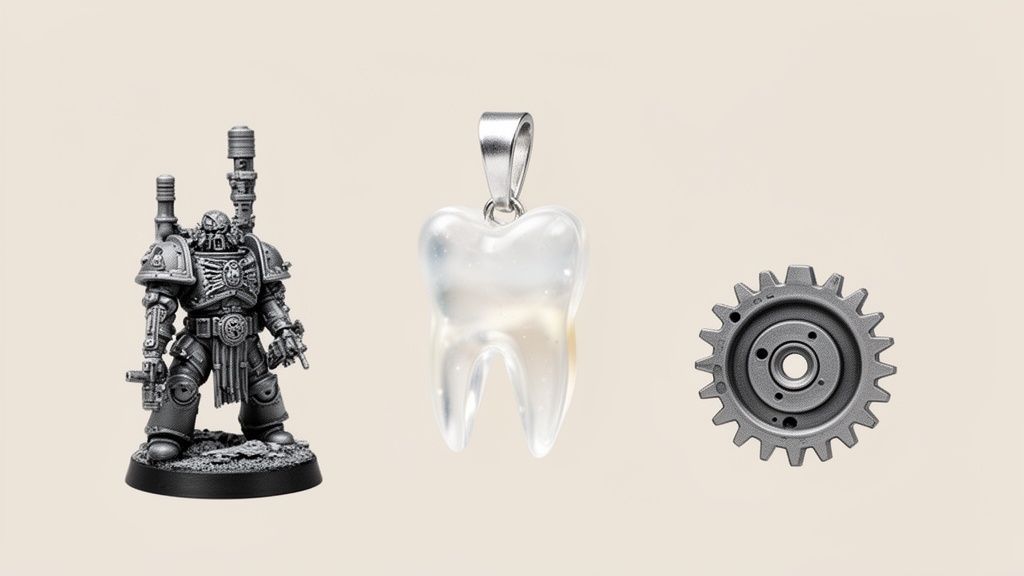
The ability to reproduce incredibly fine details is what makes resin 3D printing the go-to choice across so many fields. From the creases in the armor of a 28mm miniature to the tiny gears of a prototype, the level of fidelity is remarkable.
This precision opens up a world of possibilities for hobbyists and professionals alike:
- Miniatures and scale modeling: 🎲 Create tabletop gaming figures and dioramas with a level of detail that looks hand-sculpted.
- Custom jewelry: 💍 Perfect for casting molds or finished pieces with the accuracy needed to produce intricate filigree and settings that would be impossible any other way.
- Rapid prototyping: 👨💻 Engineers and designers can hold functional, aesthetically refined models in their hands to validate ideas within hours.
- Dental applications: 🦷 Used to produce surgical guides, temporary crowns, and orthodontic models with micron-level precision.
In short, resin printing will turn your digital designs into real-world objects with stunning definition and a professional finish right from the start. Get ready to be blown away by what you can create! 🤩
How to choose the right 3D resin for your project 🤔
Diving into the world of resins can feel overwhelming at first, but trust me — it's far simpler than it looks. 🤯 Think of each resin type as a specific tool: some are built for toughness, others for the finest detail work. The key is knowing exactly what you want to make.
Using the wrong resin can leave you with parts that snap at the slightest pressure or a post-processing nightmare you didn't sign up for. Get the choice right, though, and your resin 3D prints won't just look incredible — they'll hold up like champions.
Resin types by application
To help you find your feet, we've broken down the most common resins you'll come across. Each one has its own superpowers. 💪
- Standard Resin: The perfect starting point for almost everyone. Ideal for decorative figures and miniatures where detail is everything. It's easy to work with and delivers stunning results, especially on 8K printers.
- Water Washable Resin: Say goodbye to the mess of isopropyl alcohol! 💧 This resin cleans up with tap water, making post-processing much simpler and keeping odors to a minimum. A game-changer for beginners and anyone who wants a cleaner, more convenient workflow.
- ABS-Like Resin: Need parts that can take a beating? This is your resin. It offers significantly higher impact resistance and durability, making it perfect for functional prototypes, enclosures, or mechanical parts that need to hold up under real-world use.
- Flexible Resin: Exactly what it sounds like — this resin produces elastic, rubber-like parts. Great for gaskets, dampeners, or anything that needs to bend without breaking.
An interesting market insight: ABS-like and standard resins are the undisputed bestsellers, accounting for over 60% of sales. They're the go-to choice for modelers, prototypers, and even dental professionals. This goes hand in hand with the boom in LCD printers from brands like Anycubic and Elegoo, which are now found in 70% of homes and workshops.
Pro Tip: 💡 Don't be afraid to experiment. You can blend resins (always from the same brand and type) to dial in custom properties. For example, add a splash of flexible resin to your standard resin and watch your miniatures gain extra drop resistance. Works like a charm!
3D Resin Comparison Chart
To give you a clear overview at a glance, we've put together a handy summary table. With this, choosing the right resin for your next resin 3D print will be a breeze. Compare the key characteristics of each resin type to find the best fit for your project.
| Resin Type | Key Advantage | Recommended Use | Difficulty Level |
|---|---|---|---|
| Standard | Maximum detail, easy to use | Miniatures and decorative figures | Beginner |
| Water Washable | Easy cleanup with water | Display pieces, rapid prototypes | Beginner |
| ABS-Like | High strength and durability | Functional prototypes, mechanical parts | Intermediate |
| Flexible | Elasticity and break resistance | Gaskets, seals, flexible objects | Intermediate |
Choosing the right resin is the first step toward getting incredible results. If you want to dive deeper into the topic, don't miss our complete guide to 3D printer resins.
The Workflow for a Perfect Print 👌
Turning a digital file into a flawless physical part requires a clear process. But don't worry — it's much simpler than it sounds! 🥳 This workflow is your roadmap to achieving spectacular resin 3D prints from your very first attempt and avoiding the most common pitfalls.
Model Preparation and Supports
Everything starts on your computer, in a slicing program like Lychee or Chitubox. This is where you import your 3D model and tackle the most critical step of all: adding supports. Think of them as tiny scaffolding that holds up the overhanging parts of your print, keeping everything in shape and preventing failures.
A solid support strategy is, without exaggeration, the difference between a successful print and a failed one. If you want to master this skill, check out our complete guide on how to resin 3D print and pick up all the tips and tricks.
Printer Setup and Print Settings
With your model ready to go, it's time to set up the printer. First, make sure your build plate is properly leveled — this determines whether that all-important first layer adheres correctly. Then carefully pour your resin into the vat, keeping spillage to a minimum.
Next, dial in your print settings. The most important one is layer exposure time — simply put, how long the UV light stays on to cure each layer. Too short and your print will be weak or fail entirely; too long and you'll lose fine detail.
To help you figure out which resin is right for you, this flowchart makes the decision easy based on what you're looking for.
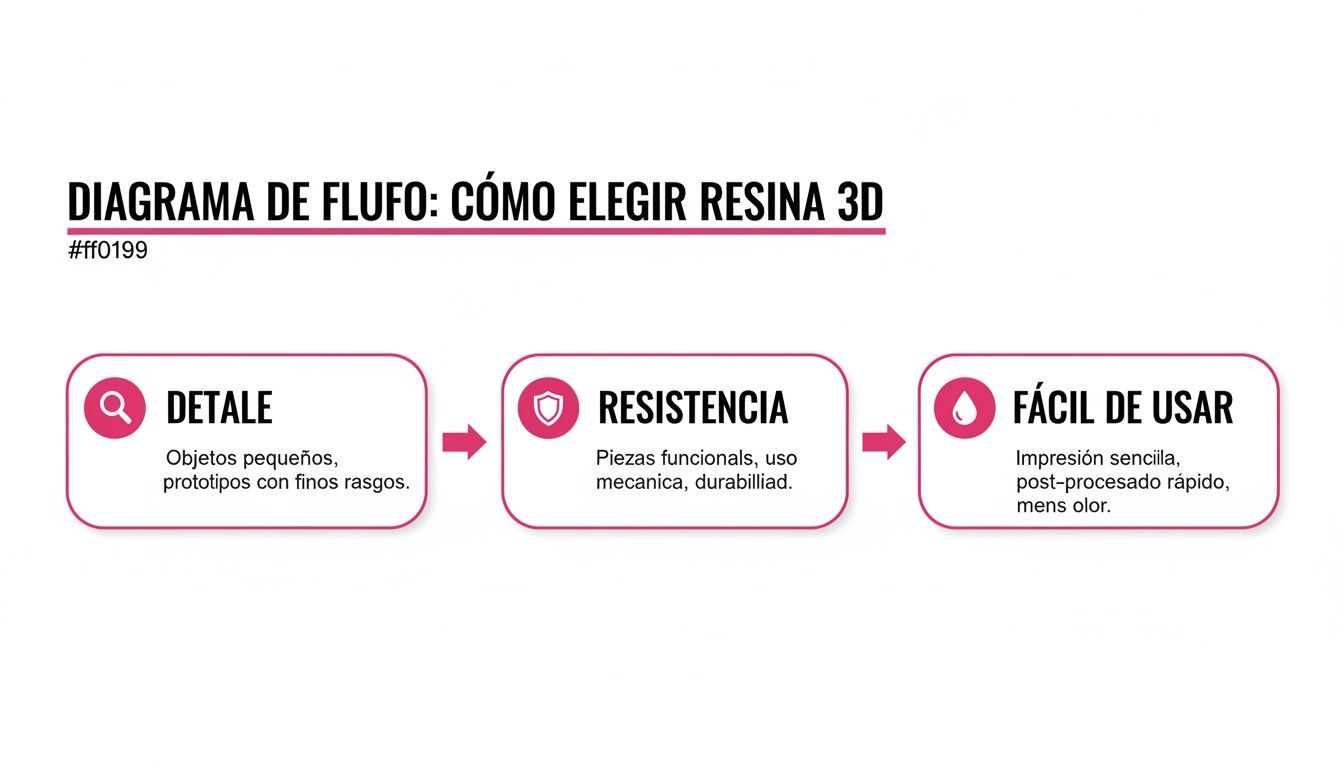
As the chart shows, whether detail, strength, or ease of use is your priority, there's a clear path to finding the perfect resin for your projects.
Post-Processing: Washing and UV Curing
Print complete! Your part comes off the printer tacky and not quite finished — there are two essential steps still to go: washing and curing.
First, submerge it in isopropyl alcohol (or water if you're using a water-washable resin) to remove any uncured liquid resin from the surface. Nobody wants a sticky print.
Once it's washed and thoroughly dried, place it in a UV curing station. This final step fully hardens the material, giving it maximum strength and durability. It's a crucial process — especially in fields like dentistry, where it delivers extremely high-precision results and can save up to 30% on materials.
Resin Safety: Print with Confidence
Let's be straight: safety comes first when it comes to resin 3D printing — but don't let that put you off, it's really not a big deal. 🛡️ Think of it like cooking: you use oven mitts to grab a hot dish and you wouldn't touch an open flame bare-handed, right? Working with resin is exactly the same.
Handling it carelessly and without protection can lead to skin irritation or, over time, an allergic reaction. That's why personal protective equipment (PPE) is non-negotiable — it's your best friend in this hobby. And don't worry, it's a simple, easy-to-find kit.
Your Essential Safety Gear
To work with complete peace of mind, always keep these three key items within reach. Trust me — they're what make the printing experience genuinely enjoyable, with no nasty surprises. 😉
- 🧤 Nitrile gloves: Non-negotiable, full stop. Wear them whenever you handle liquid resin, the printer, or freshly printed parts. They're your first line of defence against direct skin contact.
- 👓 Safety glasses: Your eyes are irreplaceable. A good pair of safety glasses protects you from any accidental splashes that can happen when pouring resin or handling prints.
- 🌬️ Proper ventilation: Always work in a well-ventilated area. Resin fumes can be unpleasant, so opening a window or running an air purifier is an absolute must.
A clean, organised workspace is a safe workspace. Set aside a dedicated area for your printer and all your post-processing gear. This keeps contamination to other areas in check and keeps everything under control.
Post-processing also demands the same level of care. When cleaning your prints — typically with isopropyl alcohol — safety remains just as important. If you want to dive deeper into this topic, take a look at our guide to using isopropyl alcohol in resin 3D printing.
What amazing projects can you create with your printer?
A resin 3D printer isn't just a machine — it's a gateway to unlimited creativity. 🤩 With it, you can bring to life projects that previously only existed in your head, whether for your hobbies or your professional work. Resin 3D prints deliver a level of detail that truly changes the game.
The sector shows no signs of slowing down. The industrial 3D printing market is set to surpass USD 18.3 billion in 2025 and is projected to grow at a rate of 15.1% annually through to 2035. Stores like Mr Resin are part of this momentum, with fast shipping from local stock that can cut delivery times by up to 50% for prototyping and modelling professionals. If you want to learn more about 3D printing market projections, check out this report.
Miniatures for wargames and scale modelling ⚔️
This is, without doubt, one of the areas where resin truly shines. You can print entire armies with details so fine they look hand-sculpted — from the texture of armour plating to the subtlest expression on a character's face.
Once printed, your figures are the perfect canvas. With paint ranges like Vallejo Game Color or Xpress Color, available in our store, you'll achieve professional-quality finishes that'll turn heads at the gaming table.
Functional prototypes and product design ⚙️
For engineers and designers, the speed and precision of resin printing is invaluable. It lets you produce functional prototypes in just a few hours — perfect for validating a design, checking part fit, or presenting an idea to a client in a tangible, hands-on way rather than just on a screen.
With a resin printer in your workshop, the design cycle speeds up dramatically. You can go from a 3D model to a physical part in your hands on the very same day. It's a game-changer for innovation.
Custom Jewellery and Dental Applications 💎
The incredible resolution of resin makes it perfect for jewellery. You can create final pieces or casting moulds with jaw-dropping detail. Much the same applies in the dental sector, where it's used to produce surgical guides, models, and splints with pinpoint accuracy.
Frequently Asked Questions About Resin 3D Printing
Whenever you start something new, questions come thick and fast — that's completely normal. Here we've pulled together the questions we get asked most often and given them a clear, straight-to-the-point answer, so you can bust through any roadblock and keep your printer running at full steam. 🤔
Why Did My First Print Fail?
Don't panic — it happens to everyone! 😅 It's basically a rite of passage. In almost every case, the problem comes down to one of three usual suspects: poor bed levelling, incorrect exposure times, or not enough supports.
Re-level the build plate calmly, following your printer's manual. Look up the recommended settings for your specific resin and printer model online. And above all, make sure your model has enough supports — especially on those areas that start printing "floating in mid-air".
Can I Use Any Resin in Any Printer?
Generally speaking, yes. Most resins that cure under 405nm UV light are compatible with the most popular LCD/MSLA printers on the market, such as those from Anycubic or Elegoo. The key to success isn't so much the brand, but dialling in the right settings. ✅
Think of each resin as having its own ideal "recipe" of times and speeds to perform at its best. At Mr Resin, we make sure to test our resins on the most common printers, so you always have a reliable starting point.
How Do I Clean the Resin Vat Without Making a Mess?
Cleaning the vat takes a bit of know-how to avoid damaging the FEP or ACF film at the bottom, which is extremely delicate. Always use a soft plastic or silicone spatula — never a metal one. Use it to carefully remove any pieces of cured resin that have stuck to the film.
Next, pour any leftover liquid resin through a mesh strainer so you can reuse it without contamination. To finish off the clean, wipe the inside with some kitchen roll dampened with a little isopropyl alcohol. And remember — always wear nitrile gloves! 🧤
Conclusion:
If you've made it this far, you'll have realised that resin 3D printing is a fascinating world — and far more accessible than it looks. You now have all the foundations you need, from the key concepts to the complete workflow, to start bringing your ideas to life with quality that will genuinely blow you away. 🤩
Now it's time to take the plunge. To help you do just that, we invite you to browse our online store at Mr Resin, where we've hand-picked all the resins, printers, and accessories you need to make your resin 3D prints come out perfectly from day one.
But wait — the adventure doesn't stop here! Resin 3D printing is so much more fun with others. Join our community on the Telegram group here to get access to exclusive community discounts and deals, plus vouchers, news, and special events. 🎁
And if you don't want to miss a single update, sign up for our Newsletter. We'll send exclusive community discounts and deals, vouchers, news, and special events straight to your inbox.
✨ Happy Printing! 🚀