

The price of a dental 3D printer spans quite a wide range. You can find entry-level models for clinics just getting started for around €1,500, all the way up to industrial production systems exceeding €20,000. The key is understanding which segment truly fits your needs so you don't end up paying a fortune for features you'll never even use.
How much does a dental 3D printer really cost?
Making the leap into digital dentistry is a strategic decision, and the first question that always comes up is: okay, but what's the price of a dental 3D printer? 🦷 The answer isn't that straightforward, because the market is divided into several segments, each designed for a specific workload and set of applications.
Luckily, technology has advanced so much that you no longer need to break the bank to get started. Brands like Elegoo or Anycubic, which we carry at Mr Resin, have made this technology accessible to everyone, offering incredible precision at a very, very competitive cost.
Price by printer type: which league are you playing in? 🏆
To give you a clear and straightforward picture, we can divide printers into three main categories. Each one corresponds to a different budget and set of needs, from a small dental studio looking to start experimenting to a lab that never stops producing.
- Entry-Level Range (Hobby/Small Studio): These are the gateway for professionals taking their first steps into digitalisation. They work great for producing study models, simple surgical guides, or custom trays.
- Mid-Range (Laboratory/Clinic): This is the sweet spot for most users. They offer greater speed, a larger print volume, and are compatible with more biocompatible resins, opening up a world of possibilities.
- Production Range (Industrial): These are the workhorses. 🏭 They're designed for high-volume labs that need to manufacture dozens of models, splints, or temporary crowns every day with bulletproof reliability.
To make it even clearer, here's a table that sums it all up at a glance.
Dental 3D printer price comparison by segment
| Segment | Approximate Price Range (€) | Ideal For | Common Applications |
|---|---|---|---|
| Entry-Level Range | €1,500 – €3,000 | Clinics just getting started, small studios, professionals who want to experiment. | Study models, custom trays, simple surgical guides. |
| Mid-Range | €3,000 – €10,000 | Clinics with an established digital workflow, medium-sized laboratories. | Occlusal splints, temporary crowns, aligners, high-precision models. |
| Production Range | Over €10,000 | Large dental laboratories, production centres, industrial environments. | Mass production of aligners, prosthetics, complex guides, 24/7 operation. |
As you can see, the choice depends entirely on how you're going to use it. There's no point buying a Formula 1 car just to pop to the shops, right? 🏎️ Well, it's exactly the same here.
This chart will help you better visualise how prices scale according to each machine's capabilities.
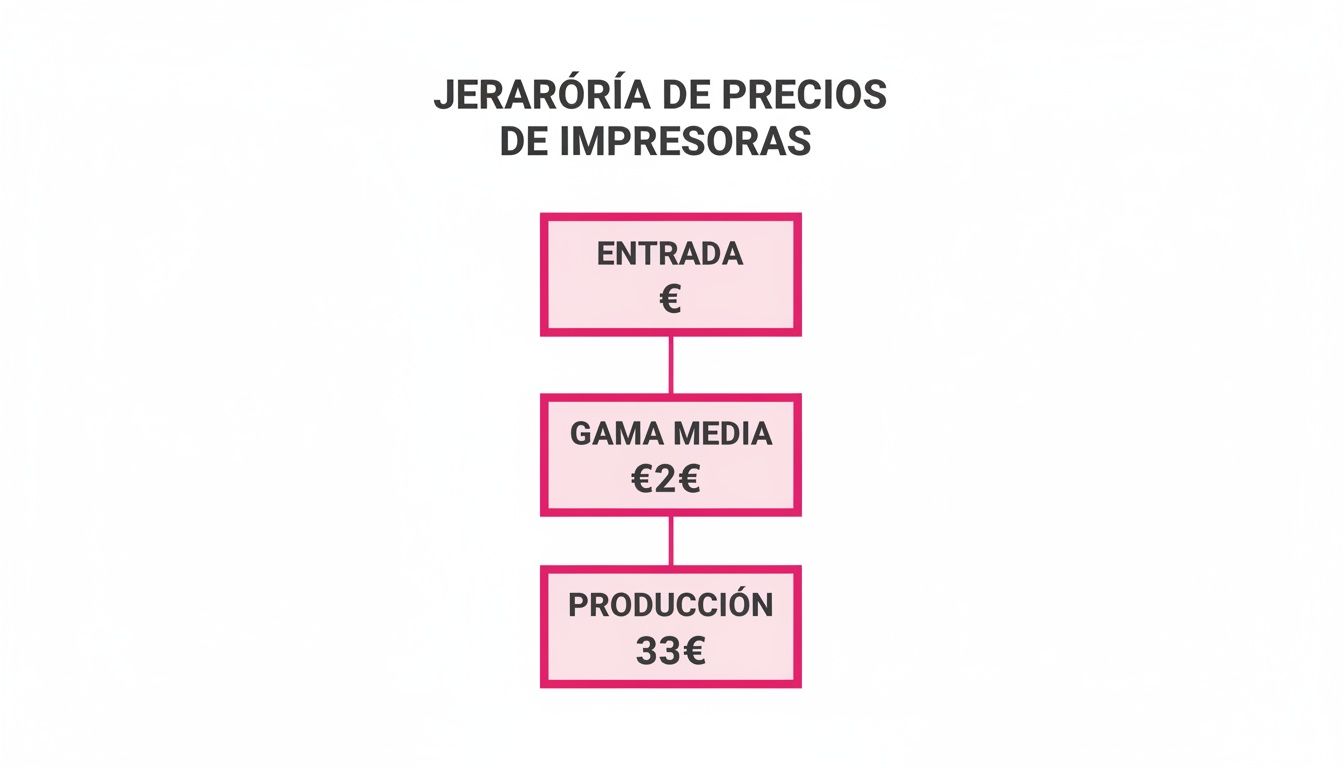
The initial investment goes hand in hand with production capacity and equipment features. Makes sense, right? 😉
Understanding these differences well is key to avoiding mistakes. If you want to take it a step further, we recommend taking a look at our article on how a dental 3D printer can transform your clinic. There we break down all its advantages.
The technical factors that define the cost of your 3D printer
Beyond the brand or segment, the price of a dental 3D printer is directly tied to its technological heart. ⚙️ Understanding these factors is like learning to read a car's spec sheet: it helps you know whether you're investing in a powerful, efficient engine or in extras that you don't actually need.
Don't be intimidated by all the technical data. We're going to break it down with simple examples so you can evaluate any 3D printer like a true expert and make an informed decision.
Resolution: how small is the detail? 🔍
Imagine that the resolution of a 3D printer is like the pixels on a 4K TV. The more pixels, the sharper and more detailed the image. In dental 3D printing, this is absolutely critical, as we work with margins and fits measured in microns.
Two key concepts come into play here:
- XY Resolution: Defines the smallest detail the 3D printer can create on the horizontal plane (width and length). It is measured in microns (µm) and depends on the pixel size of the LCD screen. A lower number means greater detail. For dental applications, an XY resolution below 50 µm is ideal for achieving precise models and splints that fit perfectly.
- Layer height (Z Resolution): This is the thickness of each individual layer that the 3D printer cures. Also measured in microns, a lower value (for example, 25 µm or 50 µm) produces much smoother surfaces with less "stepping," although printing will take a little longer.
Think of it this way: XY resolution is the quality of the drawing of each "slice" of your model, and layer height is how thin those slices are. Both are vital for the precision that dentistry demands.
Print volume: how much space do you need? 📏
Print volume is, plain and simple, the maximum size of the object you can print, defined by the width, length, and height of the work area. This directly affects your productivity and, of course, the price.
Printing a single temporary crown is not the same as needing a platform to produce ten study models at once. A 3D printer with a larger print area allows you to produce more pieces in a single batch, optimizing your time and resin usage. For example, a 3D printer with a 22 x 12 cm platform can handle several splints simultaneously, while a smaller one might limit you to one or two.
Light source type: the technology that cures the resin 💡
The "engine" of a resin 3D printer is its light source, which is what solidifies (or cures) the liquid resin layer by layer. The most common technologies in dentistry are:
- LCD (Liquid Crystal Display): Uses an LCD screen to mask UV light, curing an entire layer all at once. These are the most popular due to their incredible balance of cost, speed, and high resolution.
- DLP (Digital Light Processing): Projects the layer image using a micromirror chip. These are extremely fast and very precise, but tend to come at a higher price.
- SLA (Stereolithography): Uses a laser to draw each layer, point by point. It offers exceptional precision, but is the slowest and most costly technology, reserved for very specific applications.
For most clinics and laboratories, LCD technology offers the best return on investment.
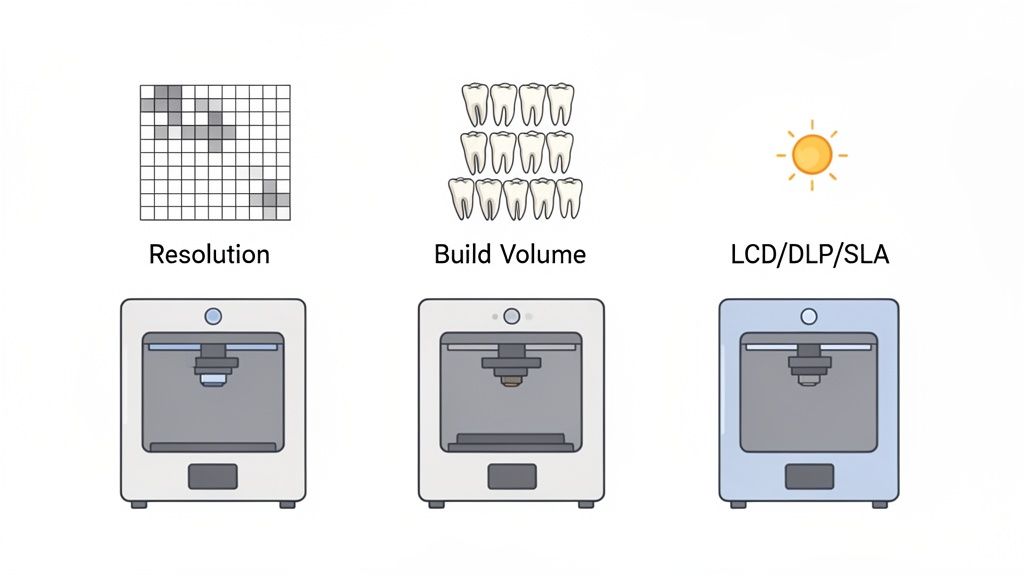
A clear example of this balance is the Elegoo Saturn 2 8K, one of the gems in our catalogue here at Mr Resin. This 3D printer combines an XY resolution of 28.5 microns (thanks to its 8K screen) with a generous print volume, all at a very competitive price. It is proof that you don't need to spend a fortune to achieve ultra-high-precision results.
If you're interested in finding out which materials you can use with these machines, take a look at our range of biocompatible 3D resins, perfect for dental applications.
Calculating the total cost beyond the initial purchase
Buying a dental 3D printer is an exciting step, but the initial investment is just the tip of the iceberg. To truly understand whether the move will be profitable for you, it's key to look beyond the price tag and calculate the total cost of ownership (TCO). 💸 But don't panic — it's not as complicated as it sounds.
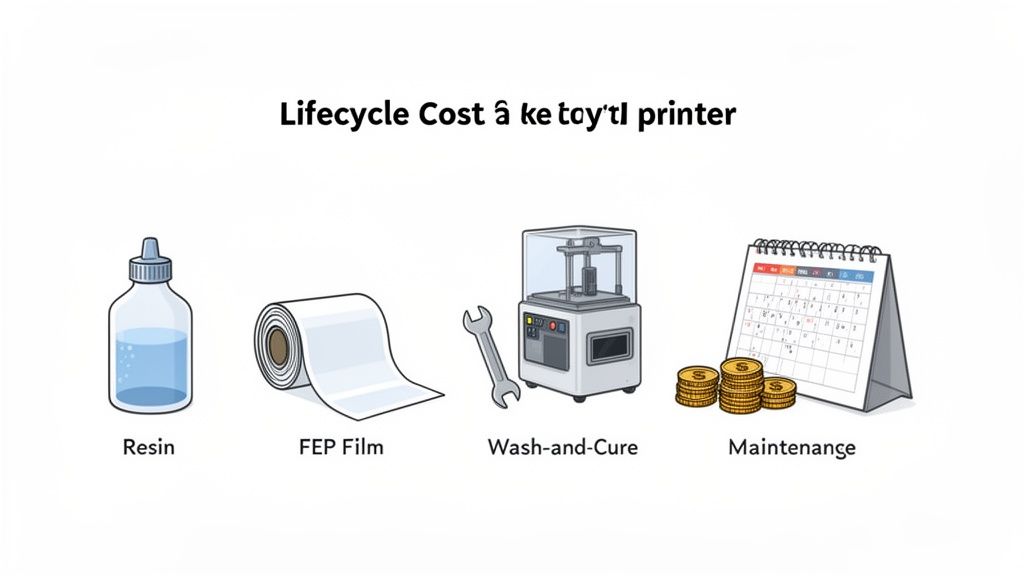
Thinking about the total cost is like buying a car: you don't just pay for the vehicle, but also for the fuel, insurance, and servicing. With a dental 3D printer it's exactly the same. There are a series of recurring expenses that ensure your machine runs at full capacity and delivers quality results day after day.
Consumables: the fuel of your production ⛽
The most common expense and, without doubt, the most significant, will be the resin. It is the raw material you will use to create your models, splints, and surgical guides. The type of resin you need depends directly on what you are going to use it for.
- Resins for models: Perfect for study and working models. They offer excellent precision at a more affordable cost.
- Biocompatible resins: They are a must for any piece that will be in contact with a patient, such as guides or occlusal splints. Logically, their price is higher due to the medical certifications they require.
- Castable resins: Used to create patterns for cast metal prostheses. Their magic lies in the fact that they burn away without leaving any residue.
Resin consumption can vary enormously. To get a clearer picture, you can take a look at our guide on how much you can print with 1 litre of resin. That is why having a reliable supplier like Mr Resin, which offers you a wide catalogue of resins at competitive prices, is essential to keeping operating costs under control.
Post-processing: the indispensable finishing touch ✨
Once the piece comes out of the printer, the work is not over. Post-processing is a critical step to ensure it has the correct mechanical properties and, where applicable, its biocompatibility. This means you will need a couple of additional pieces of equipment:
- Washing station: Uses isopropyl alcohol (IPA) or other solvents to clean the liquid resin that has not been cured and remains stuck to the piece.
- Curing station: Uses UV light to complete the hardening of the piece, giving it its final strength and stability.
Although they represent an initial investment, this equipment is a one-time purchase. In return, you optimise your workflow and ensure the final result is impeccable.
Maintenance and wear parts 🛠️
Like any precision machine, your dental 3D printer has components that wear down with use. To maintain print quality as good as on day one, you will need to replace them from time to time.
Do not underestimate preventive maintenance. A small, timely expense on a wear part can save you from a very costly breakdown and, what is worse, having the machine out of action in your clinic or laboratory.
The components you will most commonly need to replace are:
- FEP/ACF film: This is the transparent sheet found at the bottom of the resin tank. Over time it degrades and can negatively affect print quality. It typically lasts several months, depending on how heavily it is used.
- LCD screen: This is the heart of the printer, the component that projects the UV light. It has a limited lifespan (normally between 2,000 and 4,000 hours of printing) and its replacement is one of the most significant maintenance costs to take into account.
Example total cost of ownership calculation (1st Year) 🔢
To give you an idea of how all of this translates into figures, we have put together a table with estimated costs during the first year for a mid-range printer.
| Cost Concept | Estimated Cost (€) | Frequency | Notes |
|---|---|---|---|
| 3D Printer | 3,500 € | One-time | Initial equipment investment. |
| Washing/Curing Station | 500 € | One-time | Essential equipment for post-processing. |
| Dental Resin | 1,800 € | Monthly | Estimated for a consumption of 1.5L/month at €100/L. |
| Isopropyl Alcohol (IPA) | 240 € | Monthly | Estimated for parts washing (€20/month). |
| Replacement FEP Film | 120 € | Quarterly | Replacement every 3–4 months depending on use. |
| Replacement LCD Screen | 400 € | Annual | Planned replacement after approx. 2,000 hours of use. |
| First Year Total | 6,560 € | Estimated total cost of investment and operation. |
As you can see, this calculation gives you a much more realistic picture of the long-term dental 3D printer price. At Mr Resin we help you minimize these costs with quality consumables at fair prices and with our "Resinitos" loyalty points program, which rewards your loyalty. 💖
How to justify the investment and calculate your ROI
Let's get straight to the point. Turning a 3D printer purchase into a smart investment, rather than just an expense, is easier than you think. 📊 The key is to build a business case with numbers that prove the machine not only pays for itself, but actually makes you money.
Seeing the printer as an investment means looking beyond the price tag. It's about understanding how it will improve your workflows, cut what you pay to third parties, and give you the ability to offer faster and more precise services.
Quantifying the savings from stopping outsourcing 💰
The first step, and the most straightforward one, is to work out how much you save by stopping sending work out. Every time you send a model to a lab, you pay for the piece, of course, but also for the handling, the shipping and that lab's profit margin.
Think about what you outsource most often:
- Study models and orthodontics: These are the perfect candidates to start producing in-house.
- Surgical guides: They add tremendous value to your treatments and the cost of making them yourself is extremely low.
- Night guards and retainers: You control the entire process from start to finish and dramatically reduce delivery times.
By bringing this production into your clinic or lab, you take full control. This not only cuts direct costs, but also eliminates waiting times and the typical miscommunications with external suppliers. In short: greater efficiency.
Practical example calculating ROI 📈
Let's put some numbers to it so it's crystal clear. Imagine a dental clinic that outsources around 20 night guards per month.
Scenario without a 3D printer: If the external lab charges you an average of €45 per splint, your monthly spend rises to 20 x €45 = €900. Per year, you're looking at a cost of €900 x 12 = €10,800. 😱
Now, let's look at what happens if you decide to invest in a mid-range 3D printer, with a total cost (including post-processing equipment) of around €4,000.
Scenario with your own 3D printer: The cost of resin and other consumables to produce a splint in your clinic is around €8. Producing those same 20 splints would cost you 20 x €8 = €160 per month. The monthly saving is €900 - €160 = €740.
With a saving of €740 every month, you recoup the initial €4,000 investment in just over 5 months (€4,000 / €740 ≈ 5.4 months). From that point on, everything you save is pure profit!
The added value you can't see (but you'll definitely feel) 😉
Beyond the euros you save, having a 3D printer in your clinic opens up a world of possibilities. You increase your production capacity, allowing you to take on more cases or shorten waiting lists. That translates into happier patients and a reputation that goes through the roof.
It also gives you the freedom to innovate and offer services you never considered before, such as rapid prototypes or personalised solutions delivered the same day. This value is harder to put into a spreadsheet, but it directly impacts the growth of your business.
The dental sector in Spain has already taken notice. In fact, by 2026, 22% of dental clinics in Spain are expected to have plans to purchase a 3D printer. And in laboratories, the figure is even higher: 61% already use this technology, primarily for models and splints, with equipment ranging from €2,000 to over €10,000. This trend makes it clear: the ROI is real and achievable, recovering the investment within 6 to 12 months purely from savings on outsourcing. If you'd like to find out more, you can take a look at the digitalisation of the sector in this detailed analysis.
Tips for buying your dental 3D printer in Spain
When you decide to invest in a dental 3D printer, the choice goes far beyond comparing specs in a table. 🇪🇸🛒 The supplier you choose is just as important as the machine itself, especially if you want every euro you invest in the dental 3D printer price to go as far as possible.
This is where buying from a local specialist like Mr Resin makes a world of difference. Forget about customs surprises or delivery timelines stretching out for weeks. With our warehouse based in Spain, you're guaranteed fast shipping with no hidden costs that could blow your budget.
Why choose a local supplier like Mr Resin? 🤝
The key advantage, without a doubt, is support. When you have a technical question or a problem with a print, what you want is to speak to someone who understands your day-to-day, speaks your language, and gives you a quick solution. Our team of experts is there for exactly that: to guide you every step of the way and never leave you in the lurch.
On top of that, handling warranty claims becomes a straightforward, hassle-free process. You won't have to battle language barriers, extortionate international shipping costs, or impossible return policies like those you encounter on large global platforms. The peace of mind that comes with a close and efficient after-sales service is priceless.
Here you can browse our store, designed so you can find everything you need with the convenience and confidence of a local service.
A clear, specialized online store makes it easy to find not only printers, but also all the consumables and accessories you will need in your day-to-day laboratory work.
Professional performance at a price that makes sense ✅
At Mr Resin we have curated a catalog of printers that deliver professional performance without you having to mortgage the clinic. Brands like Elegoo or Anycubic have proven to be true workhorses, reliable and capable of producing parts with brutal precision, ideal for the demanding dental environment.
Choosing a good local supplier not only simplifies the purchase, but builds a relationship of trust. You get access to a community, training resources and the backing of a team that understands your daily challenges.
The Spanish dental sector is in the midst of a digital boom. This is not speculation: 60% of dental clinics in Spain are already incorporating digital technologies, such as 3D printers, to optimize their workflows. 3D printing in dentistry is growing at an annual rate of 35%, and brands like Anycubic, with models starting from 1,200 euros at Mr Resin, are perfect for dental technicians looking for millimetric precision without breaking the bank.
By holding stock right here in Spain, we can offer you resins, FEP films and everything you need at prices 20-30% lower than other international competitors. If you want to learn more about how the sector is evolving, take a look at this comprehensive report.
This is just the beginning
What a journey! We have broken down together everything behind the price of a dental 3D printer. Now it is clear that the price tag is just the tip of the iceberg and that real success lies in looking beyond it. 📈
Understanding what resolution, print volume and day-to-day costs mean gives you the power to choose wisely. Calculating the total cost of ownership is not a luxury — it is the definitive step to making your investment truly worthwhile, not just today, but in the long run.
Digital dentistry is no longer the future, it is the present that is transforming clinics and laboratories. And yes, it is completely within your reach. The efficiency, precision and control you gain are priceless.
The best investment is not the cheapest one, but the one that allows you to provide exceptional service to your patients while optimizing your time and resources. 3D printing is that tool.
Ready to make the leap into digital dentistry?
If you have made it this far, it is because you know the time has come to take your practice to the next level. We make it easy for you.
- Explore our catalog: Take a look at our selection of dental 3D printers and resins at the Mr Resin online store. We're sure you'll find the equipment you need to get started. 🛒
- Join the community: Don't miss out. Join our Telegram group here to grab discounts, deals and learn from a community of passionate 3D printing enthusiasts. 👨👩👧👦
- Subscribe and save: Want to be the first to know about everything and receive exclusive coupons? Sign up for our Newsletter! We'll keep you up to date with the latest news and events. 💌
Don't wait to hear it from someone else. It's time to shake up your workflow.
✨Happy Printing! 🚀
Frequently asked questions about dental 3D printers
We know that taking the leap into dental 3D printing raises a lot of questions. That's completely normal! That's why we've brought together the most common queries here to give you clear, straight-to-the-point answers, no beating around the bush. 🧐 We want you to have all the information about the price of a dental 3D printer and what it involves.
So, if you're wondering about materials, production times or the support you need, keep reading. We're going to clear up all your doubts so you can start this journey with complete confidence.
What materials can I use in a dental 3D printer?
This is where the magic begins. You have a wide range of specialised resins at your disposal, each designed for a specific job. The most common are resins for study models, biocompatible resins for surgical guides or splints, and castable resins for creating casting patterns. ✅
Each type has its own cost and properties, so you can choose exactly what you need for each patient.
How long does it take to print a dental piece?
It depends a lot on what you're printing, the quality you're looking for and the speed of your machine. To give you an idea, a simple surgical guide can be ready in anywhere from 30 minutes to 2 hours. ⏰
Now, if you fill the platform with several dental models to optimise production, the process could take several hours. The key is to plan your workflow well.
What maintenance does a dental 3D printer need?
Maintenance is your best ally for keeping your printer running for years. It's nothing complicated, but it is very important. Basically, it's about keeping the resin tank clean, calibrating the platform from time to time and replacing consumables when the time comes.
We're talking about the FEP/ACF film in the tank, which is replaced every few months, or the LCD screen, which has a lifespan of around 2,000 to 4,000 hours of use. With a little care, your equipment will always work like it did on day one. 🛠️
A friendly tip: Preventive maintenance not only extends the life of your printer. It's a direct investment in the quality and precision of your work. Don't underestimate it!
Is it very complicated to learn how to use it?
Not at all! Forget the idea that you need to be an engineer. Today's dental 3D printers are designed so that anyone can use them. They come with super intuitive software and processes that are becoming increasingly automated.
The learning curve is surprisingly quick. And if you buy from a provider like Mr Resin, you have the peace of mind of having Spanish-language technical support to help you resolve any questions that come up. 🎓
What precision can I expect from these printers?
The precision is simply spectacular, more than sufficient for the most demanding dental applications. The mid-range models you can find in our store, for example, typically have an XY resolution below 50 microns.
What does this mean in practice? A perfect fit for splints, surgical guides, temporary crowns, and working models.
Conclusion:
Congratulations on making it to the end! 🎉 You've covered all the key information about the price of a dental 3D printer. Now you know that the investment goes beyond the machine itself, including consumables, maintenance, and post-processing. You've learned how to calculate ROI and understand that the true value lies in the savings, efficiency, and control you gain in your clinic or laboratory.
Digital dentistry is a reality that allows you to offer a better service and optimize your resources. Now is the time to take the step!
We invite you to explore our store and discover everything that Mr Resin has to offer you. And don't forget the exclusive benefits for our community:
- 🛒 Visit our store: Find the perfect printer and resins for you at www.mrresin.es.
- 💬 Join us on Telegram: Access discounts, deals, and exclusive content in our group. We'd love to see you there! https://t.me/MrResin3D
- 💌 Subscribe to the Newsletter: Don't miss any news, coupons, or events. Sign up on our website!
✨Happy Printing! 🚀