

Meta Title: 🦷 Dental 3D Printer Price: Buying Guide for Your Clinic Meta Description: 💰 Discover the real price of a dental 3D printer. Complete guide with comparisons, hidden costs and tips for choosing the best option.
The price of a dental 3D printer covers quite a wide range, going from around €300 for entry-level models to over €20,000 for industrial-scale production systems. But rather than an expense, I can assure you it's a strategic investment that completely transforms the efficiency of any modern dental clinic or laboratory.
🤔 Is it really that expensive to bring 3D printing into your clinic?
Making the leap to digital dentistry can feel a little daunting given the investment it seems to require at first. Many colleagues, both in clinics and laboratories, wonder whether the price of a dental 3D printer is something they can actually afford. The short answer, and I say this from experience, is yes. And it's far more accessible than you might think. 😉
The trick is to shift your mindset: don't see it as a cost, but as an investment with a return that arrives much sooner than you'd expect.
3D printing technology is no longer the exclusive domain of large corporations — it has become a tool within reach of professionals like you and me. It allows us to manufacture parts with a level of precision and speed that, using traditional methods, was simply unthinkable. This not only raises the quality of the service we provide, but optimises workflows in a truly remarkable way.
The real transformation in day-to-day practice
Digital dentistry is no longer something of the future; it's everyday reality. With these machines in your own workspace, you can suddenly:
- Create study models with millimetre-level accuracy in a matter of hours.
- Manufacture personalised surgical guides that increase the safety and precision of implants.
- Produce occlusal splints or aligners directly in your practice or laboratory.
- Make the most of your materials, using the resin for your 3D printer that's perfect for each job and reducing waste to a minimum.
Having this in-house production capability frees you from dependence on external laboratories, shortens patient waiting times and, most importantly, gives you complete control over the quality of the final product. If you want to explore how this technology is changing the rules of the game, take a look at our essential guide to dental 3D printers for clinics and laboratories.
Keep this in mind: the initial cost of the printer is just one piece of the puzzle. The real value lies in the efficiency, control and profitability it will bring to your daily practice.
Throughout this guide, we're going to dismantle the myth that this is an out-of-reach technology. We'll analyse the price ranges, what factors influence them and, above all, how to calculate the real cost so you can make the best decision for your business. Get ready to make the digital leap! 🚀
📊 Dental 3D printer price comparison
To understand the price of a dental 3D printer, the most practical approach is to divide the market into categories. Not all laboratories or clinics have the same needs or the same budget, so let's group the options into three clear tiers so you know where your project fits.
Think of it like buying a vehicle: an urban car for getting around the city is not the same as a van for large-scale goods delivery. Each one serves its purpose and comes at a very different cost.
Entry level (up to €2,000)
This first tier includes the most affordable 3D printers. They are perfect for students, small labs getting started with digital workflows, or clinics looking to begin experimenting with simple applications. But don't let the price fool you — the quality these machines offer today is remarkable. ✨
- Common applications: Study models, orthodontic models, individual trays, and simple splints.
- Key features: These are generally MSLA 3D printers with high-resolution LCD screens (4K or 8K). Their build volume is smaller, but more than enough to take your first steps with confidence.
- Examples: Brands like Anycubic or Elegoo have democratized access with models that, while not designed exclusively for dentistry, offer excellent precision for many tasks. In fact, in Spain, the adoption of 3D printers in dental labs has already reached an impressive 61%. Resin models from Anycubic or Elegoo, which you can find at specialized stores like Mr Resin, range between €300 and €1,500 — an accessible investment that pays for itself very quickly by reducing production times by 40–50% compared to traditional methods. You can read more about this in this dental sector opportunity analysis by Katia Dental.
Professional level (€2,000 – €10,000)
This is where the "sweet spot" of the market lies — the most popular segment for dental clinics and mid-sized labs that need a reliable everyday tool. The price goes up because you're not just paying for the machine, but for greater reliability, speed, technical support, and — very importantly — certification for use with biocompatible resins. 💪
- Common applications: Everything from the previous level, plus surgical guides, temporary crowns and bridges, and models for removable prosthetics.
- Key features: At this level we see faster 3D printing speeds, larger build platforms, automatic calibration systems, and a much more robust software and materials ecosystem.
- Examples: Brands like Phrozen, Shining 3D, and Ackuretta are the leaders in this space, offering a near-perfect balance between cost and performance.
To give you a clearer picture, the following chart shows how these price ranges are distributed.
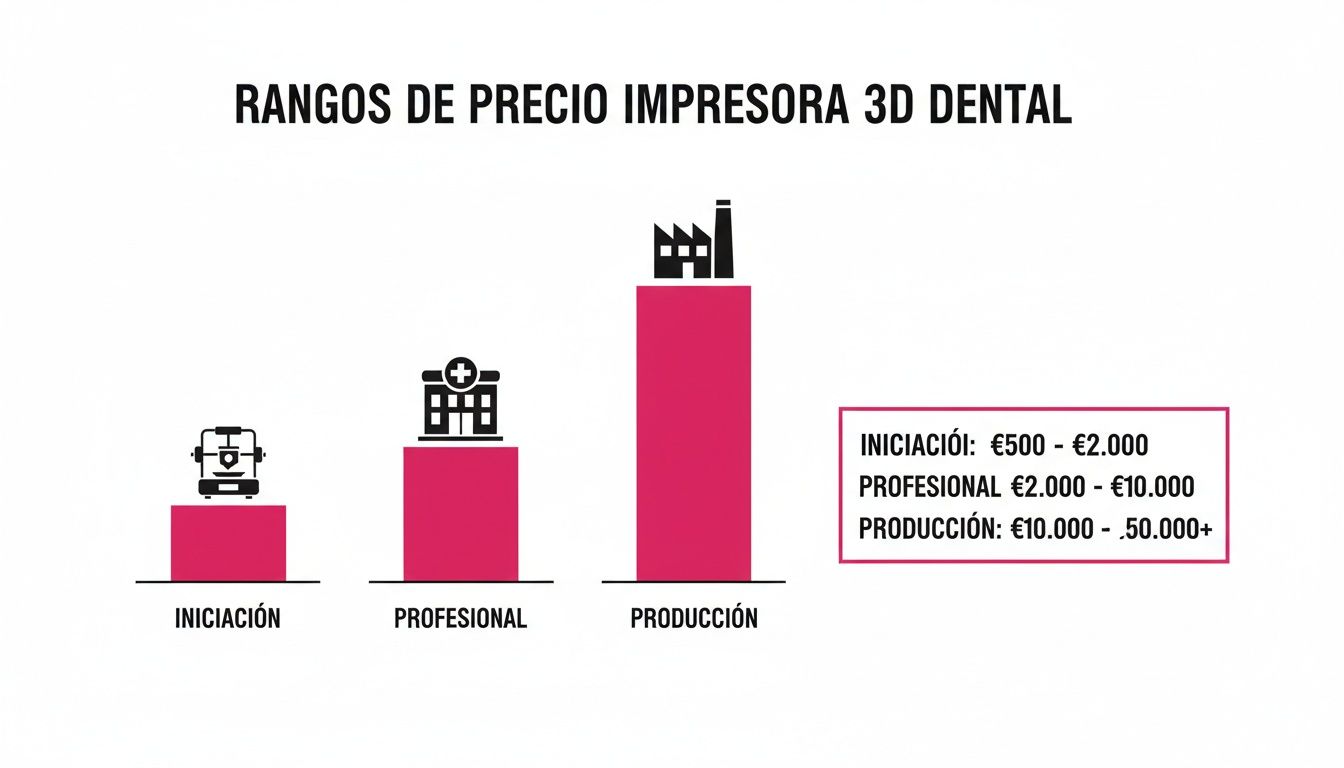
As you can see, the price jump between levels is significant, and directly reflects the increase in capacity, reliability, and production volume that each category offers.
Production Level (over €10,000)
We are now in the league of large dental laboratories and production centers that need to manufacture hundreds of parts per day. These 3D printers are true workhorses, designed to run 24/7 with minimal human intervention. 🏭
- Common applications: Mass production of clear aligners, high-precision models, surgical guides and large-scale prosthetics.
- Key features: Very high speed, enormous print volumes, process automation (such as resin management) and software to manage fleets of multiple 3D printers simultaneously.
- Examples: In this field, giants such as Carbon, 3D Systems and Stratasys operate, with advanced technologies like DLP or industrial SLA.
The key is not to buy the most expensive 3D printer, but the one that best fits your workload and the applications you truly need. Starting with an entry-level or professional model is a very smart strategy for most people.
Comparison table of dental 3D printers by level and price
To help you visualize the differences at a glance, we have prepared this summary table. It will serve as a quick cheat sheet so you know what to expect from each category. 📝
| Level | Approximate Price Range (€) | Ideal for | Typical Applications |
|---|---|---|---|
| Entry-level | €500 – €2,000 | Students, small laboratories, clinics just starting out | Study models, trays, simple splints |
| Professional | €2,000 – €10,000 | Mid-sized clinics and laboratories | Surgical guides, temporaries, high-precision models |
| Production | > €10,000 | Large laboratories and milling centers | Mass production of aligners, prosthetics and models |
Choosing the right level is the first and most important step to making a smart investment that truly drives your dental laboratory or clinic forward.
⚙️ What technical factors influence the price
Understanding why two 3D printers that look almost identical can have such different prices is essential to avoid overpaying. The price of a dental 3D printer is not chosen at random; it responds to a series of technical factors that directly affect the quality, precision and reliability of your daily work in the laboratory. Let's break them down so you know exactly what you are paying for.
Think of it like buying a car. You have the basic model that gets you from point A to point B without any issues, and then you have the high-end one with more power, better finishes and greater safety. Both transport you, but the experience and, above all, the reliability, are not even comparable. With dental 3D printers, something very similar happens.
XY resolution and layer height: precision is in the details
The XY resolution is one of the most important pieces of data. Think of it as the sharpness of your mobile phone screen: the more pixels in the same space, the clearer and more defined the image. In a 3D printer, the XY resolution is the minimum size of the light point, called a voxel, that solidifies the resin.
- A lower XY resolution (e.g., 50 microns) may be sufficient for large study models, but could fall short when it comes to accurately reproducing preparation margins.
- A high XY resolution (20 to 30 microns) is crucial for work that demands maximum precision, such as crown dies, implant fits, or complex surgical guides.
The layer height, on the other hand, is the thickness of each "slice" the printer creates. Lowering the layer height (to 25 microns, for example) produces incredibly smooth and detailed parts, but printing takes longer. Increasing it (to 100 microns) speeds up the process, but the "layer lines" will be more visible. More expensive printers tend to be more reliable and consistent when working with ultra-thin layers, which is vital for final quality.
Print volume and speed: size and pace matter
The print volume is, literally, the size of the work area. It is the usable space (width, depth, and height) you have to manufacture your parts.
A printer with a small volume may be perfect if you only need a surgical guide occasionally. But if your lab needs to produce 10 orthodontic models at once, you will need a much larger print platform. The larger the volume, the higher the price, logically.
The print speed, measured in millimeters per hour (mm/h), defines how long it takes to have the part in your hands. This is where the most advanced printers make a difference. They use more powerful light sources or more efficient layer-release mechanisms to print at full speed without losing quality — something indispensable in a production environment where every minute counts. If you want to dive deeper into the technologies used by printers and how they impact speed, take a look at our guide on resin 3D printers.
Light technology: the engine of the printer (SLA, DLP, or MSLA)
The heart of a resin printer is its light source. This is where some of the biggest price differences between models lie:
- SLA (Stereolithography): This is the original technology. It uses a laser that "draws" each layer point by point. It offers outstanding precision, but tends to be slower and more expensive. You will find it in very high-end equipment.
- DLP (Digital Light Processing): It uses a projector, like the one in a cinema, to solidify the entire layer in a single flash. It is much faster than SLA and maintains great precision. It is typical of professional-grade printers.
- MSLA (Masked Stereolithography): This is the most popular today. It uses an LCD screen that acts as a mask over an LED array. It offers a spectacular price-to-quality ratio and can be found in both entry-level and professional machines. The more affordable ones use 2K screens, while top-end models feature 8K, 12K, or even 16K screens to achieve impressive XY resolution.
Build quality and reliability: what you can't see at a glance
Finally, there is a factor that is often overlooked: material quality. A printer with a machined metal chassis, sturdy linear rails, and a long-lasting monochrome LCD screen will be far more reliable and durable than a model built with plastics and more budget components.
Prestigious brands invest heavily in build quality and, above all, offer solid technical support. This is something that is priceless when your daily production depends on the machine working without giving you a single problem.
💸 The real cost beyond the initial purchase
This is where many people get it wrong: the price of a dental 3D printer is just the tip of the iceberg. To know what the real investment will be, you need to think about the Total Cost of Ownership (TCO), which is the sum of all the expenses you will have after taking the printer out of the box. 📦
It's like when you buy a car. The price you pay at the dealership is just the beginning. Then comes the fuel (the resin), the insurance, the oil change (maintenance), the tyres (consumables)... If you only look at the purchase price, you're in for a surprise.
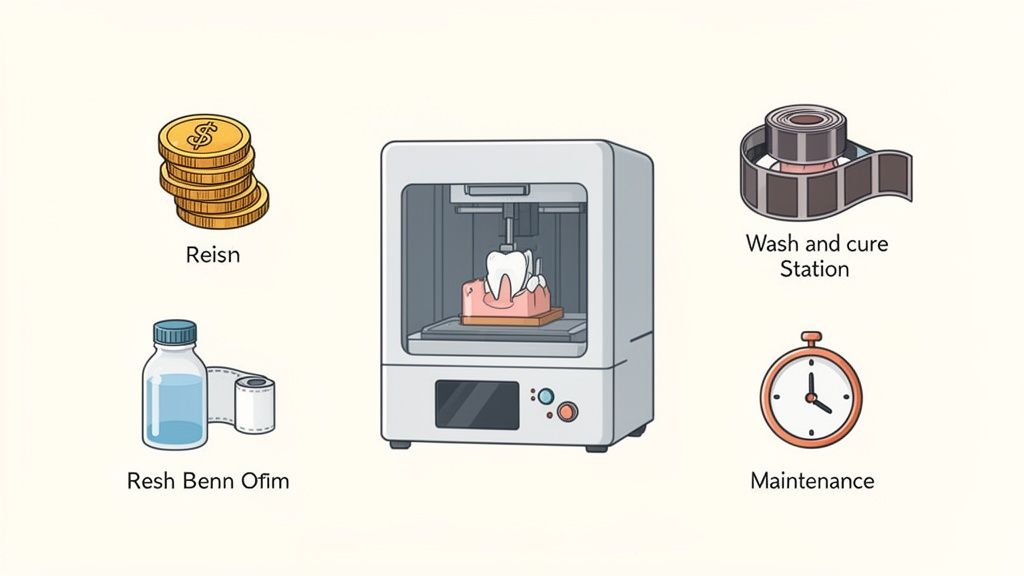
In the world of dental 3D printing, those "hidden costs" are the ones that will truly define whether your investment is profitable. Ignoring them is the fastest way to derail your budget. At Mr Resin, we want to be transparent so you know what you're up against from minute one.
TCO breakdown in dental 3D printing
Let's get down to business and analyse point by point what those recurring expenses are that you need to keep on your radar.
1. Dental resin: the fuel of your production
Resin will be your most constant expense. Every model, every guide, and every splint you print will consume material. The cost per litre varies enormously depending on the type and brand, from more affordable options for study models to certified biocompatible resins that, logically, come at a higher price.
It is essential that you choose your resin for your 3D printer wisely to find a balance between quality and cost. You won't always need the most expensive resin; for working models, a standard high-definition resin is usually more than enough, and this way you reserve the biocompatible ones for applications that truly require them, such as intraoral ones.
2. Consumables: the wear and tear machinery
Your printer has parts that, by their nature, wear out with use and need to be replaced from time to time. They are not expensive components individually, but if you print a lot, they add up.
- LCD/DLP Screen: This is the heart of MSLA and DLP 3D printers. They have a limited lifespan measured in hours of use. Modern monochrome screens last thousands of hours, but replacing them can cost several hundred euros in professional models.
- FEP/ACF/nFEP Film: This is the transparent film that sits at the bottom of the resin tank (the vat). Over time, it degrades, gets scratched, or can be punctured. Replacing it in time is vital to prevent resin leaks that could destroy your screen.
- Activated Carbon Filters: Many 3D printers include these to reduce resin odour. These filters also become saturated and require periodic replacement.
Optimism prevails in the Spanish dental sector, with 39% of clinics expecting higher revenues towards 2026 thanks, in large part, to digitalisation. Although maintenance costs, which can amount to up to 20% annually of the printer price, are a constraint, they are mitigated by affordable resins and support from local stores. The adoption of these technologies is key, as it can reduce material waste by up to 50% compared to traditional subtractive methods. You can explore more about the dental sector outlook in this analysis by Katia Dental on clinics in Spain.
3. Post-processing: the professional finish
A freshly printed piece is not ready to use. It needs to go through a washing and curing process that also has its own associated costs.
- Wash & Cure Station: Although you could do it by hand, a dedicated station simplifies your workflow, improves safety, and ensures consistent results. It is an investment we consider almost essential.
- Isopropyl Alcohol (IPA): This is the most common liquid for washing pieces and removing uncured resin. Consumption can be high, especially if your print volume is large. A great alternative is to use water-washable resin, which saves you this cost.
- Gloves and PPE: Safety comes first. Whenever you handle liquid resin, wear nitrile gloves and eye protection. It is a small but constant and non-negotiable expense.
Creating a realistic budget
When evaluating the price of a dental 3D printer, do not stop at the big number on the price tag. Make an estimate of your monthly operating costs. Ask yourself: how many models am I going to print per month?, what type of resin do I need?, how often will I need to replace the FEP?
Having that complete TCO overview will allow you to calculate the real cost per piece and, in turn, set your prices correctly. It will help you understand when you will recoup your investment and, most importantly, avoid unpleasant surprises in the future. Good guidance here makes all the difference.
##🧪 The importance of resins and compatibility
Think of it this way: resin is the true fuel of your 3D printer. You can have the most cutting-edge machine on the market, but if the material does not measure up, the quality of your work will suffer. That is why, when we analyse the price of a dental 3D printer, compatibility with resins is just as decisive a factor as the technology itself.

This is where two philosophies clash: closed ecosystems versus open ones. Closed systems "lock you in" to using exclusively their own brand's resins, which, not coincidentally, tend to be considerably more expensive. On the other hand, open ecosystem 3D printers, like the popular Anycubic or Elegoo, give you complete freedom to choose.
And that freedom not only translates into direct savings on every litre of resin, but it opens the door to experimenting with a world of materials. You can try and find the perfect formulation that fits like a glove for each application and, of course, for your budget. It's a massive advantage!
Types of dental resin and when to use each one
In the dental sector, there is no "one-size-fits-all" resin. At Mr Resin we know this well — every job has very specific requirements. That's why we offer a complete range compatible with the leading open ecosystem 3D printers.
- For study models and orthodontics: Here you need a high-definition resin capable of capturing even the finest detail with millimetric precision. The result must be a smooth, hard surface, which is the foundation for any reliable diagnosis and treatment planning.
- For surgical guides and splints: Mechanical resistance is what matters most. An ABS-like resin is the ideal choice, as it combines great hardness with just the right degree of flexibility so it won't break during clinical use.
- For streamlining post-processing: If you want to speed up your workflow, water-washable resin is a fantastic option. You can forget about isopropyl alcohol, making cleaning safer, more cost-effective and, above all, much faster.
A figure that speaks for itself: already 60% of dental clinics in Spain have integrated digital technology. In this environment, materials like water-washable resin, available from around 30 euros per litre, are making a before-and-after difference, reducing costs and working time by up to 30%. If you'd like to find out more, you can consult this report on dental digitalisation.
Tips for choosing and validating your resin
Getting the resin right is a key step that will save you a lot of headaches, time and money. The first and most important thing: make sure the 3D printer you choose is open ecosystem. Then, always check the recommended print settings for the resin you are going to use.
Brands like Anycubic and Elegoo, for example, are known for working brilliantly with a wide variety of third-party resins, such as those we offer at Mr Resin. A good tip is to start with a standard resin to calibrate the machine and, once you have it dialled in, begin testing more specific materials depending on what you need to produce. If you want to go deeper, don't miss our complete dental resin guide.
Conclusion:
We've already seen that the price of a dental 3D printer is not a barrier, but a gateway to efficiency. Remember that there are options for every budget, that the real cost goes beyond the initial purchase, and that choosing an open ecosystem printer gives you enormous freedom. 😉
With the right information, you are more than ready to make a smart decision that will drive your clinic or laboratory forward.
Ready to take the leap? Stop by our store and take a look at all the resins for 3D printers we carry. You're sure to find the perfect one for you!
And if you want to always stay up to date, don't miss our Telegram channel. Join the community through this link: https://t.me/MrResin3D. Discounts, coupons, news, and exclusive events are waiting for you there. Don't miss it!
Also, don't forget to subscribe to our Newsletter to receive the best offers directly in your email. 💌
✨Happy Printing! 🚀
🤔 Frequently asked questions about dental 3D printer prices
It's normal to have a thousand questions before investing in a new technology. It happens to all of us! That's why we're leaving you here with answers to the most common questions about dental 3D printer prices, so you can decide with all the information at hand and without fear of making a mistake.
Can I use a low-cost 3D printer for dental applications?
Absolutely! The short answer is yes. Entry-level printers, like many models from Anycubic or Elegoo, have a resolution and precision that will surprise you. They are a fantastic gateway to start producing study models, orthodontic models, or individual trays.
They let you dive headfirst into a digital workflow without a large initial outlay. That said, you do need to be aware of their limitations: they are not designed for applications that require biocompatible resins with certification, such as surgical guides or temporaries. For everything else, they are perfect for taking your first steps.
How long does it take to recoup the investment?
This is the million-dollar question, and the answer is: it depends on how much you use it, but it's usually much faster than you'd expect. Once you start producing your own pieces, you eliminate shipping costs and the waiting times from external laboratories. The cost per model or splint is reduced to what you spend on resin, and the savings are noticeable from day one.
To give you an idea, a clinic or small laboratory that prints around 10–15 models per week can recoup a professional-grade printer (between €2,000 and €5,000) in less than a year. If we're talking about an entry-level unit, the return on investment can come in a matter of months.
Do I need to be an expert to start printing?
Not at all. Forget the idea that this is only for engineers. Today's 3D printers, especially entry-level and professional ones, are increasingly "plug and play." They come with super intuitive software (slicers) and many features that make your life easier, such as automatic platform leveling.
On top of that, the online community is huge. There are thousands of tutorials on YouTube and forums where you can ask anything. With a bit of curiosity and a desire to tinker, within a couple of afternoons you'll be producing pieces with a quality you wouldn't have imagined. It's much more accessible than it seems!
What type of resin is best for dental models?
The key here is to think: what am I going to use this model for? A model to show a case to a patient is not the same as a guide that needs to be resistant.
- For study or diagnostic models where you're looking for maximum detail, a high-definition resin is perfect for its precision and great price.
- If you need the piece to withstand heavy use, such as guides or splints, ABS-like resin is your best ally for its resistance.
- And if you want to simplify post-processing and forget about alcohol, water-washable resin will save you time and money.