

Think about it for a moment: what if you could manufacture a custom dental splint, a surgical guide with millimetric precision, or a study model in just a few hours — all without leaving your clinic or laboratory? 😮 That's no longer science fiction. It's dental 3D printing, the technology that's leaving old plaster molds behind to build three-dimensional objects layer by layer from a simple digital design.
The new standard in digital dentistry
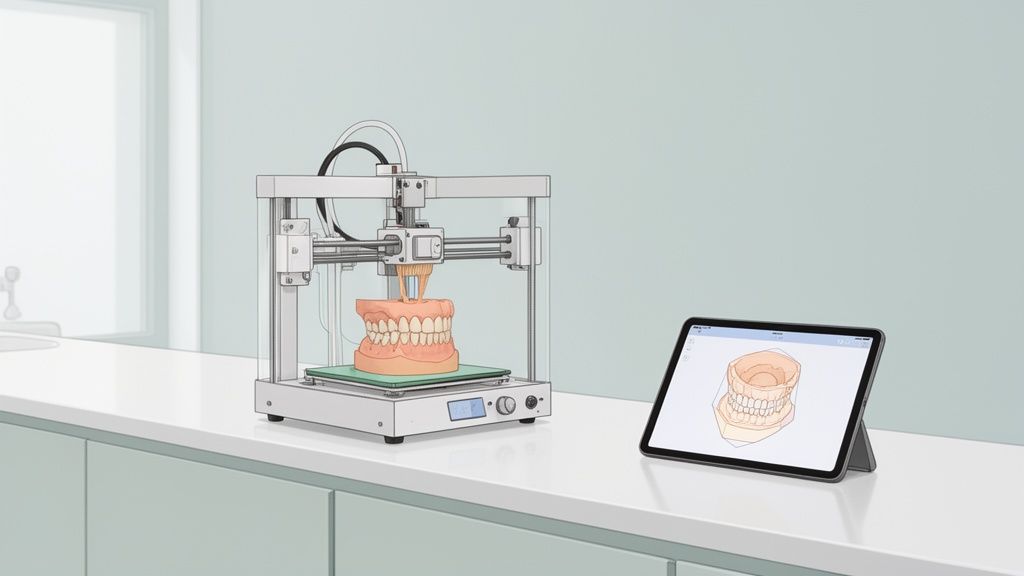
Dental 3D printing, or additive manufacturing if we're being technical, is the process of bringing physical objects to life from a digital file. Think of it like building something with microscopic LEGO pieces: a printer, guided by a computer, deposits material with a level of accuracy that would be impossible to achieve by hand. 🤖
This technological leap is completely changing the rules of the game in the dental sector. Where it once took weeks to wait for a prosthesis or a splint, turnaround times are now reduced to hours. This not only streamlines workflow like never before, but the patient experience improves dramatically.
Beyond speed: precision and personalization
But the real magic of dental 3D printing isn't just in its speed — it's in its ability to create fully customized pieces with micrometric accuracy.
Everything, from an aligner to a provisional crown, starts from an intraoral scan of the patient. The result? A perfect fit that virtually eliminates the need for manual adjustments and those annoying follow-up visits. ✅
This precision has a direct impact on treatment quality. For example, 3D printed surgical guides allow implants to be placed with millimetric reliability, reducing the risk of the procedure and time in the chair.
Additive manufacturing allows us to create complex geometries and personalized internal structures that were previously impossible or extremely expensive to produce using traditional methods such as milling.
This shift in mindset doesn't only benefit laboratories. It also empowers clinics to bring production in-house, gaining absolute control over quality and delivery times. ⏰ Digitalizing the workflow is a competitive advantage from start to finish:
- Through-the-roof efficiency: ☁️ Processes that were previously manual, slow, and error-prone are now automated.
- Cost reduction: 💰 In the long run, the savings on materials, shipping, and labor are more than significant.
- A patient experience worth falling in love with: 🥰 Offering same-day or 24-hour solutions is a differentiating factor that dramatically boosts satisfaction and loyalty.
- Total flexibility: ✨ The ability to test designs and make adjustments on the fly with no extra costs is, quite simply, a game-changer.
In short, dental 3D printing is not just another tool. It's the engine driving a more precise, agile, and above all, patient-centered dentistry. The question is no longer whether you should adopt this technology, but when you're going to start integrating it to take your practice to the next level. 🚀
Practical applications that transform every dental treatment
Dental 3D printing is no longer a thing of the future. It is a well-established reality in clinics and laboratories that is changing the rules of the game. Its true power lies not in the machine itself, but in how it transforms everyday treatments, delivering precision, speed and personalisation that were, quite simply, impossible to achieve before. 🦷✨
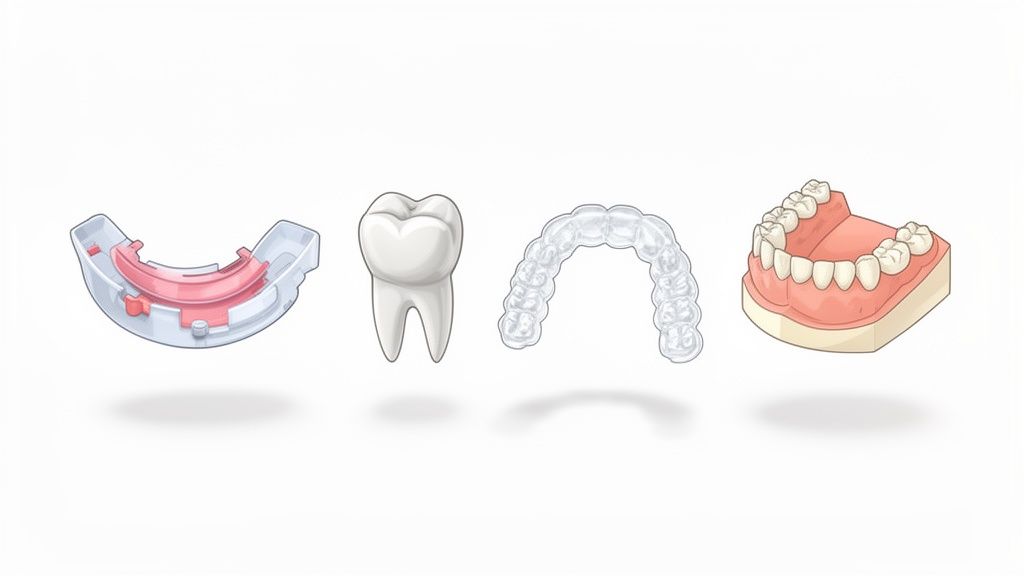
The impact is so evident that it has become a go-to tool for the majority of modern dental laboratories in Spain. In fact, the dental 3D printing market in the country is growing at a rate that exceeds 20% per year, a figure that speaks for itself when it comes to adoption. Producing splints, temporaries, aligners and dental models is now part of everyday practice, all thanks to the enormous advantages this technology offers. If you want to explore further, you can take a look at the sector trends in this comprehensive report.
Surgical guides with surgeon-level precision
One of the most remarkable applications is, without doubt, the fabrication of custom surgical guides. Starting from a 3D scan and a computed tomography (CBCT) of the patient, a guide is designed that fits like a glove over their anatomy. This piece is what directs the surgeon's drill with millimetre-level accuracy when placing implants.
What do we gain from this? The elimination of almost all surprises in the operating room. 😷 The benefits are crystal clear:
- Faster and less invasive surgeries, which translates into a far more comfortable recovery for the patient.
- The risk is drastically reduced of touching delicate structures such as nerves or maxillary sinuses.
- Implant placement is perfect, ensuring that the final prosthesis delivers an optimal long-term result.
3D printers such as the Anycubic Photon Mono M5s make it possible to create these guides with remarkable resolution.
Temporary crowns and bridges in the same visit
Picture this: a patient arrives at the clinic needing a crown. The traditional method involved taking alginate impressions, placing a generic temporary that did not always fit well and waiting weeks for the laboratory to send the final piece. Well, dental 3D printing has blown that process apart. ⚡
It is now possible to scan the patient's mouth, design and print a temporary crown or bridge within a matter of hours. Often, within the same appointment. These temporaries not only fit perfectly, but also offer excellent aesthetics and functionality. The patient leaves the clinic with a complete smile and sky-high confidence, without having to endure uncomfortable waiting periods.
This ability to deliver an immediate response not only boosts patient satisfaction, but also optimises the clinic's workflow, freeing up time and resources that are worth their weight in gold.
Orthodontics and splints: the new era of custom-made
If there is one field that has come out on top, it is orthodontics. The production of clear aligners, for example, relies almost entirely on 3D printing. Sequential models of the patient's dentition are printed, and the aligners that will move the teeth to their ideal position are thermoformed over them.
But the story doesn't end there. The fabrication of other devices has become incredibly efficient:
- Occlusal splints (Michigan type): Splints to treat bruxism can be created with a perfect fit, improving patient comfort from day one.
- Study models and orthodontics: They allow for exact replicas of the patient's mouth to be obtained for planning complex treatments with perfect visualization.
- Custom impression trays: They increase precision when taking final impressions, as they fit like a glove to each person's mouth.
Each of these applications demonstrates that dental 3D printing is not just a minor improvement. It is a tool that allows us to offer more precise, more efficient, and above all, far more human and personalized dentistry.
Understanding SLA, DLP and LCD printing technologies
Not all 3D printers are created equal, and in the highly demanding world of dental 3D printing, the differences are critical. To achieve the millimeter-level precision required by splints, surgical guides, or dental models, we are going to focus on the technologies that work with liquid resin. Forget about typical plastic filament printers (FDM) — here we play in a different league.
In digital dentistry, there are three undisputed queens: SLA, DLP and LCD. 👑
Although the end result is the same — a solid piece created layer by layer — the way each one solidifies the resin is completely different. Understanding how each one works is the key to choosing the equipment that truly fits the needs and budget of your clinic or laboratory. Let's break them down with simple analogies so there are no doubts left.
SLA: the laser precision drafter
SLA (Stereolithography) technology was the pioneer, the one that started it all. Imagine an incredibly precise laser pointer ✒️ that draws the outline of each layer of your piece on the surface of the resin. Wherever the laser passes, the resin hardens. Simple and effective.
This method, point by point, gives it exceptional precision, ideal for those ultra-fine details that make all the difference. The downside? Its speed depends directly on how complex the layer is. The more lines the laser has to "draw," the longer it will take.
DLP: the full-layer projector
DLP (Digital Light Processing) technology gave the process a new twist. Instead of a laser that draws, it uses a digital projector, very similar to the one you would find in a movie theater. 🎬 This projector emits the complete image of a layer all at once, solidifying the entire surface at the same time.
This translates into a consistent printing speed, regardless of how many pieces you are printing at once. It doesn't matter whether you place one model or ten on the platform; the time per layer will be the same. This efficiency has made it the preferred option for production.
LCD: the power of pixels
LCD technology (also known as MSLA or Masked Shadow) is the most recent and the one that has brought high-resolution 3D printing within everyone's reach. It works in a very similar way to your mobile phone screen. 📱 An LCD screen acts as a mask, allowing UV light to pass through only the pixels that form the layer being printed.
This technology combines great speed (very similar to DLP, as it cures entire layers) with a much lower equipment cost. The resolution of the final part depends directly on the pixel density of that LCD screen. Due to these advantages, printers like the Anycubic Photon Mono M5s have become a fantastic option for laboratories and clinics looking for the perfect balance between quality, speed, and cost.
If you want to dig a little deeper, you can read about SLA printing and its variants on our blog.
Choosing between SLA, DLP, or LCD is not a matter of "better or worse," but of finding the right tool for the job you are going to do. The key is to assess what matters most to you: maximum possible precision, production speed, or the initial cost of the equipment?
To help you see the differences at a glance, we have prepared a comparison table.
Comparison of Dental 3D Printing Technologies (Resin)
This table summarizes the main differences between SLA, DLP, and LCD technologies to help professionals choose the most suitable one for their laboratory or clinic.
| Feature | SLA (Stereolithography) | DLP (Digital Light Processing) | LCD (Shadow Mask) |
|---|---|---|---|
| Light Source | A single laser point | Digital projector (full image) | UV LED array with LCD screen |
| Speed | 🐢 Slower (depends on complexity) | 🚀 Fast (constant per layer) | ⚡ Very fast (constant per layer) |
| Precision | ✅ Very high and uniform | ✅ High, may vary at the edges | ✅ Very high, defined by pixels |
| Equipment Cost | 💰💰💰 Generally higher | 💰💰 Intermediate to high cost | 💰 The most affordable |
| Ideal for... | Prototypes with very fine details | Mass production and speed | Clinics and laboratories on a tight budget |
As you can see, each technology has its strong point. The final choice will depend on whether you prioritize extreme detail (SLA), high-volume production (DLP), or an unbeatable balance between cost and performance (LCD).
The fundamental role of specialized dental resins
A 3D printer, no matter how good it is, is only half of the puzzle. The true star in dental 3D printing is the material: the resin. In a field like dentistry, where patient safety, functionality, and aesthetics are non-negotiable, choosing the right resin is, simply put, crucial. 🧪
Think of it this way: resins are like the ingredients in a haute cuisine recipe. Each one has unique properties and is formulated for a very specific purpose. Using the wrong resin is like trying to make a dessert with salt instead of sugar; the result, at best, will be useless and, at worst, can be dangerous.
That is why we are going to dive into the fascinating world of dental resins. Not all of them are the same, and understanding what sets them apart is the key to achieving results that meet the most demanding clinical standards.
Biocompatible resins: the highest level of patient safety
When a printed part will be in contact with the patient, even for a short time, biocompatibility is rule number one. These resins are designed not to cause irritation, allergies, or any other adverse reaction in the body. According to health regulations, they are divided into two main classes:
- Class I: 🛡️ Designed for temporary contact. They are the perfect material for manufacturing surgical guides, custom impression trays, or certain splints.
- Class IIa: ❤️ Suitable for longer-term contact. They are used to manufacture temporary crowns and bridges or occlusal splints that the patient will wear for months.
The eSun Dental Cast Biocompatible Resin is a perfect example of a certified material for safe applications.
But being safe is not enough. These resins must also be incredibly strong and stable, capable of withstanding the forces of chewing without breaking and without degrading in saliva. If you are looking for materials with these guarantees, you can browse our full range of biocompatible 3D resins to find the ideal option for your clinic.
Materials for every specific need
Beyond biocompatibility, the catalog of dental resins is remarkably diverse. Each clinical application demands very specific mechanical and aesthetic properties, which has driven the development of highly specialized materials.
Resins for high-precision models
These are the cornerstone of digital dentistry. They are used to print exact replicas of the patient's mouth. Their key strength is dimensional stability and an ultra-smooth surface that guarantees a perfect fit for prosthetics. They usually have an opaque color, similar to plaster, which helps visualize every detail.
Resins for temporary restorations
These resins are a true marvel of engineering. They must be hard enough to withstand chewing for weeks or months (high fracture resistance) while also offering impeccable aesthetics, with a color and translucency that mimic the natural tooth. 🦷
Castable materials
They are used in the "lost-wax casting" process to manufacture metal frameworks, such as the skeletons of removable partial dentures or copings for crowns. The magic of these resins is that they burn away completely in the furnace without leaving a trace of ash, ensuring a clean and precise metal casting. 🔥
Flexible resins for artificial gums
When planning complex implant cases, models are often printed that include a replica of the gum tissue. These flexible resins mimic the texture and color of gingival tissue, allowing the professional to test the fit of the prosthesis on a far more realistic model.
Choosing the right material is not a minor detail; it is the pillar that upholds the quality, safety, and durability of any work carried out with dental 3D printing. Investing in the right resin is investing directly in patient satisfaction and in the reputation of the clinic.
As you can see, the universe of resins is as vast as dental applications themselves. From a simple study model to a temporary crown, there is always a material designed to deliver the best performance. At Mr. Resin, we are proud to be your trusted store, offering you not only the materials, but the knowledge to always make the right choice.
The digital workflow in dentistry, step by step
If you're thinking about integrating dental 3D printing into your clinic or laboratory, you'll be glad to know that the process is far more intuitive than it seems. The key is to follow a well-defined workflow that transforms a simple scan of a patient's mouth into a physical piece with millimeter precision. This isn't just a to-do list — it's your roadmap to achieving predictable, extremely high-quality results. 🗺️
This method is the reason why adoption of the technology has skyrocketed. To give you an idea, the dental 3D printing market in Spain was valued at $3.1 million in 2022 and is projected to grow at an annual rate of 20.1% through 2030. Forecasts suggest it will reach $13.42 million, proving that this is no passing trend, but a solid investment with a bright future. You can find more details about the growth of the dental 3D market in Spain.
Let's break this process down into five stages so you can master it from start to finish.
1. Intraoral scanning: the digital starting point
Everything begins here. Say goodbye forever to the uncomfortable and often imprecise alginate impressions. With an intraoral scanner — a small device passed around the patient's mouth — you can capture a full-color, three-dimensional digital image in minutes. 😮
The result is a digital file, typically in STL (Standard Tessellation Language) format, which is an exact replica of the patient's anatomy. It's the foundation on which everything else is built, ensuring the final piece fits perfectly from the very first attempt.
2. CAD design: where the magic takes shape
With the scan in hand, we move on to the brain of the operation: computer-aided design (CAD) software. Specialized tools such as exocad or 3Shape Dental System are what allow dental technicians to take that digital file and turn it into a 3D model ready for fabrication.
At this stage, the surgical guide is designed, the occlusal splint is modeled, or the provisional crown is planned. The software offers complete customization, allowing every detail to be adjusted with micrometric precision that would be unthinkable to achieve by hand. ✍️
3. Preparation and printing: the materialization
Once the design is approved, the file is exported to slicing software — also known as a slicer — such as ChiTuBox or Lychee Slicer. This program acts as the translator between your 3D model and the printer. Its job is to:
- Orient the piece to optimize print time and surface quality.
- Add supports to prevent the piece from warping or detaching during fabrication.
- "Slice" the model into hundreds or thousands of ultra-thin layers that the printer will build one by one.
When everything is ready, the file is sent to the printer, which begins materializing the design, layer by layer. If you'd like to dive deeper into this, we recommend our complete guide on how to 3D print with resin.
4. Post-processing: the final finishing touch
When the printer finishes, the piece is still not ready to use. It is still coated with a thin layer of uncured liquid resin that must be removed completely. This washing is carried out using isopropyl alcohol (IPA) or specific cleaners designed for this purpose.
To make this step quick and efficient, there are washing and curing machines like the Anycubic Wash & Cure 3.0. These devices automate the cleaning process and guarantee a perfect, safe finish with no effort at all. 🧼
5. UV Curing: the step toward maximum strength
The final step is UV curing. The already clean part is placed inside a curing chamber that bombards it with ultraviolet light. This light bath completes the polymerization of the resin, giving the part its final mechanical properties, such as hardness and strength.
This final curing is absolutely critical. Not only does it harden the part, but it is an indispensable step to ensure its biocompatibility, especially in applications that will be in direct contact with the patient.
By following these five steps, any clinic or laboratory can successfully integrate dental 3D printing and open the door to a whole new world of precision, speed, and efficiency.
The future is now: take the next step in your clinic
At this point, it is clear: dental 3D printing has stopped being a technology of the future and has become the driving force of modern dentistry. 🦷 Integrating it into your clinic or laboratory is not just an improvement — it is a giant leap toward faster, more precise, and more personalized treatments that your patients will notice from day one. In short, going digital is synonymous with efficiency.
If you have made it this far, it is because you know this is the way forward. Now it is time to take action. 📈 We invite you to explore our selection of specialized dental 3D printers and resins for yourself in the Mr. Resin store. Every product has been carefully hand-picked so that you only need to focus on one thing: delivering flawless results.
Do not fall behind in this race. Subscribe to our newsletter and we will send the best deals and all the latest industry news straight to your inbox. And if you want more, join our community on Telegram. There you will find discounts, direct support, and a place to share questions and successes with other professionals. Growing together is so much easier! 👇
Conclusion:
Dental 3D printing has revolutionized the industry, offering unprecedented precision, speed, and customization. From surgical guides to occlusal splints, this technology allows clinics and laboratories to optimize their workflows, reduce costs, and, most importantly, dramatically improve the patient experience. Embracing this digital shift is no longer an option — it is a necessity to stay at the forefront.
Ready to take your practice to the next level? Explore our store at Mr. Resin and discover the equipment and materials you need to get started.
And don't forget — we have an incredible community waiting for you! Join our Telegram group to access exclusive discounts, news, and deals.
✨Happy Printing! 🚀
We answer your questions about dental 3D printing
Are you considering making the leap into digital dentistry but still have a few questions? That is completely normal! 🤔 Let us address the most common questions we come across when talking about dental 3D printing, with clear, straight-to-the-point answers so you can get started with total confidence.
What level of precision can be achieved?
This is where the magic happens. The precision in dental 3D printing is simply astonishing and is measured in microns (μm). A professional-grade resin 3D printer can achieve precision levels of between 25 and 50 microns.
To put it in perspective, a human hair is about 70 microns thick. We are talking about an accuracy that ensures surgical guides, temporary crowns, and splints fit perfectly, without the need for those time-consuming manual adjustments. 🎯
Are biocompatible resins safe?
Absolutely, but with one key caveat: as long as you use certified resins and follow the workflow to the letter. Patient safety is non-negotiable. For this reason, biocompatible resins must comply with very strict health regulations, such as Class I or Class IIa certification.
These certifications ensure that the material is non-toxic, non-irritating, and completely safe for patient contact. Post-curing with UV light is not optional; it is the indispensable final step to ensure the piece reaches its maximum biocompatibility and is ready for clinical use.
What is the approximate initial investment?
Equipping your clinic or laboratory with dental 3D printing is far more affordable than most people think. If we break down the initial investment, it would look something like this:
- 3D printer (LCD/DLP): You can start with very capable entry-level models from around €400, or go for higher-production equipment for €3,000 or more.
- Washing and curing station: A combined unit, which is the most practical option, costs around €150–300. It is an essential piece of equipment for clean, safe, and efficient work.
- Initial consumables: To get started, you will need specific resins, isopropyl alcohol (IPA), and some other materials, which can add up to around €200–400.
Running the numbers, with an initial investment starting from as little as €750, you could already be producing your own pieces with excellent quality. 💰
How long does it take to print a splint?
The exact time depends somewhat on the printer technology (DLP/LCD models are the fastest) and the height of the piece. That said, the times are incredibly short compared to traditional methods.
As a reference, printing a night guard or a surgical guide can take between 1 and 3 hours. And here is the best part: on most printers, you can print several pieces at once with almost no increase in time. ⏳ It is pure efficiency.