

If you've searched for "dental resin price," you've probably come across a range of costs that would confuse anyone. You can find everything from resins for basic models at around €50 per litre to biocompatible materials exceeding €400. This massive difference is no coincidence: each resin is a world unto itself, and its technology, certifications, and above all its final use dictate what it's worth.
Decoding the price of dental resin for 3D printing 🧐
Diving headfirst into dental 3D printing means accepting one truth: the price of a resin is much more than a number on a label. It reflects its precision, its safety for the patient, and the reliability it will give you day in, day out.
Thinking that all resins are more or less the same is like believing that a brick and a surgical titanium implant are identical just because both are used to "build" something. 🏗️ It makes absolutely no sense.
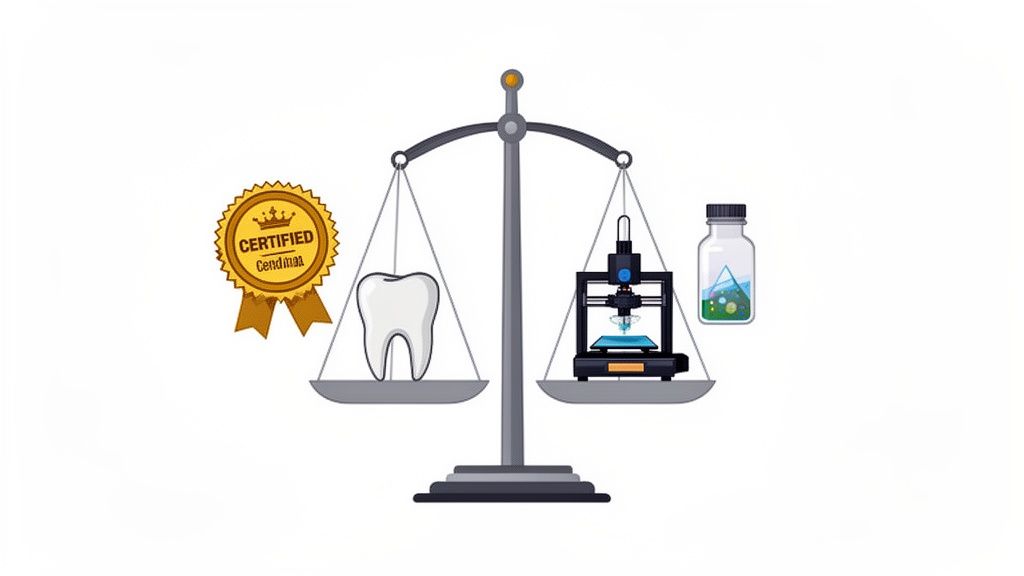
The reality is that every bottle of resin is formulated down to the last additive for a very specific purpose. Its price is directly tied to the factors that ensure patient safety and the quality of the final result.
The factors that truly matter in cost ✅
To help you understand why a resin costs what it costs, let's break down what lies behind that price.
-
Biocompatibility and Health Certification: This is, without a doubt, the factor that changes everything. A resin that is going to be placed in a patient's mouth (whether a splint, a temporary crown, or a surgical guide) must pass extremely rigorous clinical checks and obtain certifications such as the Class IIa CE marking. This paperwork doesn't come cheap, but it is the only guarantee that the material is non-toxic and won't cause problems. 📜
-
Specific Application: A resin for printing a study model that will sit on a desk is not the same as one for manufacturing a surgical guide that must achieve micrometric precision. Resins for models are more affordable because their technical and legal requirements are far less stringent.
-
R&D and Chemical Formulation: Developing a resin with specific mechanical properties (flexible yet resistant to breakage, wear-resistant, colour-stable...) requires a massive investment in research and development. Behind every formula lie thousands of hours of laboratory work. 🧪
In dentistry, price goes hand in hand with safety and precision. Investing in a certified resin is not an expense — it is a guarantee for your patient and a safeguard for the reputation of your clinic or laboratory.
With this in mind, you can now evaluate the options on the market from a different perspective. It's not about finding the cheapest option, but the most suitable one for each job.
To give you a clearer visual overview, we've put together a table with the most common price ranges.
Estimated price ranges by dental resin type (per litre) 📈
This table will give you a general overview of approximate costs. As you'll see, the price shoots up as soon as a resin requires certification for clinical use.
| Dental Resin Type | Main Use | Approximate Price Range (€/L) |
|---|---|---|
| Dental Model Resin | Study models, orthodontics. | 50 € - 120 € |
| Castable Resin | Cast metal frameworks. | 150 € - 250 € |
| Surgical Guide Resin | Guided implant surgery. | 250 € - 400 € |
| Crown and Bridge Resin | Temporary restorations. | 300 € - 500 € |
| Occlusal Splint Resin | Occlusal splints and guards. | 280 € - 450 € |
As you can see, understanding these ranges helps you better plan your costs and justify the investment in quality materials when the work calls for it.
Resin types and their real impact on your budget 💰
Getting into the world of dental resins is a bit like walking into a high-end hardware store: you know there's a world of difference between a basic hammer and an industrial-grade rotary hammer drill. Each resin is formulated for a very specific task, and understanding what each one is for is the first step in justifying why the dental resin price can vary so much from one bottle to the next. 🧐
Not all resins are made the same way. Their chemistry, their mechanical properties, and above all, whether or not they are certified for intraoral use, are the factors that make the difference and determine what role they play in your clinic or laboratory.
Resins for study and working models
Let's start with the most common and affordable: model resins. These are the bread and butter of many laboratories, the base material for creating exact replicas of a patient's mouth.
Their job is simple but crucial: to deliver extremely high dimensional accuracy and a smooth, hard surface you can work on with complete confidence. They are ideal for diagnostic models, for creating antagonists, or for planning orthodontic treatments.
Since they are not intended to come into contact with the patient, their certification requirements are much more relaxed. This translates, logically, into a considerably lower price, making them the perfect workhorse — highly cost-effective for everyday use.
Castable resins for metal frameworks
Castable resins are a marvel of chemistry with a very specific purpose: they burn away without leaving the slightest trace of ash. 🔥 This property is the key to the lost-wax casting process, which is used to manufacture metal frameworks such as copings, bridges, or the skeletons of removable prostheses.
The workflow is straightforward: you print the piece, invest it in a heat-resistant (refractory) material, and place it in a furnace. The resin vaporises completely, leaving a flawless hollow mould ready to receive the molten metal. A good castable resin must have minimal thermal expansion and burn cleanly to ensure a precise, pore-free casting.
As you can imagine, this highly specialised formulation justifies a higher price than that of a standard model resin.
Biocompatible resins for intraoral applications
This is where the dental resin price takes a significant jump, and for very good reasons. Biocompatible resins are medical-grade materials, designed and tested for direct and prolonged contact with the human body.
Biocompatibility is not just another feature — it is a legal and ethical requirement. These resins go through rigorous clinical trials and must obtain certifications such as the Class IIa CE marking or ISO 13485. All of this is to ensure they are non-toxic, do not cause allergies, and do not release strange substances in the patient's mouth.
Within this category, things get even more interesting with several subspecialties:
- For surgical guides: These need to be incredibly rigid and precise so that the surgeon can place implants with millimetric accuracy. They must also be autoclave-sterilisable without warping.
- For occlusal splints: These strike a delicate balance between hardness, to withstand the most severe bruxism, and a degree of toughness to avoid brittleness. Transparency and stain resistance to coffee also score points.
- For temporary crowns and bridges: Here aesthetics are key, with colours that mimic the natural tooth (the well-known shades A1, A2, A3). They must also have sufficient mechanical strength for comfortable chewing over weeks or months.
- For denture bases: These resins mimic the colour of the gum and must be highly resistant to fracture and wear to withstand the daily demands of a full denture.
The enormous investment in R&D, clinical trials, and all the certification procedures explain their price. Paying for them is, in reality, investing in the safety and peace of mind of your patients.
The context of a growing market 📈
This commitment to increasingly advanced materials is no coincidence. The dental sector in Spain is booming. According to data from the Spanish Federation of Health Technology Businesses (Fenin), the dental market generated 1.1 billion euros, 11.4% more than before the pandemic. Laboratory segments and CAD-CAM solutions are among the most dynamic, with growth of 6.6%.
This momentum is driving demand for more specialised and reliable materials, where certified quality is no longer an option but a necessity. If you want to better understand how resins are classified in general, beyond the dental sector, you will love our consumer resin guide for 3D printing.
Understanding this classification makes you a smarter buyer, capable of choosing the right material for each job and justifying every euro you invest.
Calculating the real cost of each printed part 🧮
Buying a bottle of resin is just the beginning. To know whether your investment is truly profitable, you need to look beyond the dental resin price on the label and calculate what each part coming out of your 3D printer actually costs you. 🧐 It is the only way to set prices that keep you competitive and, above all, to understand your margins.
Stopping at the cost per litre is like calculating the value of a cake by only counting the price of the flour. What about the eggs, the sugar, the oven electricity, and, most importantly, your time? 🍰 In dental 3D printing it is the same; there are several "hidden" costs that need to be brought to the table to avoid surprises.
This diagram summarises the key factors you should consider in the resin selection process, placing use and certification first, followed by material quality.
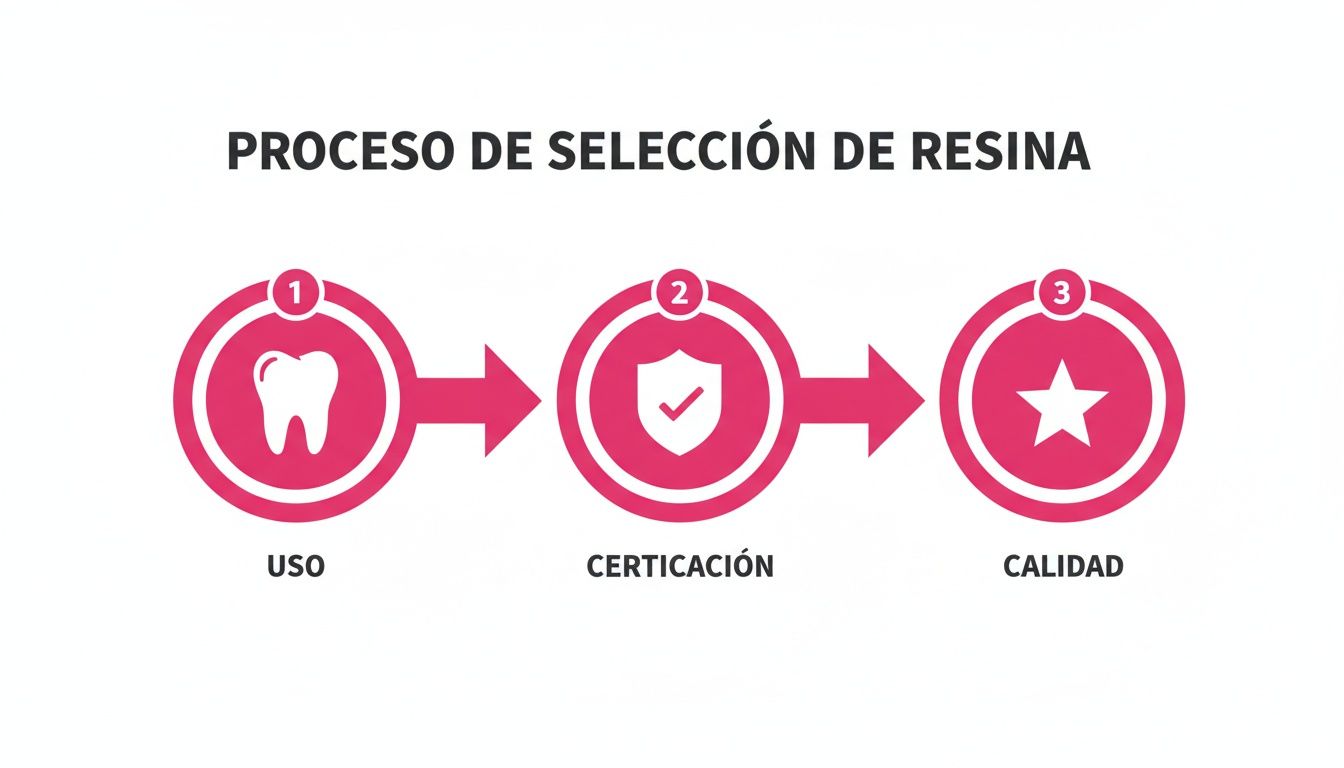
As you can see, the first thing is to think about what the part is for (its use) and whether it requires certification. Those are the filters that determine the resin category you need before you start evaluating quality.
Breaking down the hidden costs of printing
To get the real cost per part, you need to add up all those small expenses that appear from the moment you open the slicer until the part is ready to deliver.
- Resin consumption per print: Your slicer software (such as Chitubox or Lychee) gives you a pretty good estimate of how many millilitres (ml) or grams (g) the part will need, including supports. Don't forget about them — they cost money too!
- Margin for failed prints: Let's be realistic, not everything comes out perfect on the first try. It's a good idea to add a small buffer (a 5–10% is usually a sensible estimate) to the cost to cover the material lost in failures.
- Isopropyl Alcohol (IPA) for washing: Each part needs its IPA bath to remove uncured resin residue. This alcohol gets "dirty" with use and needs to be replenished. It's a small cost, but it adds up.
- Energy consumption: Your 3D printer and your washing and curing station draw power. A print lasting several hours can cause a spike in your electricity bill that, accumulated over the course of a year, becomes noticeable. ⚡
- Equipment depreciation: The printer, the curing station, and even the printer's LCD screen have a limited lifespan. Sooner or later they need to be replaced. Accounting for a small portion of their cost in each print is a very sound financial practice.
The cost-per-part formula 📝
With all this in mind, we can put together a simple formula to calculate what it costs us to manufacture anything.
Cost per Part = (Cost of Resin Used + Cost of Supports) + Failure Margin + IPA Cost + Energy Cost + Depreciation
It might seem complicated, but the reality is that the vast majority of the cost (over 90%) comes from resin consumption. The other factors are important for getting an exact figure, but if you're just starting out, don't obsess over them.
Practical example: cost of a night guard
Let's put some numbers to it. Imagine we're going to print a night guard.
-
Initial data:
- Price of 1 litre (1000 ml) of resin for night guards: €350.
- The slicer tells us that the night guard with its supports will use 15 ml of resin.
-
Calculating the resin cost:
- Cost per ml: €350 / 1000 ml = €0.35/ml.
- Resin cost for the night guard: 15 ml * €0.35/ml = €5.25.
-
Adding the extras:
- Adding 10% to cover failures, IPA, electricity, etc., we add: €5.25 * 0.10 = €0.53.
-
Estimated total cost per night guard:
- €5.25 + €0.53 = €5.78.
This calculation gives you a solid basis for knowing how much it costs you to produce each night guard. From here, you can already add your profit margin and the value of your time to set a fair and profitable selling price.
If you want to dive deeper into how much you can get out of each bottle, you can take a look at our article on how much you can print with 1 litre of resin. Mastering these numbers is key to keeping your lab running like clockwork.
How to choose your resin and optimise your investment ✅
Making a smart purchasing decision goes far beyond hunting for the lowest dental resin price. To truly optimise your investment and avoid unpleasant surprises, you need to think strategically. Here are the keys to choosing the perfect resin without making the typical beginner mistakes that end up costing a fortune. 💸
First and foremost, it's essential to understand that not all resins work with all 3D printers. Ignoring this is a recipe for disaster.
Compatibility is king 👑
Before adding any resin to your cart, you need to make sure it "speaks" the same language as your 3D printer. This comes down to two technical factors you simply cannot overlook.
- Wavelength (nm): Almost all LCD/MSLA 3D printers for dentistry cure with a light of 405 nm. Trying to use a resin designed for a different wavelength (such as 385 nm) simply won't work or, worse still, will give you catastrophic results. Always check the label!
- Print settings: Each resin has its own curing "recipe", with specific exposure times per layer. Serious manufacturers provide pre-validated settings for the most common 3D printers. If you use a resin without a known profile, you'll have to experiment through trial and error, wasting time and material.
A cheap resin that isn't compatible with your machine is, in reality, the most expensive of all. It will cost you failed prints, wasted resin, and no end of frustration.
True value for money 🤔
The price per litre is just a number, but it doesn't tell the whole story. To find out whether a resin is truly cost-effective, you need to look at other details that directly affect your wallet and your day-to-day workflow.
- Print success rate: What good is a cheap resin if one in every three prints fails? A higher-quality resin, even if it seems more expensive, can be far more cost-effective if it guarantees a 99% success rate. Fewer failures mean less material and time thrown away.
- Ease of post-processing: Some resins clean up more easily, require less curing time, or leave supports cleaner. All the time you save on cleaning and finishing pieces is money in your pocket.
- Mechanical and aesthetic properties: Does the resin hold its colour over time? Is it durable enough for your intended use? A splint that breaks or a temporary crown that stains within two days is a direct blow to your reputation.
The risk of "too cheap" and counterfeits ⚠️
In a market growing at full speed, you need to keep your eyes open. Forecasts suggest that the European dental materials market will grow from $7.2 billion in 2026 to $11.33 billion in 2034. This boom attracts many players, but not all of them play fair.
This is where the danger of uncertified resins and counterfeits comes in. Using a material that is not biocompatible for something that goes in a patient's mouth is a serious act of negligence that can cause allergies and health problems. ☣️
That's why buying from specialized stores and authorized distributors like MrResin.es is not an expense, it's an investment in peace of mind. You ensure the product is authentic, has been stored properly, and you have technical support in Spanish if anything goes wrong. If you want to know more, our blog covers where to buy 3D resin in Spain with all the guarantees. Protecting your patients and your clinic's reputation is priceless.
The future of digital dentistry and new resins ✨
Diving headfirst into 3D printing is no longer a decision to make "in the future" — it's the driving force behind dentistry today. And this is precisely where the discussion about dental resin pricing takes on a new dimension, shifting from being a cost to an indicator of how advanced a clinic or laboratory is. The digitalization of processes is everywhere, and with it comes a surge in demand for materials that rise to the occasion: more precise, faster, and above all, reliable. 🚀
Understanding this changes the rules of the game. Investing in a quality resin is not an expense, it's a strategy. It translates directly into surgical guides that nail implant placement, into splints that fit perfectly, and into provisionals you can deliver in record time. And most importantly: patient satisfaction. That feeling of "they work so well and so fast here" puts you ahead of the competition, and that value far exceeds what the bottle of resin cost.
This evolution is a sign that the industry trusts what's coming. Don't just take my word for it — a recent study by Key-Stone confirms it: the dental sector in Spain is in a moment of stability, and confidence levels are the highest since the pandemic. The study makes it clear that people are betting on digital technology and that the priority is investing in equipment that makes a difference. You can read more about dental sector trends here.
Trends already redefining the sector
The future is already here, and it comes packed with innovations that are going to change the way we work. Technology never stops, and dental resins are at the forefront of this revolution. 💡
Here are some of the most powerful trends we will see consolidate:
- Permanent 3D printed resins: Forget about temporaries. Materials are arriving with such great strength and aesthetics that they allow crowns, inlays and onlays to be printed directly in the clinic as permanent restorations. This is a game-changer, because it reduces the number of appointments and costs for everyone.
- Materials with bioactive properties: Imagine resins that not only rebuild, but also help the patient. Materials that release fluoride ions to prevent cavities or that have antibacterial components to keep plaque at bay. 3D printing is going to become an active treatment tool.
- Breathtaking printing speeds: Advances in 3D printers and resin chemistry will allow a splint or surgical guide to be printed in minutes, not hours. Workflow optimization is going to be massive.
The real mindset shift is to stop seeing technology and materials as a cost and start seeing them as your best ally to stay competitive. The question is no longer whether you can afford to invest in quality resins, but whether you can afford not to.
Getting on board with this is what will allow clinics and laboratories not only to stay in the market, but to lead it. Every euro you invest in a quality resin is a step toward more efficient, more precise dentistry with a happier patient. The future is digital and it is 3D printed.
Conclusion:
After this journey, we hope one thing has become clear: the price of a dental resin is much more than a number on a bottle. It is the sum of years of research, patient safety certifications and the technology that makes it possible to create parts with incredible precision. 🤓
So you never get lost and always make the best decision, keep these three key ideas in mind:
- Every resin has its reason: A material for a simple study model is not the same as a biocompatible resin for a splint that will be worn in the mouth. Understanding what each one is for justifies its cost and ensures you don't make the wrong call.
- Calculate the real cost per piece: Forget the price per litre as your only reference. Think about the support structures, possible printing failures and the consumables you use. Only then will you know if your work is truly profitable.
- Rely on trusted suppliers: Working alongside experts like MrResin.es gives you the peace of mind of knowing you are buying genuine material, with technical support in Spanish and no nasty surprises. It is an investment in quality and safety.
Now you have the tools to optimize your purchases and take your laboratory or clinic to the next level. 3D printing is no longer the future, it is the present, and you are more than ready to make the most of it. 💪
Ready to take action? 🚀 Take a look at our full catalogue of dental resins in the MrResin.es store and find exactly what you need for your projects.
And if you want to stay up to date with everything, join our community. Join our Telegram group here to access exclusive community discounts and deals, as well as exclusive coupons, news and events. 🤫 Oh! And don't forget to subscribe to our Newsletter so all the latest news lands straight in your inbox. 💌
✨Happy Printing! 🚀
Frequently asked questions about dental resin pricing
When you start investing in technical materials like dental resins, it's normal for your head to fill with questions. That's why we've gathered the most common doubts here so you have everything clear and can decide with complete confidence. 😉
Why is a biocompatible resin so expensive?
The price difference between a model resin and a biocompatible one is enormous, and there's a solid reason for it. It's not just the chemistry of the material — it's the entire process behind it to guarantee it's 100% safe for a patient. 🩺
The price of dental resin for biocompatible materials skyrockets for these reasons:
- Years of Research and Development (R&D): This isn't something mixed together in a day. Behind it lie years of laboratory work to find a stable, resistant formula that, above all, is non-toxic.
- Extremely strict clinical trials: Before reaching the market, the material undergoes a huge number of tests to prove it doesn't cause allergies, doesn't irritate, and doesn't release strange substances in the mouth.
- Certification processes: Obtaining certifications such as the Class IIa CE marking or compliance with ISO 13485 isn't free. It involves audits, endless paperwork, and fees that add up to thousands of euros.
- Manufacturing in "clean rooms": These resins are manufactured in sterile environments to prevent even a single speck of dust from contaminating them, which significantly increases production costs.
In short, that high price is the cost of safety. It's the only guarantee that what you place in a patient's mouth meets the world's most demanding healthcare standards.
Can I use a cheap resin to make a splint?
The answer is a firm and categorical NO. 🚫 Using a model resin — which is neither designed nor certified for use inside the mouth — to manufacture a splint, a temporary restoration, or anything else a patient will wear, is an extremely serious act of negligence.
The health risks are unacceptable.
- Pure and simple toxicity: The components of cheap resins can be toxic when in contact with mucous membranes, releasing chemicals that the body ends up absorbing.
- Allergic reactions: They can cause anything from simple gum irritation to a severe allergic reaction.
- Degrades in the mouth: They are not made to withstand the moisture and acidity of saliva, so they can break, lose their shape, and become brittle.
Saving a few euros on this is gambling. You put your patients' health at risk and expose yourself to very serious legal and professional consequences. Safety is non-negotiable.
How much can I save by optimising my prints?
Here comes the good news! 🎉 While you can't cut corners on resin quality, you can significantly reduce consumption by optimising your workflow. With a bit of skill, you can save between 15% and 30% of material on each print.
The key lies in how you prepare your files in your slicer. Pay close attention to part nesting (placing multiple models together to make the most of the space) and support optimisation. Using thinner or hollow supports where possible and orienting parts so they need less assistance are tricks that, by the end of the month, make a real difference to your bottom line.
Where is it safe to buy dental resins online?
With so many options out there, it's vital to buy from a source that gives you guarantees. The best approach is always to go to authorised distributors and specialised stores, such as MrResin.es.
Buying from a trusted supplier gives you peace of mind on several key points:
- Product traceability: You know the resin is genuine, not a counterfeit, and you know its batch number and expiration date.
- Proper storage: Resins are sensitive to light and temperature. A good distributor stores them correctly so they don't lose their properties.
- Technical support that knows what it's talking about: If a print goes wrong or you don't know which profile to use, having someone on the other end who understands the subject and speaks your language is priceless.
Investing in a good supplier is part of the strategy for achieving perfect results and working without unpleasant surprises.
And finally...
We've seen that the price of dental resin is not a whim, but a reflection of the innovation, safety, and specialization that goes into every bottle. To always make the right choice, keep these ideas in mind: know your resin types well, calculate the real cost of each piece you produce, and rely on trusted suppliers who offer you guarantees and support. ✅
Now you have the information you need to optimize your investment and take your lab or clinic to the next level.
Ready to start printing with the best quality? Take a look at our catalog of dental resins at the Mr Resin store. 🛒
We also invite you to join our community. Join our Telegram group here to grab discounts, deals, and support you won't find anywhere else. And of course, don't forget to subscribe to our Newsletter to be the first to hear about all the latest news and coupons! 💌
✨Happy Printing! 🚀