

Dental 3D printing is simply a form of additive manufacturing: a process that builds three-dimensional objects, layer by layer, from a digital file. In dentistry, this allows us to create everything from study models and surgical guides to temporary crowns with a precision and speed that traditional methods simply cannot match.
The digital revolution has arrived at your dental clinic
Remember film photography? The darkrooms, the waiting, the uncertainty... Traditional dentistry, with its alginate impressions and plaster models, has lived in that same era for decades. It was a manual, slow process and, let's be honest, quite uncomfortable for the patient. 😫
Well, 3D printing is to dentistry what the digital camera was to photography. It's a paradigm shift. 📸
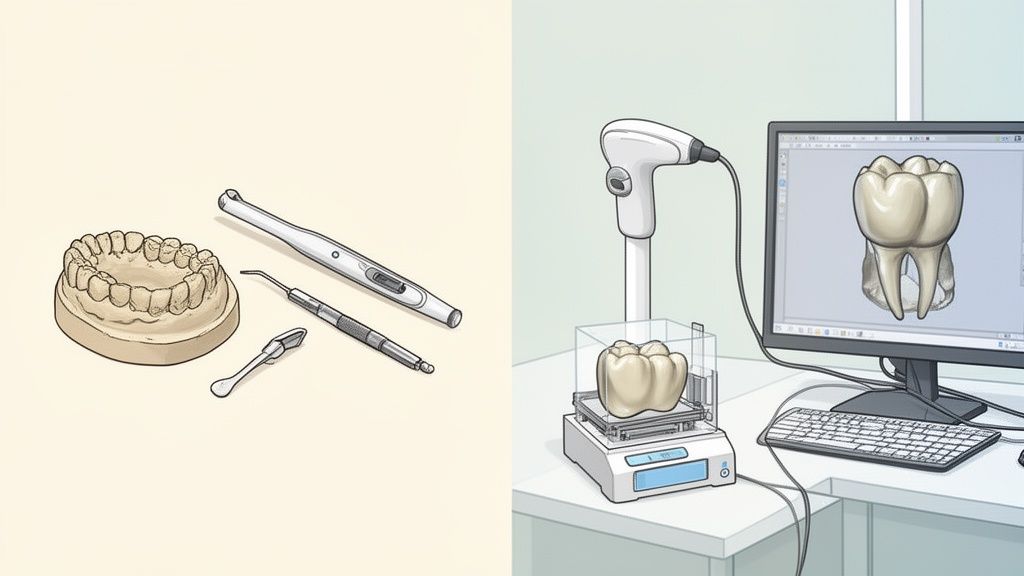
This technology is redefining the rules of the game. We're no longer talking about something futuristic; it's a real, tangible tool that is giving clinics and laboratories that jump on board a massive competitive advantage. The workflow becomes digitized, precise and extraordinarily agile.
The real impact on your day-to-day
Adopting 3D printing isn't just about buying a new machine. It's a strategic decision that directly impacts your efficiency and profitability. It allows you to start producing in-house things that you previously had no choice but to outsource, eliminating dependence on third parties and their endless delivery times.
Imagine producing a perfect surgical guide right in your own practice in a couple of hours, instead of waiting a week. Or being able to deliver a night guard the very next day. That's not the future — that's what 3D printing lets you do today. 💡
The benefits you'll notice almost instantly are these:
- Drastic cost reduction 💰: By producing in-house, you bypass the margins of external laboratories on a huge range of jobs, from study models to temporaries. The savings are direct.
- Breathtaking turnaround times 🚀: Treatments that previously required multiple appointments and weeks of waiting can be completed in days, sometimes even the same morning.
- Improved patient experience 😊: Say goodbye to impression trays, alginate and that suffocating feeling. Now everything is handled with a quick, clean intraoral scan that is far more comfortable.
- Millimetric precision and customization 🎯: Parts are manufactured with exceptional accuracy, ensuring a perfect fit and minimizing chairside adjustments.
This shift isn't just an anecdote — it's happening on a large scale. The dental 3D printing market in Spain is growing at an incredible rate. In 2022, this market was worth 3.1 million USD and is projected to soar to 13.42 million USD by 2030. These figures don't lie: clinics are adopting this technology at full speed to improve their services.
If you want to fully understand everything you can do, explore in depth the many applications of 3D printing and how they can transform the way you work.
Understanding the key 3D printing technologies
To dive headfirst into dental 3D printing, you don't need to be an engineer. The idea is simple: instead of removing material from a block like a sculptor, here you build from scratch, adding ultra-thin layers one on top of the other. It's an additive process, but with a precision that's truly impressive. 🔬
In dentistry, the leading technologies are those that use liquid resin: SLA, DLP and MSLA. Think of them as ultra-high-definition cinema projectors. Their mission is to project ultraviolet light onto a vat filled with photosensitive resin, a liquid that hardens as if by magic when it receives that light.
The printer projects the outline of a layer, the resin solidifies, and the build platform rises a minimal distance, sometimes less than the thickness of a hair. This cycle repeats over and over, and little by little, the 3D object emerges from the liquid. It's almost hypnotic to watch. ✨
SLA, DLP and MSLA: the three musketeers of resin
Although all of them are based on curing resin with UV light, the "how" they do it is what sets them apart. Understanding their nuances is essential for choosing the equipment that best suits your clinic or laboratory.
- SLA (Stereolithography): It's the veteran of the group. It uses a high-precision laser that "draws" the outline of each layer onto the resin, point by point. The result is spectacular detail, but it has one drawback: it's slower, because the laser has to travel across the entire surface.
- DLP (Digital Light Processing): This technology replaces the laser with a digital projector. Instead of drawing, it projects the complete image of the layer in a single flash. ⚡ And the entire layer solidifies instantly. This makes it much faster than SLA, especially when printing large parts or several at once.
- MSLA (Masked Stereolithography): It's the logical evolution of DLP and the most popular technology today thanks to its incredible balance between cost, speed and quality. It uses an LCD screen as a mask to allow UV light from an LED matrix to pass through. Like DLP, it solidifies entire layers at once, achieving impressive printing speeds.
What about filament printing (FDM)?
You've surely seen or heard about 3D printers that use plastic spools, known as FDM. They're fantastic machines for a thousand things and very common at the hobbyist level, but for the dental sector, they simply don't make the cut. ❌
The difference in precision between an FDM 3D printer and a resin one is like comparing a thick marker to a fine-tipped pencil. To draw a detailed portrait, you need the pencil. In dentistry, that precision isn't a luxury — it's an absolute necessity.
FDM 3D printers can't even dream of reaching the micrometric level of detail demanded by a crown, a surgical guide or a precise study model. The layers are too visible and the surfaces far too rough, which rules them out for almost any serious clinical application. If you want to learn more about the subject, you can learn everything about resin 3D printing on our blog.
To make it clearer, here's a table that sums up the key differences at a glance.
Comparison of 3D printing technologies for dental use
This table will help you visualise why resin technologies are the undisputed leaders in the dental sector.
| Technology | Precision and Detail | Printing Speed | Compatible Materials | Ideal For |
|---|---|---|---|---|
| SLA | Very high, ideal for fine details and smooth surfaces. | Slow, as the laser draws each point of the layer. | SLA-specific photosensitive resins. | Prototypes with intricate details, jewelry. |
| DLP/MSLA | Excellent, with resolutions of up to 25 microns. | Very fast, cures entire layers at once. | Wide range of biocompatible dental resins. | Dental applications: models, guides, splints. |
| FDM | Low, layers are visible and detail is limited. | Variable, depends on complexity and infill. | Thermoplastic filaments (PLA, PETG, ABS). | Functional prototypes, large parts, hobby. |
At the end of the day, for dental 3D printing, the choice is clear. Resin technologies like DLP and MSLA give you the winning combination of precision, speed and specialized materials you need to take your work to the next level. 🏆
Dental resins as a fundamental pillar
If the 3D printer is the engine of your clinic or laboratory, resins are the high-octane fuel that makes it run. ⛽️ They are the component that defines everything: precision, durability and, most importantly, patient safety.
Choosing the wrong resin is like putting diesel in a Formula 1 car; it simply won't perform the way you expect.
In the world of dental 3D printing, each clinical application demands a material with very specific properties. Printing a study model is not the same as printing a surgical guide that will be in direct contact with living tissue. That's why understanding the universe of resins is absolutely crucial to getting the most out of this technology.
This is where amateurs are separated from professionals. Selecting the right material is not a minor detail, but the foundation on which a safe treatment with guaranteed success is built. 🎯
Types of resins by clinical application
Each treatment has its ideal resin. The most practical way to know which one you need at any given time is to group them by use. Let's break down the main categories so you don't get lost.
-
Resins for Dental Models: These are the bread and butter of any laboratory or clinic that has made the digital leap. You need them to be extremely precise in order to replicate the patient's anatomy without errors. Look for resins that offer high resolution, minimal shrinkage and a smooth, opaque finish —generally in plaster-like colors such as beige or grey— so you can see every detail clearly. Their star quality is dimensional stability.
-
Biocompatible Resins: This is where maximum responsibility comes in. 🧑⚕️ These resins are formulated to be safe in contact with the human body, whether temporary or prolonged. They are essential for manufacturing occlusal splints, surgical guides or impression trays. They must comply with very strict regulations, such as ISO 10993.
-
Castable Resins: A true marvel for creating metal structures such as crowns or bridges through the lost-wax process. The piece is printed in the desired shape and, when placed in the oven, the resin burns away without leaving any trace of ash. This creates a perfect mold for injecting molten metal. 🔥
-
Temporary Resins: Need to create a temporary crown or bridge while the permanent one is being made? These resins are the solution. They combine excellent aesthetics, with shades that mimic the natural color of the tooth (A1, A2, A3), with sufficient mechanical strength to withstand chewing for weeks.
Key properties and regulations you need to know
When you look at a resin's technical data sheet, don't be intimidated by the data. Certain properties carry more weight than others depending on your intended use.
For example, for a splint, in addition to biocompatibility, you will need it to have high resistance to abrasion and impact. For a surgical guide, rigidity and the ability to be sterilized are critical to ensuring it does not deform during surgery.
In the field of healthcare, there are no shortcuts. Certified biocompatibility is not an option, it is a requirement. Any material that comes into contact with a patient must comply with ISO 10993, which guarantees that it is non-toxic, non-irritating, and will not cause allergic reactions. ✅
To be sure you are using a correct and reliable material, it is essential to pay attention to these certifications. If you want to explore the topic further, you can take a look at our selection of biocompatible 3D resins, all chosen for their quality and regulatory compliance.
Resin examples for your clinic
To make all of this more tangible, let's talk about specific products you can find in our store. Brands such as Anycubic and Elegoo have developed resins with an exceptional value for money, perfect for starting to digitize your workflow without breaking the bank.
A great example is the Anycubic DLP Craftsman resin, designed for DLP printers. It offers incredible precision, ideal for those dental models where every micron counts. It is a highly reliable material that will deliver consistent results time and time again.
The most important thing is to understand that choosing the right resin is an active part of the treatment. It defines the quality, safety, and efficiency of your work. Knowing the types, their properties, and the regulations will give you complete control over the final result. 💪
Your digital workflow step by step
Now that you have a clear understanding of the technologies and materials, let's get down to business. 💪 Dental 3D printing is not just a machine that produces objects, but the heart of a perfectly orchestrated digital workflow that completely transforms the way you work.
Let's break this process down into simple steps, from the moment the patient sits in the chair to the moment you have the finished piece in your hands. You will see that, once you master it, it is a logical, efficient cycle that you can repeat over and over again.
1. Intraoral scanning: the starting point 😮
Everything starts here. The first step is saying goodbye forever to uncomfortable alginate impressions and welcoming the intraoral scanner. This device, which looks like a slightly oversized pen, captures thousands of images per second to create an incredibly precise 3D model of the patient's mouth in real time.
This digital file, usually in STL format, is the cornerstone of everything. It is a millimeter-precise replica of the patient's anatomy, free from the typical distortions or bubbles of the traditional method.
2. CAD design: shaping the solution 💻
With the 3D model already on the computer, it is time to design. This is where CAD (Computer-Aided Design) software comes into play. Programs such as Exocad, 3Shape, or even the open-source software Blender for Dental allow you to model the piece you need directly on the digital copy of the mouth.
Whether it is a night guard, a surgical guide, or a temporary crown: you have complete control over every detail. Thickness, contact points, morphology... It is like sculpting, but with the precision that only a computer can give you.
3. Slicing: translating for the printer 🔪
Once the design is ready and approved, you cannot send it as-is to the printer. First, it must be "translated" into a language the machine understands. This process is known as slicing.
Slicing software (such as ChiTuBox or Lychee Slicer) takes your 3D model and cuts it into hundreds, or thousands, of very thin horizontal layers. This is also where you configure all the print settings, such as layer height, exposure times, and — crucially — support structures.
A workshop tip 🛠️: Support structures are those temporary structures that are printed to hold up the parts of the model that are "hanging" or have very steep angles. Placing supports correctly is the key to preventing print failures and making them easy to remove afterwards without leaving marks.
4. The magic of 3D printing: let's build! ✨
With the file already sliced and saved to a USB drive, the moment of truth arrives. We load the file into the printer, check that the resin tank has enough material, and that the build platform is spotless. And then we hit the print button! 🖨️
The printer will get to work, curing the resin layer by layer according to the file's instructions. Within a few hours, the piece will be ready, emerging from the liquid as if by magic.
5. Post-processing: a critical step you cannot skip
Watch out! The work does not end when the printer beeps. 🚨 In fact, this final phase is absolutely crucial to ensure that the piece has the proper mechanical properties and, above all, that it is biocompatible.
Post-processing is divided into two key stages:
- Washing 🧼: The freshly printed piece comes out coated in uncured liquid resin. It is vital to clean it thoroughly to remove any residue. To do this, it is submerged in a solvent such as isopropyl alcohol (IPA) or specific solutions. Ideally, a washing station that agitates the liquid should be used to ensure a perfect clean.
- Curing ☀️: Even though the piece may appear solid, it is not yet fully polymerized. It needs a final "bath" of UV light to harden completely and reach its maximum strength and biocompatibility. A UV curing chamber ensures the piece receives light from all angles for the exact amount of time recommended by the resin manufacturer.
Skipping or poorly performing this step can undo all the previous work and, worse still, compromise patient safety.
Digitalization is having a massive impact on the efficiency of Spanish clinics. 3D printing is the main protagonist in the transformation of dental prosthetics. While traditional clinics handle an average of 8.5 prosthetic cases per week, clinics that have already integrated these technologies reach up to 13.1 cases. This leap is due to the ability to produce temporaries and models in hours, rather than days. If you want to dive deeper, you can read this study on the dental sector in Spain.
The following chart shows you the main applications you can start producing in your own clinic or laboratory following this workflow.
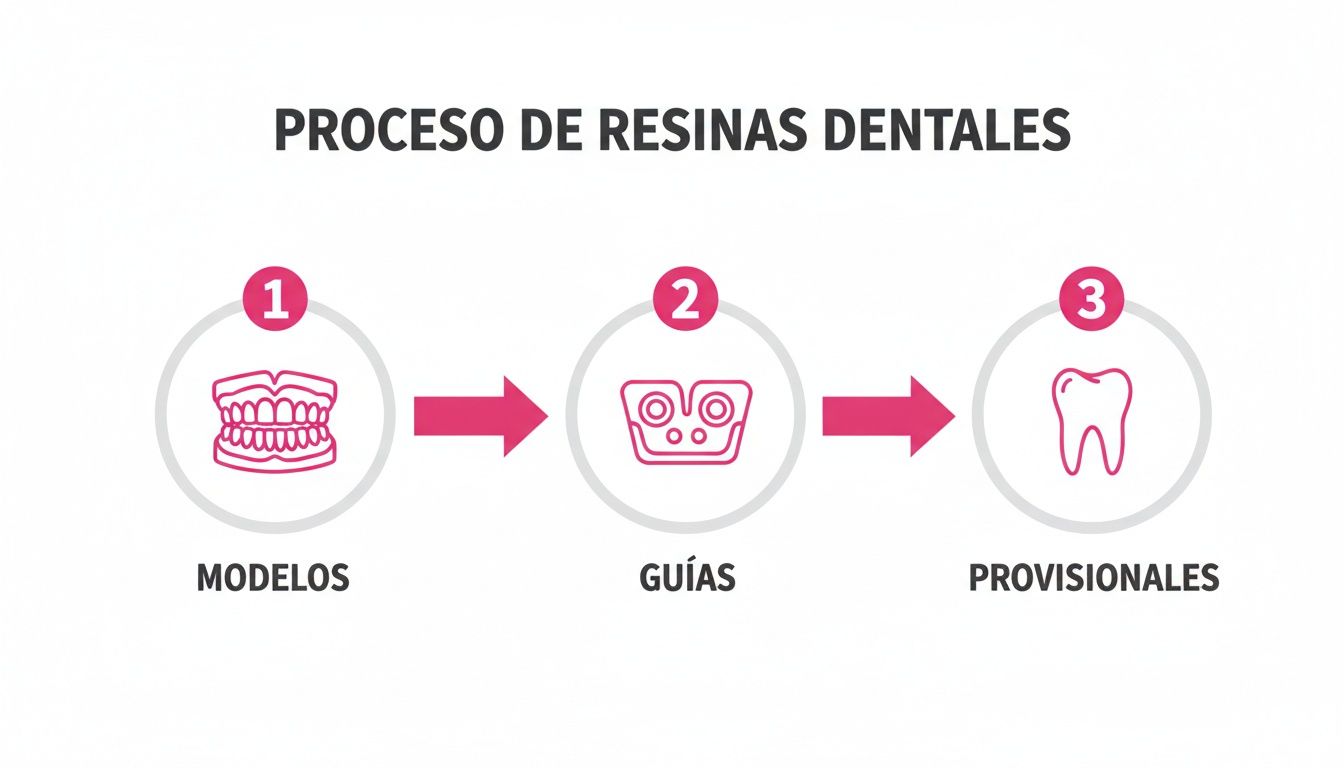
As you can see, these are the three pillars of in-house production in 3D dentistry. The same workflow allows you to diversify the treatments you offer with an agility that was unthinkable just a few years ago.
For this entire process to flow without interruptions, it is vital to have quality consumables. Parts like FEP or ACF films, which sit at the bottom of the resin vat, are essential. At Mr Resin, we offer you a complete range to ensure your prints always come out perfectly.
How to choose the perfect printer and resin for your clinic
Taking the leap into 3D printing can seem like a maze of technical specifications and marketing promises. 😵💫 But don't worry, that's exactly what we're here for. Let's break down the process so your investment is a resounding success from day one.
Choosing the right equipment is not just a matter of budget; it is a strategic decision that will define the productivity of your clinic, the quality of your treatments, and ultimately, your capacity to grow.
Checklist for choosing your dental 3D printer ✅
Before reaching for your credit card, take a deep breath and analyze these four key points. They are what separate a good purchase from a future headache.
-
1. Resolution and Precision (are a few microns enough?) In dentistry, precision is not negotiated, it is demanded. Here we talk in microns (µm). An XY resolution of between 25 and 50 microns is the gold standard for your models, guides or temporaries to fit like a glove. Don't settle for less.
-
2. Build Volume (how large is your production?) Think about your day-to-day. Do you need to print full-arch models or do you focus on individual pieces such as crowns? A generous build volume allows you to produce several pieces at once (for example, a batch of nightguards), which optimizes your time in a massive way.
-
3. Speed and Reliability (can I sleep soundly while it prints?) A fast printer is great, but a reliable printer is essential. Look for machines with good reviews in the community, a robust build and software that won't let you down. A failed print halfway through an urgent job is a cost no clinic can afford.
-
4. Ecosystem and Support (if something goes wrong, who do you call?) Don't focus only on the machine. Is it compatible with third-party resins (open system) or does it lock you into a single brand (closed system)? And, above all, who is going to help you if you have a problem? Having a supplier like Mr Resin, who provides technical support in Spanish, is a lifesaver. 🤝
Key factors for selecting the right resin
If the printer is the engine, the resin is the fuel. The final result depends entirely on it, and each clinical application has its own requirements.
The best printer in the world with the wrong resin will produce mediocre results. Material compatibility and specificity are just as important as the machine itself.
To avoid making the wrong choice, follow these three steps:
- Define the application: Are you going to print a study model, a surgical guide or a night guard? Each use requires different properties: dimensional accuracy, rigidity, flexibility, biocompatibility...
- Verify certifications: If the piece is going to come into contact with a patient (even briefly), it is mandatory that the resin complies with biocompatibility regulations, such as ISO 10993. This is a legal matter and, more importantly, a matter of professional ethics.
- Confirm compatibility: Make sure the resin you want to use has been validated for your printer model. Using an untested combination is playing the lottery with your prints.
The dental industry has a clear picture: the demand for professionals who master these technologies is through the roof. The dental 3D printing market is growing at a rate of more than 20% per year, but there is an alarming shortage of well-trained technicians. With more than 23,000 clinics in Spain alone, the need for specialists is critical. If you want to go deeper, you can read more about dental employment trends in Spain here.
A trusted supplier is your best ally
Beyond the machine and the materials, your supplier is a key piece of this puzzle. You don't need an online store that ships boxes to you, but a partner who understands your work and your deadlines.
At Mr Resin we don't just sell products; we offer you a comprehensive solution. We guarantee real stock and fast shipping from Spain so your production never stops. And if any questions come up, our Spanish-speaking support team is just a phone call away to help you. 📞
The most frequently asked questions about dental 3D printing 🤔
We know that getting into a new technology can raise a lot of questions. 🌊 That's why we've gathered the most common questions we receive from professionals like you, who are considering whether to make the leap into dental 3D printing.
Let's answer them straight.
Is getting started with dental 3D printing very difficult?
Although it might seem like a whole new world at first, the reality is that the learning curve is much gentler than you think. 🧐 Today's printers are becoming easier and easier to use and the software guides you every step of the way.
The key is to get a solid grasp of the workflow: scanning, design, printing and post-processing. Once you're clear on those four steps, the rest is a matter of repeating a process that becomes very, very streamlined.
Most professionals manage to print their first models or night guards to clinical quality in just a few days. You don't need to be an engineer, just understand the process.
Additionally, having a trusted supplier who gives you support in Spanish, as we do at Mr Resin, is essential for resolving those small doubts that always come up at the beginning.
What regulations should I follow when using biocompatible resins?
This is a crucial question and the answer is very straightforward: biocompatibility is a very serious matter and there are no shortcuts here. 🚫
If a part you print is going to come into contact with a patient (a surgical guide, a splint, whatever...), you absolutely must use a resin that complies with very strict regulations. The most important is ISO 10993, which essentially ensures that the material is non-toxic and won't cause adverse reactions.
It is vital to purchase resins from brands that provide all the documentation and certifications. But watch out — it doesn't end there. The post-processing (the washing and curing) must follow the manufacturer's instructions to the letter. If you fall short on curing, the biocompatibility goes out the window, no matter how certified the resin is.
How much does it really cost and when do I recover the investment (ROI)?
The initial investment (the printer, the washing and curing machine, the first bottles of resin...) might seem like a significant amount, but the return on investment (or ROI) comes much sooner than people think. 💸➡️💰
The savings show up everywhere:
- Lower lab costs: You start doing in your own clinic or laboratory work that you previously had to outsource. Goodbye to third-party margins.
- Optimised time: You go from delivering work in days to doing it in hours. This means you can see more patients and close treatments much faster.
- New services: Suddenly, you can offer things that weren't worth your while before, like a night guard ready in 24 hours.
Many clinics and laboratories recover their investment in less than a year. Don't see it as an expense, but as a direct investment in becoming more efficient, more profitable, and in setting yourself apart from the competition.
Now that all the cards are on the table, it's your turn to make a move. At Mr Resin you have everything you need to start your journey in digital dentistry, from the most cutting-edge printers to the most complete range of dental resins.
Take a look at our store and find the perfect equipment for you
Conclusion
3D dental printing is no longer something of the future — it is a key tool for the present of any dental clinic or laboratory that wants to stay ahead. 🚀 We have seen together the impact it has, the leading technologies like SLA and MSLA, how critical biocompatible resins are, the digital workflow from start to finish, and how to make the right choice when selecting your equipment.
Adopting this technology will allow you to cut costs, be incredibly faster with deliveries and, most importantly, give your patients treatments with a precision and quality that were previously unthinkable. It is a safe bet that places you at the forefront. 💪
Don't stand by watching the industry move forward. The time to give your clinic a boost is now. We invite you to explore the selection of products we have prepared in the Mr Resin online store.
And to stay up to date and grab the best deals, join our community. Subscribe to our Newsletter to receive exclusive coupons and promotions, and don't forget to join our Telegram group here to access discounts, news, and connect with other professionals in the industry. 💬
✨Happy Printing! 🚀