

A dental 3D printer is, in simple terms, a machine that builds three-dimensional objects layer by layer from a digital design. This allows clinics and laboratories to create everything from study models to surgical guides and splints, with a level of precision that was previously unthinkable.
Its arrival is retiring the old (and slow) manual plaster processes, opening the door to a far more efficient and personalized dentistry.
How digital dentistry is revolutionizing your daily practice
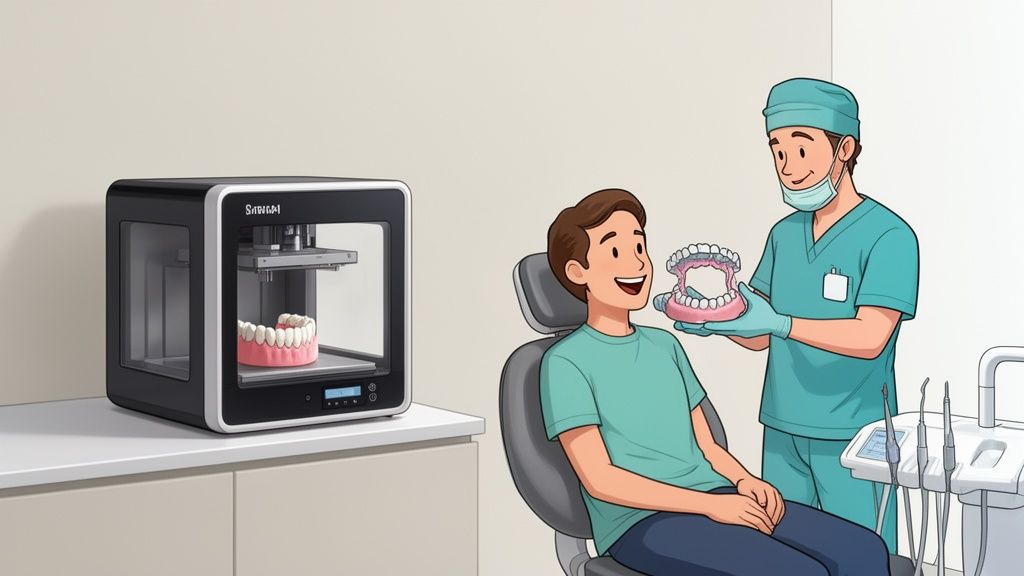
Dentistry has taken a giant leap. 🚀 The shift from traditional methods to digital workflows is not a simple improvement — it is a radical change in the way treatments are planned and executed.
Imagine leaving behind forever the days of taking alginate impressions, waiting for plaster to set, and wrestling with the inaccuracies of manual work. Digital dentistry, with the dental 3D printer as its centerpiece, turns your clinic or laboratory into an agile, high-precision production hub. ✅
And this technological leap is spreading at a dizzying pace. In Spain, the progress is clear: around 30% of dental clinics were already digitalized in 2022, a year in which the sector generated revenues of over 930 million euros. This boom is reflected in a 65% increase in digital equipment sales compared to 2019. The trend is unstoppable. If you want to dive deeper, you can explore the details of the Spanish dental market.
Unlimited precision and personalization 👌
The greatest benefit of having a dental 3D printer is the ability to manufacture fully custom pieces with remarkable accuracy. Unlike traditional methods, where human error is always lurking, 3D printing nails the digital design.
In day-to-day practice, this translates into:
- Perfect fits: Splints, temporary crowns, and surgical guides fit like a glove. This means less chair time for adjustments and much happier patients. 😊
- Complex treatments, simplified: It enables the creation of surgical guides that ensure the precise placement of implants, minimizing risks and speeding up recovery.
- Total design freedom: A world of possibilities opens up for creating prosthetic and orthodontic solutions that were previously impossible or too costly to manufacture. 🎨
Speed as a competitive advantage ⚡
In a sector as competitive as dentistry, time is money. Being able to produce in-house what you previously had to outsource and wait days (or weeks) to receive is a massive strategic advantage. ⏰
With a dental 3D printer in your clinic or laboratory, you can manufacture a model, a custom tray, or several occlusal splints in a matter of hours. This agility not only makes your life easier, but transforms the patient experience, delivering fast and effective solutions that build loyalty and trust.
The real transformation lies not in the machine itself, but in the workflow it makes possible. Integrating 3D printing means redesigning the way you work to be faster, more precise, and ultimately more profitable. 💰
In short, embracing this technology is no longer a future option; it is a necessity for any professional who wants to stand out, improve clinical outcomes, and optimize the profitability of their practice. It is the definitive step toward smarter, patient-centered dentistry.
Understanding SLA, DLP, and MSLA 3D Printing Technologies
Diving into the world of resin 3D printing can seem like a maze of acronyms and technical jargon, but it's easier than it looks. 🤓 For any clinic or laboratory, the first step to choosing the right machine is understanding how a dental 3D printer works.
The three technologies that dominate the dental sector are SLA, DLP, and MSLA. They all do the same thing: solidify liquid resin layer by layer using ultraviolet (UV) light. What changes is how they do it, and those differences are key when it comes to speed, precision, and cost. Let's break them down with simple analogies so you can see which one fits best into your day-to-day workflow.
SLA (Stereolithography): the meticulous artist 👨🎨
Imagine an artist drawing with an ultra-precise light pen. That's how SLA technology works. A UV laser, guided by mirrors (called galvanometers), traces the outline of each layer of the model onto the liquid resin. This method is incredibly precise, capable of creating the finest details and ultra-smooth surfaces.
Its key strength is millimeter-level accuracy, which is crucial for work where fit is everything, such as crowns or bridges. But of course, this level of detail comes at a price: speed. Since it has to "draw" each point of the layer, the process is slower, especially with large pieces or when printing multiple models at once.
DLP (Digital Light Processing): the cinema projector 📽️
Now, think of a cinema projector. Instead of drawing point by point, DLP technology projects the complete image of the layer all at once, like a slide. 🎞️ A matrix of microscopic mirrors directs UV light to cure the entire layer simultaneously.
What's the big advantage? Speed. It doesn't matter whether you're printing a single model or a full build platform; the time per layer is constant and much faster than with SLA. This is perfect for high-volume production laboratories that need to turn out large numbers of splints or study models every day.
"The choice between technologies is not a matter of which one is 'better,' but of which one aligns with your priorities. Do you need the maximum possible precision for a single complex piece, or the ability to produce twenty identical models in record time?"
MSLA (Masked Stereolithography): the smart evolution 💡
MSLA technology is the star of the moment and the one you'll find in the most popular 3D printers, such as those from Anycubic or Elegoo. It is a brilliant and more affordable evolution of DLP. Instead of an expensive projector, it uses a monochromatic LCD screen as a mask for the UV light. 💡
This screen works like a stencil: it lets light through only where the resin needs to be solidified and blocks it everywhere else. Just like DLP, it cures entire layers at once, achieving impressive speeds. The big difference is that modern LCD screens have extremely high resolutions (4K, 8K, and beyond), eliminating the old problem of visible pixels and achieving a level of precision that goes head-to-head with SLA.
To better understand how this process works, don't miss our guide on resin 3D printing.
MSLA has made high-quality dental 3D printing much more accessible, offering a near-perfect balance between speed, precision, and a very competitive cost.
Here's a quick cheat sheet to compare these technologies at a glance. 📋
Quick comparison of dental 3D printing technologies
This table summarizes the key characteristics of SLA, DLP, and MSLA in dental applications, helping you decide based on your precision, speed, and budget needs.
| Technology | Light source | Precision | Speed | Ideal for |
|---|---|---|---|---|
| SLA | A UV laser that draws the layer | Very high | Slow | Crowns, bridges, and parts that require a perfect fit. |
| DLP | A projector that illuminates the layer | High | Fast | Mass production of models, splints, or aligners. |
| MSLA | An LED array with an LCD mask | Very high | Very fast | Most dental applications, due to its balance between cost, speed, and quality. |
As you can see, there is no default winning technology. MSLA has become the de facto standard for many due to its versatility and cost, but SLA remains the queen of precision for very specific cases. The key is understanding what you need to produce and how frequently.
The digital workflow: mastering the process from start to finish 🔄
Having a dental 3D printer in the clinic or laboratory is only the first step. The real magic happens when you master the complete digital workflow, a process that transforms a patient scan into a physical piece, ready to use, within a matter of hours. ⏱️
Although it may seem like a whole new world, it is actually a very logical sequence of steps. Let's break it down into four key phases so you can see how simple it is to go from screen to reality, optimizing each stage to achieve flawless results.
1. From scan to CAD design 🖥️
It all starts in the chair. The first step is to leave behind the uncomfortable and often imprecise alginate impressions and welcome the intraoral scanner. This device captures the patient's anatomy in 3D with remarkable precision, generating a digital file in minutes.
Once you have that virtual model, it's time to design the solution. This is where Computer-Aided Design (CAD) programs such as Exocad, 3Shape, or Blue Sky Plan come into play, which are the industry standard. With them you can design anything from a simple occlusal splint to a complex surgical guide with total control over every detail. The result is a file in STL (Standard Tessellation Language) format, which is essentially the universal language of 3D printing.
2. The magic of 3D printing 🖨️
With your STL file ready, it's time to bring it to life. But before hitting the "print" button, there is a crucial intermediate step: slicing software, better known as a slicer. Programs such as Chitubox or Lychee Slicer are the conductor of your printer's orchestra.
This software takes your 3D model and "slices" it into hundreds or thousands of extremely thin horizontal layers. At this stage you make decisions that directly affect the final quality of the piece:
- Orientation: Tilting the model strategically can shorten printing time, improve the precision of critical surfaces, and minimize the need for supports.
- Supports: These are small structures generated to hold up the parts of the model that would be left "floating in mid-air" during printing. Placing them correctly is an art: they must be strong enough to prevent failures, yet thin enough to be removed easily and without leaving marks.
Once everything is configured, the slicer generates the final file that the printer can understand. Now we're ready to print! 🥳
3. Professional cleaning and finishing 💧
When the printer finishes its job, the piece is not yet ready. It comes out of the machine covered in a layer of uncured liquid resin that must be completely removed. This step is essential for achieving smooth surfaces and sharp details.
The standard method is to wash the piece in isopropyl alcohol (IPA), which effectively dissolves those resin residues. To make this phase simpler and more repeatable, washing and curing stations exist, such as the Anycubic Wash & Cure, which automate the process with a magnetic vortex, guaranteeing a perfect clean without damaging the piece.
4. UV post-curing for maximum strength ☀️
After washing and drying, the piece is in a "green" or semi-cured state. It already has its final shape, but its mechanical properties are not yet optimal. The final step is post-curing, which is simply exposing the piece to UV light and heat in a very controlled manner.
Post-curing is not an optional step — it is an indispensable phase of the process. It is what ensures the piece reaches its maximum hardness, strength, and most importantly, its certified biocompatibility.
This final curing completes the polymerization of the resin, "locking" the polymer chains and ensuring the material is completely safe for contact with the patient. The same washing stations typically include a UV curing function with a rotating platform to ensure uniform exposure. Once this step is complete, the piece is ready for clinical use! ✨
How to choose the right dental resins for each application
If the dental 3D printer is the engine of your clinic or laboratory, resin is the fuel. 🧪 And believe me, not all resins are equal. Choosing the wrong material is like trying to start a petrol car with diesel: the result, at best, will be a disaster.
Each dental job has its own rules, from the millimetric precision demanded by a model to the mandatory biocompatibility of a splint. Understanding which resin to use at any given moment is key to making your investment pay off and achieving flawless clinical results.
Resins for study and diagnostic models 📝
Here, precision is the undisputed queen. 👑 For study models, orthodontics, or treatment planning, you need a resin that replicates every minute detail of the intraoral scan. These models are the working blueprint, so any deformation or shrinkage of the material can throw the entire plan into disarray.
ABS-Like resins are a safe bet for this task. They offer excellent rigidity, minimal shrinkage, and leave an ultra-smooth surface — perfect for checking contacts and morphology. They tend to come in opaque colours such as grey or beige, which help to see all the details without distracting reflections.
Resins for surgical guides and splints 👩⚕️
Now we're entering sacred territory: biocompatibility. Any piece that will come into contact with a patient's mouth, even briefly, must have its medical certifications in order. For surgical guides or occlusal splints, you're not just looking for precision — you also need them to be autoclave-sterilizable without warping.
Typically, these resins are transparent or light-toned to maintain visibility during the procedure. In terms of properties, they need to be rigid enough not to flex, while also withstanding impact without breaking. Class I or IIa biocompatibility is simply non-negotiable.
Resins for temporaries and restorations 🦷
When we talk about temporary crowns or bridges, things get even more serious. Biocompatibility alone is no longer enough — aesthetics and sandwich-proof durability come into play here. 💪
These resins are designed to mimic the color and translucency of real teeth, with VITA shade ranges to ensure a seamless match. They also need to be hard enough to withstand chewing for weeks or even months.
What should you look for in them?
- High flexural strength: So they don't crack in high-stress areas.
- Low water absorption: This keeps the color stable and prevents bacterial buildup.
- Polishable surface: For a beautiful finish that's comfortable for the patient.
Castable resins for metal casting 🔥
The digital workflow has now reached the creation of metal frameworks as well. Castable resins are designed for the traditional lost-wax process. With them, you print the patterns for crowns, bridges, or skeletal frameworks that are then invested and cast in metal.
The most important quality of a castable resin is that it burns out completely without leaving any ash residue. A clean burnout is essential for the molten metal to fill the mold perfectly, with no porosity or surprises. If you want to make sure you're always using the best material, don't miss our complete guide to resins for 3D printers.
Choosing the right resin is not just a matter of quality — it's a decision about efficiency and safety. A thorough understanding of the materials available to you will open the door to getting everything you can out of your dental 3D printer.
Key factors for selecting your first dental 3D printer
Diving headfirst into dental 3D printing is a strategic decision that goes far beyond the price you pay upfront. 📈 The key isn't buying the most expensive machine or the cheapest one — it's finding the tool that truly fits your workflow, your practice's needs, and your growth plans.
Choosing wisely means focusing on the details that make a real difference day to day. Let's break down the five pillars you need to weigh up to make sure your investment is a success and not a headache.
Precision and resolution: the DNA of your prints 🔬
In dentistry, precision is everything. We're not talking about millimeters here, but microns (µm), and even the smallest error can cause a misfit that forces you to redo the work and keep the patient in the chair longer. It's essential to distinguish between XY resolution (which depends on the pixels of the LCD screen) and the Z layer height.
For applications requiring maximum accuracy, such as crowns, bridges or surgical guides, look for an XY resolution below 50 microns. For study models or splints, a range between 50 and 100 microns is usually more than sufficient.
Don't get obsessed with the lowest number. A 35 µm 3D printer is a marvel, but if your goal is to produce study models in series, perhaps a faster 50 µm one with a larger volume will work out much better for you. 😉
Print volume: your daily production capacity 📦
Print volume is, simply put, how many pieces you can produce in one go. It is measured in millimetres and defined by the platform size. The question is: do you need to print a single surgical guide or produce batches of ten orthodontic models per day? 🤔
- For getting started or for small clinics: A compact-volume 3D printer, such as an Elegoo Mars, is a great starting point. It is affordable and lets you get the hang of the workflow without a large outlay.
- For laboratories or high-demand clinics: Here you definitely need a larger platform. Models such as the Anycubic Photon Mono M5s let you place many more pieces at once, optimising time and significantly boosting daily production.
Speed: how it affects your delivery times 🏃♂️
Print speed (measured in mm/hour) tells you how fast the platform rises. Thanks to the monochrome LCD screens on MSLA 3D printers, speeds have improved enormously, and today a modern machine can reach 70–100 mm/h.
This translates directly into agility. Being able to produce a splint in under an hour gives you the option of offering same-day delivery, a powerful competitive advantage over others. That said, remember that the final speed will always depend on the resin you use and the layer height you configure.
Software and ecosystem: the importance of ease of use 👍
A 3D printer may have the best technology in the world, but if its software is a labyrinth, frustration is guaranteed. Look for an ecosystem that is intuitive, stable and, above all, compatible with the dental design programmes you already use, such as Exocad or 3Shape.
A good slicer programme (the one that prepares the file for printing) should allow you to orientate pieces, generate support automatically and save resin profiles without complications. Wi-Fi connectivity is also a great bonus for sending jobs without having to walk back and forth with a USB drive. If you want to go deeper into how these systems integrate, our article on the dental 3D printer gives you more insight.
Total cost of ownership: beyond the initial price 💸
The price of the 3D printer is just the tip of the iceberg. To know what it will truly cost you, you need to calculate the total cost of ownership (TCO), which includes all the expenses you will incur while using it. Take note of these:
- Resins: Your main consumable. The price varies greatly depending on your needs (biocompatible, castable, etc.).
- FEP/ACF film: This is the transparent sheet that sits at the bottom of the resin tank. It wears down with use and needs to be replaced periodically.
- LCD screen: This also has a lifespan, although monochrome models last for thousands of hours.
These costs are part of the game. The trend is clear: it is projected that by 2026, 22% of dental clinics in Spain will have plans to purchase 3D printers. This widespread commitment is aimed precisely at reducing costs and lead times by bringing production in-house.
The next step in your digital dentistry 🚀
At this point, it's clear that a dental 3D printer is not simply just another machine. It's the engine of a new work ecosystem that boosts precision, streamlines processes, and improves the profitability of your practice. 📈
Success rests on a simple but powerful formula: a great printer, high-quality resins, and a well-defined, seamless workflow. If you feel the time has come to make the leap, we invite you to explore the selection of printers and resins we have prepared in the Mr. Resin store.
You'll not only find the most reliable equipment, but also the backing of expert support in Spanish and fast shipping so you can start producing as soon as possible. 🚀
Don't stay out of the conversation. 🗣️ Join our community on Telegram by clicking here and access exclusive discounts, industry news, and direct support with other professionals like you.
And if you want the best deals and new arrivals to reach your inbox directly, don't forget to subscribe to our Newsletter. It's the most convenient way to always stay up to date! 💌
In summary: your clinic, at another level 🌟
If we take away one idea, let it be this: integrating a dental 3D printer into your clinic or laboratory is one of the smartest decisions you can make. It's a strategic investment that completely transforms the way you work.
This technology gives you the control to manufacture in-house everything from study models and splints to complex surgical guides, with a precision and speed that traditional methods simply cannot match.
The key lies in choosing the right technology (SLA, DLP, or MSLA), always using certified resins for each application, and mastering post-processing. With these three pillars, excellent clinical results and greater profitability are guaranteed.
Ready to transform your practice? Head over to the Mr. Resin store and discover the equipment that best fits your needs. And to never miss a thing, join our exclusive community on Telegram, where we share deals, tips, and news.
✨Happy Printing! 🚀
Frequently asked questions about dental 3D printers
Diving headfirst into dental 3D printing always raises a ton of questions. That's completely normal! 🧐 Let's clear up the most common doubts here so you can make the leap with complete confidence.
What precision do I actually need for my work?
In dentistry, precision is everything, but let's be practical: not all applications require the same level of detail. This is measured in microns (µm), both in the horizontal plane (the well-known XY resolution) and in the vertical plane (the Z layer height).
- For the most demanding work (Crowns, bridges, surgical guides): There is no margin for error here. The fit has to be perfect, so you need an XY resolution below 50 microns. This guarantees that margins and contact points are replicated with absolute fidelity.
- For standard applications (Study models, splints, trays): In these cases, a resolution between 50 and 100 microns is more than sufficient. It gives you an excellent level of detail for planning and diagnosing without printing times going through the roof.
A golden tip: "more" is not always better. Obsessing over maximum precision can slow down your workflow. The key is to adjust the resolution to what each job requires, to find that sweet spot between quality and efficiency. 🎯
Is maintaining these printers very costly?
This is one of the great myths that needs to be debunked. Although there is an initial investment, the maintenance of a dental 3D printer is surprisingly low and predictable. Long-term costs focus on consumables, which have a clear lifespan.
- FEP/ACF Film: This is the transparent sheet at the bottom of the resin vat. It wears down with use, but replacing it is cheap and very straightforward. It is a minor expense that depends on how much you print.
- Monochromatic LCD Screen: This is the engine of MSLA printers. Unlike old color screens, today's monochromatic models last more than 2,000 printing hours. For most clinics and laboratories, that translates into years of worry-free work.
- Resin: This will be your main consumable. The price varies depending on the type (biocompatible, castable, etc.), but modern printers are very efficient and minimize waste.
Day-to-day maintenance is basically keeping the machine clean, well calibrated, and the software up to date. These are tasks that involve no extra cost.
Do I need to be a CAD design expert to get started?
Not at all. Zero drama about this! 🥳 Today the workflow is highly streamlined. Dental design programs like Exocad or 3Shape are designed for people like you — dentists and technicians, not engineers. They are super intuitive and, in many cases, export a print-ready STL file with just a couple of clicks.
What I do recommend is getting a little familiar with the slicer software (such as Chitubox or Lychee). Learning to orient parts correctly and place support intelligently is a skill you pick up quickly and that makes a huge difference in the final quality. It will give you full control, optimize print times, and prevent failed prints.
Conclusion:
We've covered a lot of ground together, haven't we? 😉 From understanding the differences between SLA, DLP, and MSLA to mastering the workflow, choosing the right resins, and knowing what to look for when buying your first dental 3D printer.
The main idea is simple: this technology is no longer a promise for the future — it is the present of a more agile, precise, and profitable dentistry. It gives you the power to manufacture whatever you need, custom-made, in your own clinic or laboratory. This not only improves the quality of your treatments, but also the experience of your patients.
Ready to take the next step? We invite you to visit our store at Mr Resin to browse a carefully curated selection of printers and resins we have chosen with great care, with your needs in mind. 🛒
And to stay up to date with everything, join our community on Telegram here to access exclusive community discounts and deals, as well as exclusive coupons, news, and events. 💬 Don't forget to also subscribe to our Newsletter to receive everything directly in your inbox!
✨Happy Printing! 🚀