

In a nutshell, a 3D printing service is like having a prototype and parts factory on demand, but accessible from your computer. 🧑💻 Instead of spending a fortune on equipment and burning the midnight oil learning how to use it, you can delegate manufacturing to experts who know how to turn your digital designs into high-quality physical objects.
What is a 3D printing service and how can it help you?
You've probably been there. You have a great idea for a product, you're missing a spare part that's no longer manufactured, or you want a unique miniature for your gaming sessions. 😮 In the past, going from idea to object was a long, expensive road full of obstacles. Today, a 3D printing service removes all those barriers in one fell swoop, creating a direct bridge between your imagination and the real world. 🌉
This service model gives you access to cutting-edge technology and professional materials without having to dig deep into your pockets with a large upfront investment. The process is simple: you upload your 3D file to a platform, choose the material and technology, and a team of professionals gets to work. 💪
Your own factory in the cloud
Think of it as good old "print on demand," but for solid objects. You don't need to own a 3D printer, or deal with maintenance, calibration, or buying consumables. The services handle the whole operation, guaranteeing you a result that will likely surpass what you could achieve at home. This opens up a world of possibilities for a huge number of people:
- Engineers and designers: 🧑🔬 They can create functional prototypes in record time to test their ideas before committing to mass production. This dramatically accelerates development cycles.
- Makers and hobbyists: hobbyists can bring personal projects to life with professional quality, from components for a drone to custom enclosures for their electronic gadgets. 🤖
- Artists and creators: 🎨 They have a way to produce sculptures, jewelry, or figures with a level of detail that would be impossible to achieve by hand.
The key to the success of these services lies in their use of top-tier equipment and materials. A desktop printer is fantastic for getting started, but a professional service plays in a different league. They use industrial machines and superior-quality consumables, such as Mr Resin's high-definition resins, to achieve impeccable finishes and highly specific mechanical properties.
Instead of being limited to the same basic materials as always, a good service opens up a huge catalog ranging from flexible or ultra-resistant resins to technical filaments for the most demanding applications.
This approach not only saves you time and money, but democratizes additive manufacturing. You no longer need to be an expert to take advantage of its benefits. All you need is an idea and a digital file. The 3D printing service takes care of the rest, turning that vision into a tangible reality, piece by piece. 💡
Your idea's journey: from digital file to physical object
Turning an idea in your head 🧠 into something you can hold in your hands is an almost magical process. With a 3D printing service, this journey breaks down into clear, organized steps that ensure the final result is exactly what you expected. Let's break down each stage of this adventure.
This diagram gives you a visual overview of the workflow, from the moment the idea is born to when you have the object in your hands.
As you can see, everything comes down to three main blocks: ideation, professional service, and materialization.
💡 Step 1: Design and file creation
Every great project starts with a good design. This is where your concept comes to life in a digital environment, using 3D modeling software to create a detailed blueprint of the part you want to make. It's the starting point and, without a doubt, the most creative one.
Once the design is ready, it's exported to a format that 3D printers can read. The most common ones are .STL and .OBJ. It's essential that the model is "watertight" — meaning it has no holes or odd geometries that could drive the printer crazy.
If you're taking your first steps, it'll be really helpful to get to know the best 3D design programs, many of them free and ideal for beginners.
💻 Step 2: Submitting and quoting your project
With your file ready, the next step is to upload it to the printing service's platform. This step is usually super intuitive: you drag in the file, choose your preferred technology (resin or FDM), and select the material that best suits your part.
The platform will automatically analyze your model and give you a quote almost instantly. The price is calculated based on factors such as material volume, estimated print time, and design complexity.
⚙️ Step 3: Preparation and slicing (the famous slicing)
This is where the expertise of the 3D printing service comes in to optimize your file. This process, known as slicing, uses specialized software to cut your 3D model into hundreds or thousands of ultra-thin horizontal layers, like slices of deli meat.
Slicing software doesn't just cut the model. It also determines the best orientation of the part on the print bed and adds support structures wherever they're needed to prevent warping during fabrication.
Good optimization at this stage is everything when it comes to ensuring the final quality, dimensional accuracy, and strength of the part.
🖨️ Step 4: The magic of printing
With the file prepared, the 3D printer gets to work. Whether it's a resin printer that solidifies a liquid with UV light or an FDM machine that melts filament, the printer begins building your object layer by layer with incredible precision. This process can take anywhere from a few hours to several days, depending on the size and complexity.
✨ Step 5: Final post-processing
Printing is done, but the work isn't over yet. Post-processing is the cherry on top — the set of steps that transform a freshly printed part into a product with a professional finish. It's, without a doubt, what separates an amateur result from a top-tier one.
The process varies depending on the technology, but it typically includes:
- Cleaning: Any remaining material is removed, such as liquid resin that hasn't been cured.
- Support removal: The support structures added during slicing are carefully removed to avoid leaving marks on the part.
- Curing: In the case of resin, the part is exposed to UV light so it fully hardens and reaches its final mechanical properties.
- Finishing: If desired, parts can be sanded, painted, or varnished to achieve the exact look you're going for.
Using quality supplies — such as good cleaning fluids and efficient curing equipment — is vital at this stage. At Mr Resin you'll find everything you need to ensure your post-processing takes your parts to the next level.
Choosing the right 3D printing technology: resin vs FDM
Here we come to one of the most important decisions, the one that can make the difference between a perfect project and a small disappointment. Choosing between resin 3D printing or filament (FDM) 3D printing isn't about which one is "better", but about which one is the perfect tool for your job. 🤔 Let's break down their differences without getting into technical jargon so you can be completely clear on this.
Think of it this way: if you were a sculptor, resin would be your finest chisel, the one you use for those jaw-dropping details. FDM, on the other hand, would be your mallet and gouge, perfect for shaping large blocks with strength and speed. Both are great tools, but each one serves a purpose.
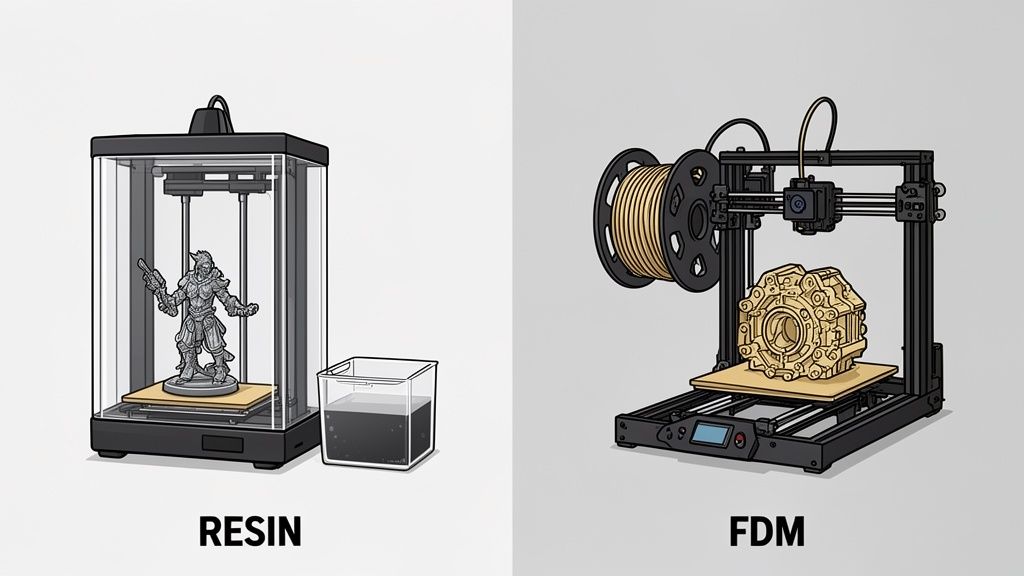
👑 The queen of detail: resin 3D printing
Resin 3D printing (which includes technologies such as SLA, DLP and LCD) is the undisputed champion of high definition. Its magic lies in curing liquid resin with UV light, layer by layer, with incredible precision. The result? Parts with a silky-smooth surface finish and a level of detail that borders on the impossible.
Imagine the teeth on a 28 mm miniature, the engravings on a piece of jewellery or the tiny connectors on a prototype. There, every micron counts. Resin is capable of nailing those details with a fineness that FDM simply cannot achieve.
A 3D printing service that works with quality resins, such as Mr Resin's 14K or high-definition resins, is your best option when visual finish is what matters most.
- Ideal for: Wargame miniatures, busts, jewellery, product prototypes, dental models.
- Main advantage: Unbeatable surface quality and level of detail. 👌
- Worth noting: Post-processing requires more work (washing and curing) and parts can be somewhat more fragile, although resins such as ABS-like have greatly improved their durability.
💪 The workhorse: FDM 3D printing
In the other corner we have FDM (Fused Deposition Modeling) 3D printing, which is synonymous with tough, functional and affordable parts. This technology works by "drawing" with melted plastic filament, layer upon layer, like a high-tech piping bag. 🤖
It's the perfect choice when what you need are large, functional parts that can take a beating. A housing for an electronics project? A custom support for a tool? A prototype to see how a mechanism works? That's where FDM really shines.
Moreover, materials such as PLA or PETG are very affordable and easy to print, which brings the cost per part down considerably, especially when we're talking about large objects.
- Ideal for: Mechanical parts, functional prototypes, supports and jigs, large objects.
- Main advantage: Durability, low cost and speed for large parts. 🚀
- Worth noting: Layer lines are visible, so the finish is not as polished. Very fine details are its weak point.
If you want to go even deeper, don't miss our complete guide where we compare a resin 3D printer vs filament.
In the end, it all comes down to the application. For a collector's bust, resin is the only option. For a wall mount that needs to bear weight, FDM is the way to go.
3D Printing Technology Comparison: Resin vs FDM
So you can see everything at a glance, we've put together a summary table. Use it as a quick cheat sheet to decide which type of 3D printing service best suits what you have in mind.
| Feature | Resin Printing (SLA/DLP/LCD) | Filament Printing (FDM) |
|---|---|---|
| Precision and Detail | ⭐⭐⭐⭐⭐ (Exceptional) | ⭐⭐⭐ (Good) |
| Surface Quality | ⭐⭐⭐⭐⭐ (Very smooth, no visible layer lines) | ⭐⭐ (Visible layer lines) |
| Mechanical Strength | ⭐⭐⭐ (Good, improves with technical resins) | ⭐⭐⭐⭐ (Very good, ideal for functional parts) |
| Printing Speed | Fast for small, detailed parts | Fast for large, simple parts |
| Print Volume | Generally smaller | Allows printing of large parts |
| Material Cost | Medium - High | Low - Medium |
| Post-processing Complexity | Requires washing and UV curing | Mainly support removal |
| Material Variety | Wide (rigid, flexible, dental, etc.) | Very wide (PLA, PETG, ABS, TPU, etc.) |
As you can see, each technology has its strengths. That's why talking to your 3D printing service provider is essential. A good professional will listen to you, understand what you're trying to achieve, and recommend the perfect technology and material to make your project turn out brilliantly.
Key factors that influence price and final quality
Have you ever wondered why two quotes for the same part can be so different? 🤔 It's not dark magic, I assure you. The cost and quality of a 3D printing service depend on a very clear combination of factors. If you understand them, you'll not only be able to read a quote, but you'll also be able to optimise your designs to achieve spectacular results without sending your costs through the roof.
When you request a price, the provider analyses your 3D model and calculates the cost based on three pillars: the material to be used, the time the machine will be occupied, and the manual labour hours for post-processing. Each of these points has its nuances, and they're what make the final figure go up or down.
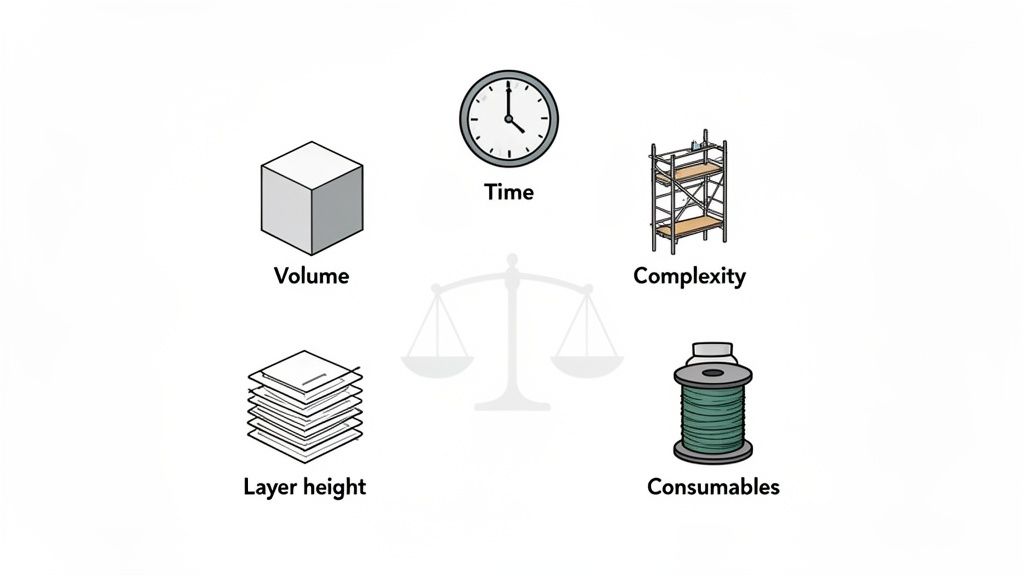
The pillars that define the price 💰
Imagine the cost of your part is on a set of scales. If you add weight to one side, the price goes up. Knowing these "weights" gives you the power to tip the scales in your favour.
- Material volume: This is the most obvious factor. The larger and more solid the piece, the more resin it will use and the more expensive it will be. A veteran's trick is to hollow out models (if the structure allows it) to save a good chunk of material.
- Print time: 3D printers are like a taxi: the meter keeps running. A tall piece with many fine details requires a very low layer height, which translates into many more hours of work for the machine. ⏳
- Complexity and supports: If your design has many overhangs or tricky angles, it will need a solid support structure to keep it from collapsing. This not only uses more material, but also demands more hours of manual work to remove the supports without damaging the piece.
The secrets of superior quality ✨
But of course, price isn't everything. Quality — that finish that makes you stand there smiling at the piece — depends on other variables. And this is where you can really tell the difference between a run-of-the-mill provider and a truly good one.
Layer height is one of the settings that has the greatest impact on the result. It is measured in microns and defines the thickness of each layer. A small layer height (for example, 0.025 mm) creates pieces with extremely fine details and surfaces as smooth as silk, but at the cost of a much longer print time. On the other hand, a greater height (0.1 mm) prints faster, but the layer lines will be more visible.
The factor that defines everything, without a doubt, is material quality. You can have the best 3D printer in the world, but if you feed it cheap resin, the result will be mediocre. A reliable provider invests in top-quality consumables because they know that the quality of the raw material accounts for 90% of success.
In Spain, the 3D printing market is booming, with forecasts pointing to surpassing 10.125 billion euros before 2027. This growth is driven by sectors such as rapid prototyping, where material quality is non-negotiable. Specialist stores like Mr Resin, with fast shipping from Spain and support in Spanish, are key players in this ecosystem, offering high-quality resins from brands like Anycubic and Elegoo that enable printing services to deliver professional results. If you're curious, you can read more about this trend in this study from the University of Valladolid.
Resin as a differentiating factor
The choice of resin not only affects how the piece looks, but also how it behaves. A good 3D printing service will offer you a varied catalogue so you can find exactly what you need:
- Standard Resins: Ideal for visual models and figures where detail is the top priority.
- ABS-Like Resins: Provide greater impact resistance and durability. They are perfect for functional prototypes or pieces that are going to take a bit of a beating.
- 14K / High Definition Resins: Formulated to capture even the finest detail, they are essential for jewellery or competition-level model making.
In the end, achieving the best value for money is a dialogue between your design and what the service can offer. Don't hesitate to ask questions and seek advice. A good professional will help you fine-tune your model so the result is spectacular without giving your wallet a nasty shock. 😜
How to choose the best 3D printing service for your project
Choosing the right provider is just as crucial as having a flawless design. A good printing partner doesn't simply manufacture your part; they accompany and advise you so the final result is even better than you expected. 🤝
With so many options out there, how do you make sure you choose the best 3D printing service for what you have in mind? Don't worry, you don't have to go in blind. We've put together a quick cheat sheet with the key points to help you make a great decision and find a trusted collaborator, not just a printer. Let's get into it!
1. Available technologies and materials
First things first: does the service offer the technology your part needs? We've already seen that looking for the extreme detail of resin for a miniature is not the same as the robustness of FDM for a gear. Make sure their machinery aligns with your goal.
Just as important is the variety of materials they work with. A good provider doesn't stop at standard resin or the same old PLA. Look for more specific options, such as ABS-like resins for greater durability, 14K resins for jaw-dropping detail, or technical filaments like PETG. 🧪 The breadth of their catalogue says a lot about their experience and their ability to adapt to projects that go beyond the ordinary.
2. Quality testing and portfolio
Words are cheap, but physical parts don't lie. A provider who is proud of their work will have no problem showing you their portfolio. Ask to see examples of previous projects, especially if they are similar to yours.
Don't rely solely on studio photos with perfect lighting. Ask if they can show you sample parts or videos of real projects. The quality of the finishes, the precision in the details, and how clean the support points are once removed are the ultimate tell-tale signs of their level of professionalism.
3. Delivery times and communication
Speed matters, yes, but reliability is queen. Ask about their estimated delivery times and check that they fit your schedule. 🗓️ A good service will give you a realistic date and, if anything unexpected comes up, will keep you in the loop. Transparency is golden.
Communication is the other pillar. Do they respond quickly to your questions? Do they offer support in your language and understand what you need? An excellent 3D printing service doesn't just hit the "print" button. They advise you on how to optimise your file, suggest improvements if they spot something off, and answer any technical questions you may have. This collaboration is what truly makes the difference.
4. Reviews from other users
Last but not least, take a look at what other customers are saying. Search for reviews on Google, in specialist forums, or on their social media. Testimonials from fellow makers like you are a goldmine of honest information. 🌟
Pay attention to comments about part quality, whether they meet deadlines, and above all, what their customer service is like. In the end, you want someone who solves your problems, not someone who creates them.
And that's a wrap on our journey... for now
We've made the full journey together, from having an idea on screen to holding it in your hands. You've already seen that a 3D printing service is a powerful tool within everyone's reach for bringing your projects to life, whether you're after the millimetre-perfect detail of resin or the functional strength of FDM. 🚀
The key to success lies in understanding how the whole thing works, choosing the right technology, and above all, finding a provider who is more of a true partner than just a vendor.
What's coming next
3D printing, both in resin and FDM, is revolutionizing the landscape for makers and professionals in Spain. And the best is yet to come: mind-blowing advances are expected, such as multi-laser systems that could double printing speeds by 2026. On top of that, programs like Autodesk Netfabb are refining their algorithms so much that they could reduce material waste by 15%, something we'll feel directly in our wallets when using ABS-like resins or PETG filaments. In this scenario, Mr Resin isn't falling behind: we offer everything from key consumables like FEP films to everything you need for post-processing. If you want to snoop around and learn more about what's brewing in the future of additive manufacturing, take a look at this article.
Ready to take the next step?
If after reading all this you've caught the bug and want to set up your own home workshop, we invite you to stop by the Mr Resin store. There you'll find all the quality materials and consumables you need to make your projects turn out brilliantly. ✨
Don't miss out on the action! Join our Telegram group here to grab discounts, coupons and exclusive deals you won't find anywhere else. It's the meeting point for 3D printing geeks like us.
And so you don't miss a single new release, tutorial or bargain, don't forget to subscribe to our Newsletter. We'll send the very best of the 3D printing world straight to your inbox. 💌
We answer your questions about 3D printing services
We know that diving into the world of on-demand 3D printing is an amazing journey, but it's completely normal for a whole bunch of questions to pop up at the beginning. So you're not left wondering, we've put together the most common queries we receive about our 3D printing service. 🧐 Let's get into them!
What file do I need to send you for printing?
This is the million-dollar question, but the answer is much easier than it sounds! So we can bring your idea to life, we just need you to send us your design in a standard 3D file format.
The most common ones, which will work without any issues pretty much anywhere, are these:
- .STL (Standard Triangle Language): This is the life of the party — by far the most universal format. No matter which modelling program you use, you can definitely export in .STL.
- .OBJ (Object File): Another classic. It's especially useful if your model has colours or textures, because this format does save that information.
- .3MF (3D Manufacturing Format): The modern "successor" to STL. Its advantage is that a single file can store more model data, such as the material or its properties.
Don't stress if this sounds like gibberish to you. Almost all design programs have a clearly visible "Export" or "Save as" option where you can choose one of these formats without breaking a sweat. ✅
How long will it take for my part to be ready?
The only honest answer is: it depends. There's no fixed timeframe, because every part is different and print time is a mix of several factors. Even though there's no magic formula, we can tell you what influences the clock the most. ⏳
To give you an idea, a small, simple figure just a few centimetres in size can be ready in around 3–4 hours. At the other end of the scale, a large, solid prototype with incredibly fine detail could spend several days in the 3D printer.
The factors that add the most hours to the clock are:
- Size and volume: The larger the piece, the more material to solidify layer by layer. It goes without saying.
- Design complexity: Complex geometries with many curves and intricate recesses force the 3D printer to move more slowly and carefully.
- Layer height: Here's the trick. A low layer height (around 25 microns, for example) gives you a silky-smooth finish, but it dramatically increases the number of layers to print and, with it, the time.
- The technology used: Not all 3D printers are equally fast, even within the same technology (resin or FDM).
The easiest way to find out? Upload your file to the printing service's platform. The system will analyze it in seconds and give you a super accurate time estimate along with the quote.
Will the printed piece be hard and resistant?
Absolutely! But keep in mind, resistance depends 100% on the material you choose. 3D printing has taken an incredible leap forward, and today we have materials with mechanical properties that many traditionally manufactured parts would envy.
If you're looking for hardness and durability to really put it through its paces, you have some spectacular options:
- ABS-like resins: They're amazing. As the name suggests, they mimic the properties of ABS plastic, so they hold up well against impacts and heavy use. They're great for functional prototypes, casings, or mechanical parts.
- PETG and ABS filaments (in FDM): These are the workhorses for functional parts. They have excellent mechanical and thermal resistance.
That said, let's be realistic. If you need a part for an extreme stress application, such as a critical engine component, traditional CNC machining may be the best option. But for the vast majority of prototypes and end-use parts, today's materials will leave you speechless. 💪
Can you print in multiple colors at once?
A very common question, especially for those of you who want to create figures or models that really catch the eye. The short answer is that, generally speaking, each piece is printed in a single color.
In resin printing, which reigns supreme in detail, the machine works with a tank full of liquid resin in a single color. Therefore, the entire piece will come out in that color. With FDM technology something similar happens; although there are 3D printers with multiple extruders for mixing colors, this is not standard in most services.
So, how do I get my piece in full color? The solution is the same one professionals use: painting the model after printing it. A piece printed with a high-definition grey resin is the perfect canvas. With a coat of primer and a little skill with the brushes, you can achieve a spectacular finish that is 100% to your liking. 🎨
At Mr Resin we don't just offer you a top-tier printing service — we also stock all the materials you could need if you catch the bug and decide to set up your own workshop. Take a look at our online store and discover a selection of resins, filaments, and accessories from the best brands.
Conclusion:
We've covered the full journey together, from the moment your idea is just a file on your computer to the moment you hold it in your hands. Now you know that a 3D printing service is an incredibly powerful and highly accessible tool for bringing any project to life. Whether you're looking for the millimetric detail of resin or the resistance of FDM, the key is understanding how it works and choosing the right partners for your journey.
If this whole adventure has inspired you to get your hands dirty yourself, we invite you to visit our online store. There you'll find all the high-quality materials and consumables to start printing on your own. 🤩
Don't forget to join our community on Telegram here to get access to members-only discounts and deals, as well as exclusive coupons, news and events.
And of course, subscribe to our Newsletter so you don't miss a single update and receive the best deals directly in your inbox!
✨Happy Printing! 🚀